Indian Rupee struggles for direction as RBI policy awaited
- The Indian Rupee flattens at around 95.33 against the US Dollar in the countdown to the RBI policy.
- Investors expect the RBI to leave the Repo Rate unchanged.
- Financial markets await the outcome of US-Iran talks.

The Indian Rupee (INR) trades flat at around 95.33 against the US Dollar (USD) on Tuesday. The Indian currency is expected to trade sideways as investors await the Reserve Bank of India’s (RBI) monetary policy announcement on Wednesday.
RBI to leave policy rates unchanged
Analysts at Commerzbank note that the Reserve Bank of India is likely to maintain its current policy stance, with the central bank "expected to leave the benchmark repurchase rate unchanged at 5.25% at its next meeting on 5 August." They acknowledge that "inflation risks remain tilted to the upside due to higher global commodity prices and a weaker monsoon season," but point out that the latest June CPI report "showed it rose 4.4% YoY, which was within RBI's 2-6% target range," reinforcing the case for policy continuity in the near term.
Investors await outcome of US-Iran talks
Oil prices attract bids on Tuesday as financial markets remain concerned about the outcome of talks between the United States (US) and Iran. On Monday, US President Donald Trump said that discussions with Iran are going on, but he doesn’t know why they are denying it in the media. Trump added, “This is the last chance for them to sign a good document.” He further added, “They’re going to go quickly one way or the other. It’s not very complex. We’re talking about the opening of the strait, having it open literally by tomorrow—completely open,” Reuters reported.
Over the weekend, US President Trump shelved planned attacks on Iran, stating that Tehran has agreed to reopen the Strait of Hormuz and the nuclear conditions. This led to a significant plunge in oil prices.
In the opening session, the MCX Crude Oil contract expiring on August 19 trades 1.3% higher to near Rs. 7,745.
Higher oil prices bode poorly for currencies from economies, such as India, which rely heavily on oil imports to meet their energy needs.
US JOLTS Job Openings data in focus
During the Asian session, the US Dollar clings to Monday’s recovery move, with investors awaiting the US JOLTS Job Openings data for June, which will be published at 14:00 GMT. US employers are expected to have posted 7.45 million fresh jobs, slightly lower than 7.594 million in May.
At press time, the US Dollar Index (DXY), which gauges the Greenback’s value against six major currencies, reflects strength near 100.00.
This week, the major event for the US Dollar will be the US Nonfarm Payrolls (NFP) data for July, which will be released on Friday.
Technical Analysis: USD/INR stays below 20-day EMA
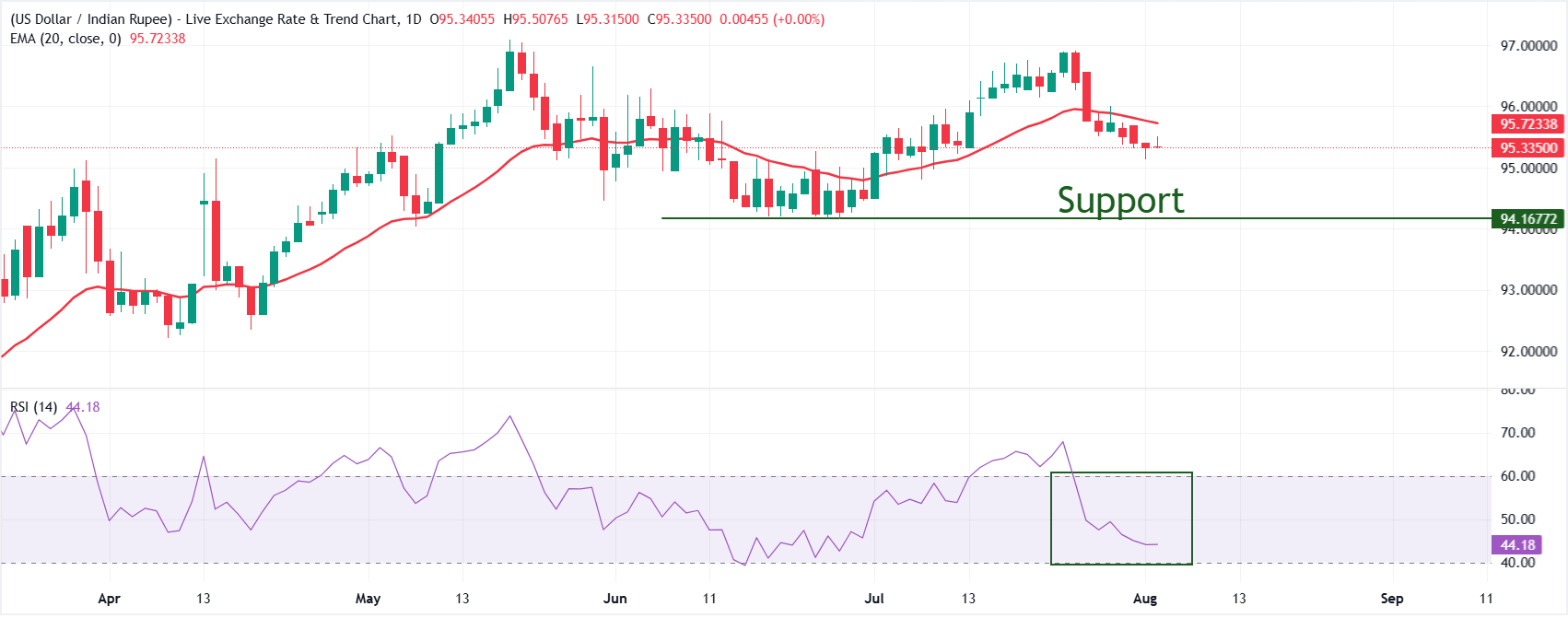
USD/INR trades at around 95.33, maintaining a bearish near-term bias as spot holds beneath the 20-day exponential moving average (EMA) at 95.7234.
The pair’s inability to reclaim this short-term EMA suggests upside remains capped, while the Relative Strength Index (14) at 44.18 leans slightly soft, hinting at waning bullish momentum rather than outright oversold conditions.
On the topside, immediate resistance is located at the 20-day EMA at 95.72, and a sustained break above this barrier would be needed for a more constructive recovery toward the July 29 high near 96.00. On the downside, major support levels are the July 7 low at 94.80 and the June low at 94.21.
(The technical analysis of this story was written with the help of an AI tool. Know more.)
Economic Indicator
JOLTS Job Openings
JOLTS Job Openings is a survey done by the US Bureau of Labor Statistics to help measure job vacancies. It collects data from employers including retailers, manufacturers and different offices each month.
Read more.Next release: Tue Aug 04, 2026 14:00
Frequency: Monthly
Consensus: 7.4M
Previous: 7.594M
Source: US Bureau of Labor Statistics
Author

Sagar Dua
FXStreet
Sagar Dua is associated with the financial markets from his college days. Along with pursuing post-graduation in Commerce in 2014, he started his markets training with chart analysis.