Indian Rupee plummets as US-Iran ceasefire collapse lifts oil prices
- The Indian Rupee falls vertically against the US Dollar due to a significant recovery in oil prices.
- Renewed Middle East risks have lifted oil prices.
- Investors await FOMC Minutes for fresh cues over the US interest rate outlook.

The Indian Rupee (INR) plunges against the US Dollar (USD) in India's afternoon trading hours on Wednesday. The USD/INR pair jumps to near 95.65 as the collapse of the memorandum of understanding (MoU) between the United States (US) and Iran has lifted oil prices.
In the opening session, the MCX Crude Oil contract expiring on July 20 soars over 7% to near 7,200, the highest level seen in two weeks. The contract also gained almost 2.35% on Tuesday.
Currencies from economies, such as India, which rely heavily on oil imports to meet their energy needs, tend to underperform when oil prices surge.
US strikes in retaliation for attacks on commercial ships
While speaking at the NATO summit in Ankara, Türkiye, during the European session on Wednesday, US President Donald Trump said, "I think the MoU with Iran is over," adding, "I don't want to deal with Iran. They are sick people."
US President Trump also criticized Iran for attacking commercial ships transiting through the Strait of Hormuz, a critical chokepoint for almost 20% of the global energy supply, on Tuesday, and stated that Washington retaliated by launching powerful attacks on Iranian military infrastructure. However, Tehran clarified that it attacked those ships for crossing the chokepoint without its approval.
US Dollar ticks down ahead of FOMC Minutes
In the late Asian trade, the US Dollar Index (DXY), which tracks the Greenback’s value against six major currencies, trades subduedly near 101.10. The US Dollar is expected to trade broadly sideways ahead of the Federal Open Market Committee (FOMC) minutes of the June policy meeting, which will be published at 18:00 GMT.
Investors will gauge what possible reasons were behind policymakers’ decision to avoid delivering remarks on the monetary policy outlook. In the policy press conference, Fed Chair Kevin Warsh said that forward-looking remarks are not well-suited in the current policy juncture.
FIIs remain net buyers for three straight trading days
Foreign Institutional Investors (FIIs) continue to increase their stake in the Indian stock market, extending the buying streak for three trading days on Tuesday. In the past three trading days, overseas investors have poured investment worth Rs. 1,991.55 crore. An improvement in sentiment of foreign investors towards Indian equities ahead of the start of the Q1FY27 earnings season underscores their optimism over quarterly earnings growth.
Technical Analysis: USD/INR corrects to near 20-day EMA
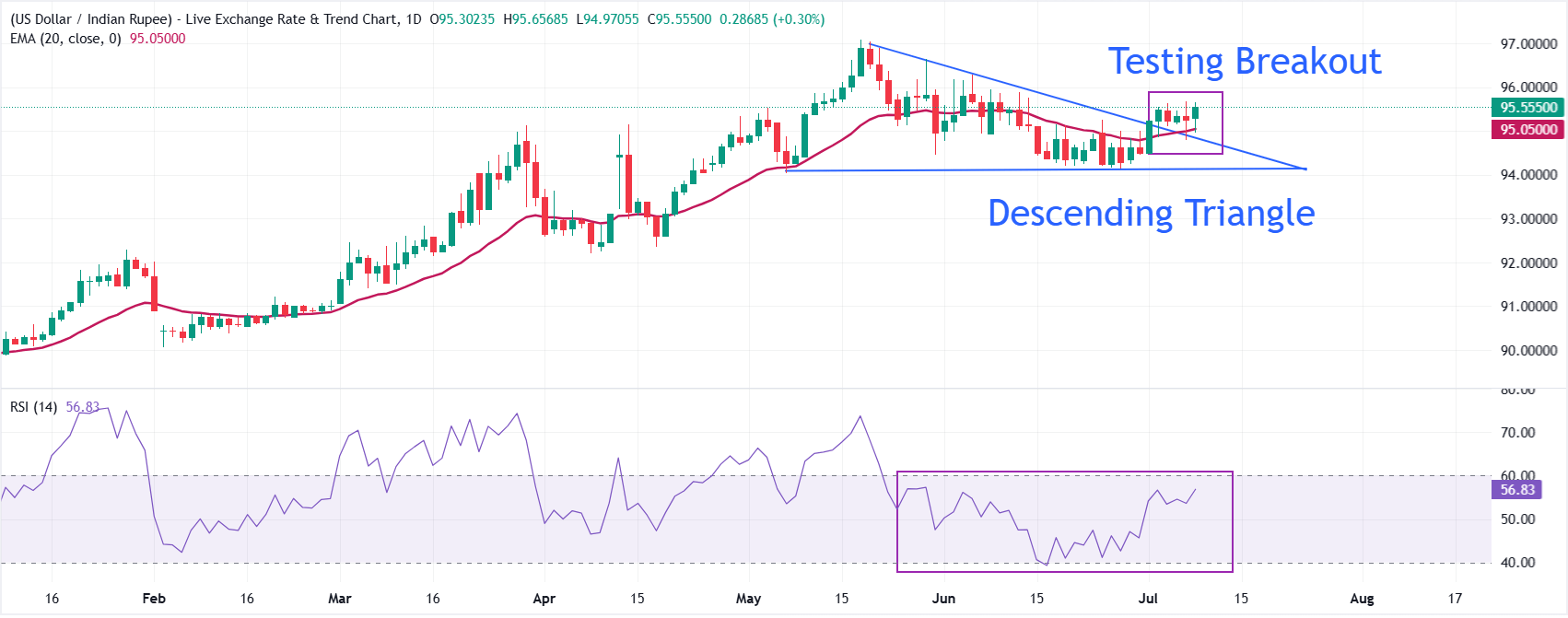
USD/INR jumps to near 95.65 at press time. The pair holds a modest bullish bias as it remains above the 20-day exponential moving average (EMA) at 95.05 and the breakout of the Descending Triangle formation.
The Relative Strength Index (14) at 56.8 stays in positive territory without overbought conditions, which suggests ongoing buying interest, though the broader advance is still capped by the longer-term downward resistance trend line projected from 96.9932
On the downside, immediate support is defined by the 20-day EMA at 95.00; a break below it would expose the pair to the May 7 low at 94.03. On the topside, a more meaningful resistance level is seen near the original descending trendline start point around 97, where a sustained break would open the way for a stronger bullish extension.
(The technical analysis of this story was written with the help of an AI tool. Know more.)
Economic Indicator
FOMC Minutes
FOMC stands for The Federal Open Market Committee that organizes 8 meetings in a year and reviews economic and financial conditions, determines the appropriate stance of monetary policy and assesses the risks to its long-run goals of price stability and sustainable economic growth. FOMC Minutes are released by the Board of Governors of the Federal Reserve and are a clear guide to the future US interest rate policy.
Next release: Wed Jul 08, 2026 18:00
Frequency: Irregular
Consensus: -
Previous: -
Source: Federal Reserve
Minutes of the Federal Open Market Committee (FOMC) is usually published three weeks after the day of the policy decision. Investors look for clues regarding the policy outlook in this publication alongside the vote split. A bullish tone is likely to provide a boost to the greenback while a dovish stance is seen as USD-negative. It needs to be noted that the market reaction to FOMC Minutes could be delayed as news outlets don’t have access to the publication before the release, unlike the FOMC’s Policy Statement.
Author

Sagar Dua
FXStreet
Sagar Dua is associated with the financial markets from his college days. Along with pursuing post-graduation in Commerce in 2014, he started his markets training with chart analysis.