Indian Rupee recovers strongly as oil prices remain broadly lower
- The Indian Rupee rebounds against the US Dollar despite oil prices finding buying interest.
- Iran fires missiles at commercial ships transiting through the Strait of Hormuz.
- Investors keenly await the FOMC Minutes of the June policy meeting.

The Indian Rupee (INR) recovers early losses and turns positive against the US Dollar (USD) on Tuesday. The USD/INR pair drops to near 94.95 even as Iran’s attacks on commercial tankers transiting through the Strait of Hormuz, a vital passage for almost 20% of global energy supply, have lifted oil prices.
At press time, the MCX Crude Oil contract expiring on July 20 trades 1.3% higher to near 6,640. However, they are still close to their multi-month low of 6,435 posted last week.
Currencies from economies, such as India, which rely heavily on oil imports to meet their energy needs, tend to underperform when oil prices rebound.
According to an Axios reporter, Iran fired at least two missiles at commercial ships transiting through the Hormuz. Two commercial ships were hit and suffered significant damage, but no casualties were reported, Bloomberg reported.
However, the impact of the sudden rebound in oil prices is expected to be limited, as the ceasefire between the United States (US) and Iran remains intact.
All eyes on FOMC Minutes
This week, the major trigger for the USD/INR pair will be the Federal Open Market Committee (FOMC) minutes of the June policy meeting, which will be released on Wednesday. Market participants will likely pay close attention to the minutes for cues on the possible reasons officials avoided delivering forward guidance on monetary policy.
In the policy meeting, the Fed decided to leave interest rates unchanged in the range of 3.50%-3.75%, and the Fed’s dot plot showed that nine of 19 policymakers were in favor of an interest rate hike by the year-end.
Currently, the CME FedWatch tool shows that the odds of the Fed delivering at least one interest rate hike by the September policy meeting are 55.2%.
FIIs remain net buyers for second straight day
Foreign Institutional Investors (FIIs) turned out to be net buyers for the second straight trading day on Monday; however, the amount invested was significantly lower than the amount bought on Friday. On Monday, FIIs increased their stake in the Indian stock market worth Rs. 243.03 crore, lower than the Rs. 1,355.33 crore investment seen on Friday.
It appears that the return of oil prices to pre-Middle East war levels has improved the sentiment of overseas investors toward the Indian stock market.
Going forward, foreign investors will closely track India Inc.’s earnings to decide on their forward investment decisions. From the Nifty 50 basket, Tata Consultancy Services (TCS) will be the first to release its Q1FY27 earnings on Thursday.
Technical Analysis: USD/INR corrects to near 20-day EMA
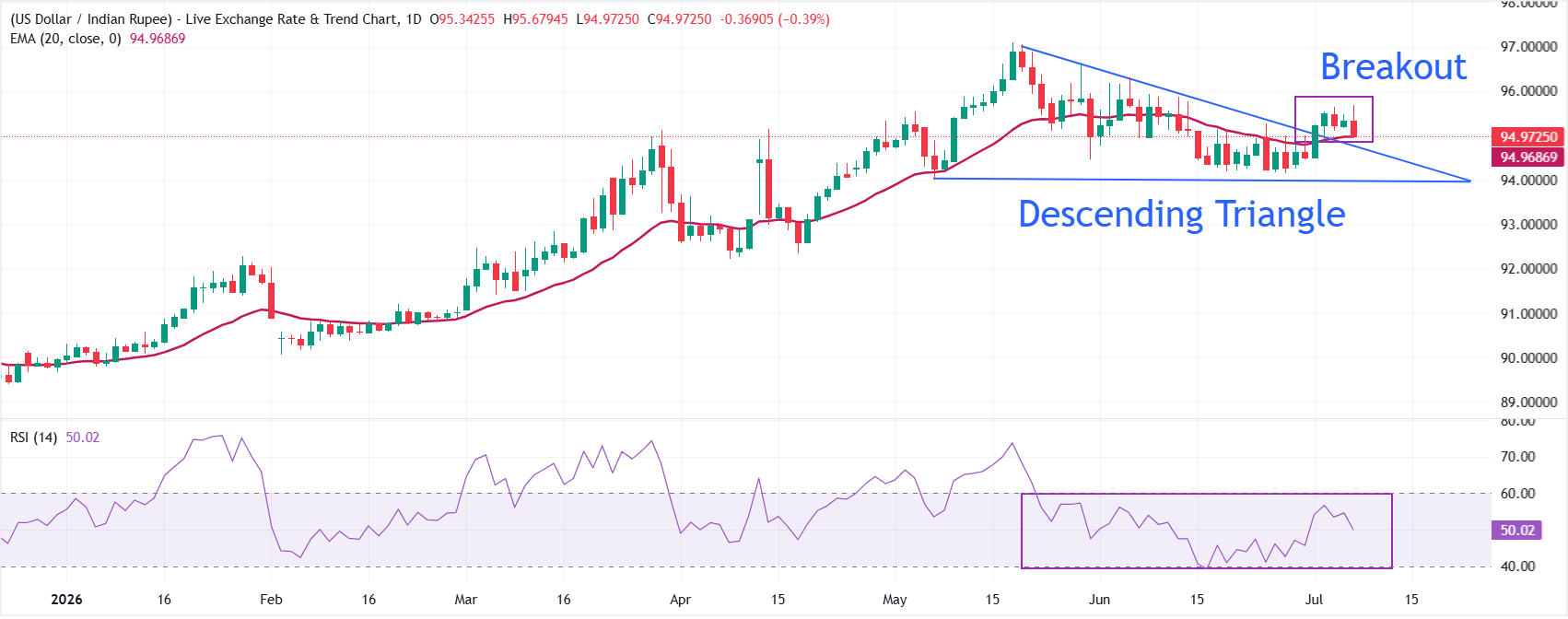
USD/INR declines to near 94.97, correcting to near the 20-day exponential moving average (EMA) at 95.00 and testing the breakout region of the Descending Triangle breakout. The Relative Strength Index (RSI) around 50 suggests a broader sideways trend.
On the downside, the May 7 low at 94.03 is the key support level. Looking up, the pair aims to revisit the all-time high around 97.10.
(The technical analysis of this story was written with the help of an AI tool. Know more.)
Fed FAQs
Monetary policy in the US is shaped by the Federal Reserve (Fed). The Fed has two mandates: to achieve price stability and foster full employment. Its primary tool to achieve these goals is by adjusting interest rates. When prices are rising too quickly and inflation is above the Fed’s 2% target, it raises interest rates, increasing borrowing costs throughout the economy. This results in a stronger US Dollar (USD) as it makes the US a more attractive place for international investors to park their money. When inflation falls below 2% or the Unemployment Rate is too high, the Fed may lower interest rates to encourage borrowing, which weighs on the Greenback.
The Federal Reserve (Fed) holds eight policy meetings a year, where the Federal Open Market Committee (FOMC) assesses economic conditions and makes monetary policy decisions. The FOMC is attended by twelve Fed officials – the seven members of the Board of Governors, the president of the Federal Reserve Bank of New York, and four of the remaining eleven regional Reserve Bank presidents, who serve one-year terms on a rotating basis.
In extreme situations, the Federal Reserve may resort to a policy named Quantitative Easing (QE). QE is the process by which the Fed substantially increases the flow of credit in a stuck financial system. It is a non-standard policy measure used during crises or when inflation is extremely low. It was the Fed’s weapon of choice during the Great Financial Crisis in 2008. It involves the Fed printing more Dollars and using them to buy high grade bonds from financial institutions. QE usually weakens the US Dollar.
Quantitative tightening (QT) is the reverse process of QE, whereby the Federal Reserve stops buying bonds from financial institutions and does not reinvest the principal from the bonds it holds maturing, to purchase new bonds. It is usually positive for the value of the US Dollar.
Author

Sagar Dua
FXStreet
Sagar Dua is associated with the financial markets from his college days. Along with pursuing post-graduation in Commerce in 2014, he started his markets training with chart analysis.