Hecla Mining (HL) and the $150 Silver thesis

Introduction
Hecla Mining Company (NYSE: HL) occupies a unique position within the global precious metals sector as the largest primary silver producer in the United States and Canada and a leading domestic producer of critical minerals. With more than 130 years of operating history, Hecla is the oldest precious metals mining company listed on the New York Stock Exchange in North America. Given its concentrated exposure to silver prices, Hecla functions as a leveraged equity proxy for movements in XAG/USD. Recent corrections in silver have weighed on the company’s valuation; however, when viewed through a long-term structural and Elliott Wave framework, these adjustments appear consistent with cyclical price behavior rather than indicative of deteriorating fundamentals. This analysis argues that Hecla is positioned within a powerful secular advance, supported by a developing Elliott Wave nesting structure that aligns with a broader bullish cycle in silver.
Silver price corrections and equity leverage
As a primary silver producer, Hecla exhibits pronounced operating and earnings leverage to movements in silver prices. A significant portion of the company’s revenue and margin profile is directly linked to XAG/USD. This means that even modest declines in silver prices can disproportionately compress cash flow expectations and equity valuation multiples. Consequently, corrections in silver prices exert an outsized influence on Hecla’s share price, often amplifying downside moves during corrective phases.
Importantly, this dynamic also works in reverse. During sustained silver advances, primary producers such as Hecla historically outperform the underlying commodity. This is due to expanding margins, improving free cash flow, and re-rating of valuation multiples. Recent weakness in HL shares therefore appears to reflect a cyclical adjustment tied to silver’s consolidation rather than a structural impairment of the business. This sets the stage for asymmetric upside should silver resume its long-term advance.
Elliott Wave framework and the significance of the 2000 low
From an Elliott Wave perspective, the year 2000 represents a critical inflection point for Hecla. The lows established during this period marked the end of a prolonged secular bear market and the beginning of a new Grand Super Cycle advance. Despite intermittent volatility and deep corrections since that time, price action has continued to respect higher-degree structural lows, reinforcing the interpretation of a long-term bullish trend.
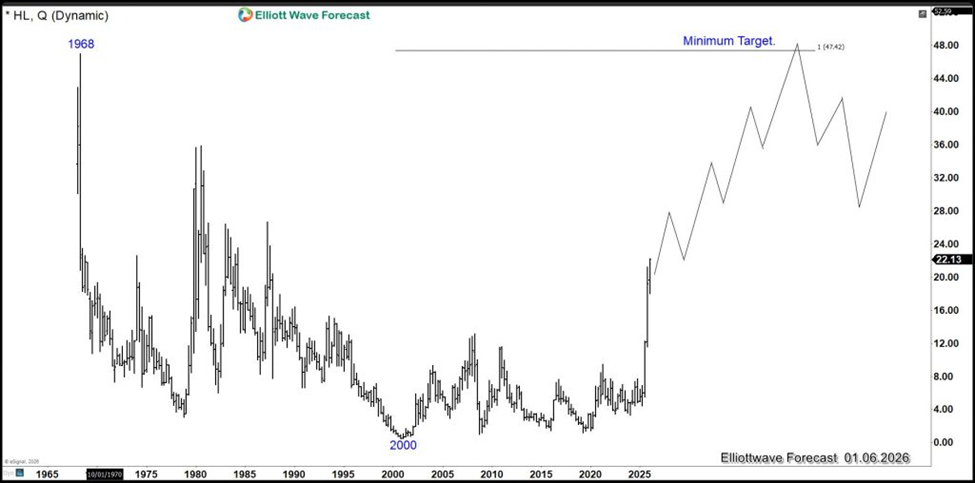
Hecla remains well below its historical peaks from 1968, underscoring the significance of the 2000 low as a foundational base rather than a terminal high. This long-term underperformance relative to silver further suggests that HL is still in the earlier stages of its secular advance, with substantial upside potential remaining as the cycle matures.
Nesting structure and wave (III) implications
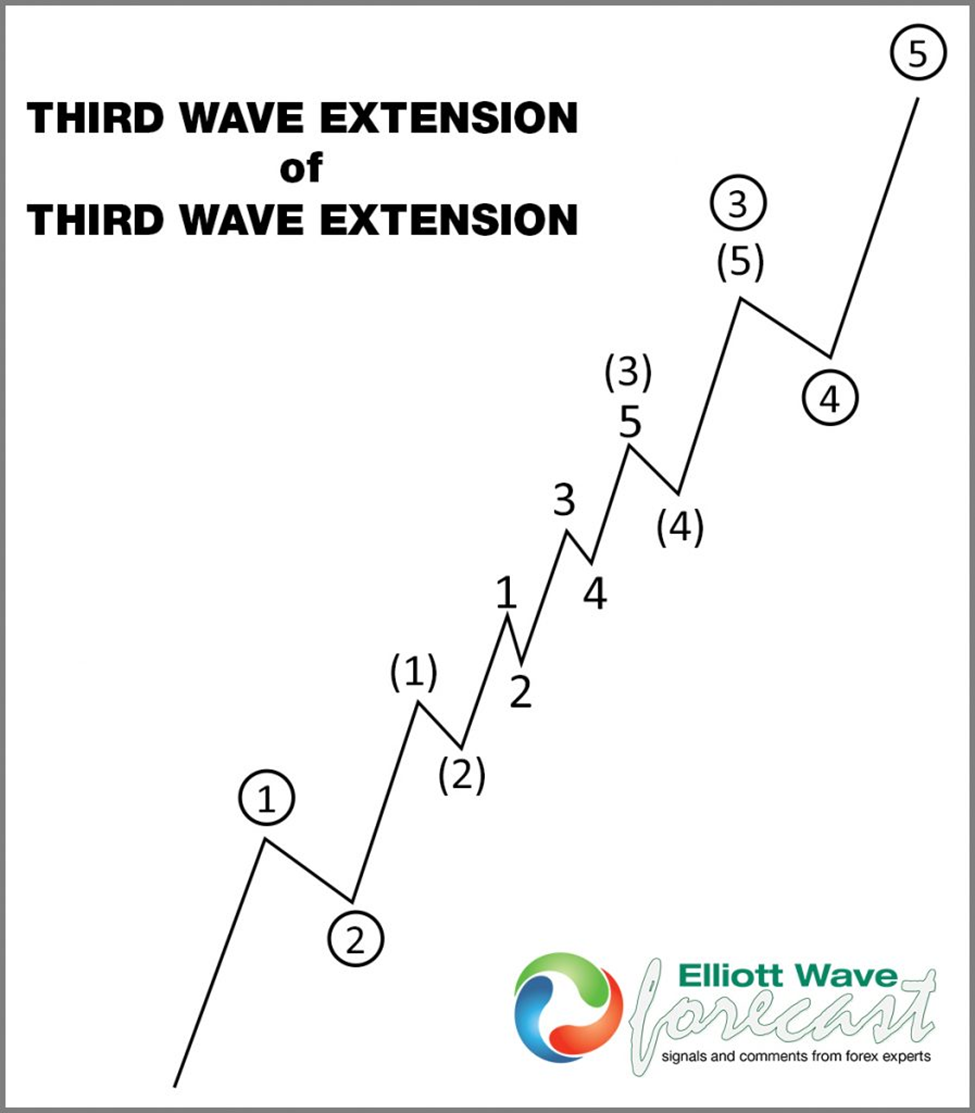
A defining feature of the current Elliott Wave structure in Hecla is the presence of a developing nest. In Elliott Wave Theory, a nest consists of a series of overlapping five-wave advances that form prior to a powerful acceleration into wave (III). These structures reflect persistent accumulation, shallow corrective pullbacks, and increasing momentum. This signals that the market is building energy rather than exhausting a trend.
Here is how a nest looks like in the Elliott Wave Theory:
Price action in HL since October 2000 closely mirrors the characteristics of a textbook nesting pattern. Multiple impulsive advances have unfolded without violating key structural support levels. Each correction has served to reset momentum rather than reverse the trend. This configuration strongly supports the interpretation that Hecla is preparing for a major wave (III) advance within the larger Grand Super Cycle. Here is HL nest with labels pointing higher in wave ((3)).
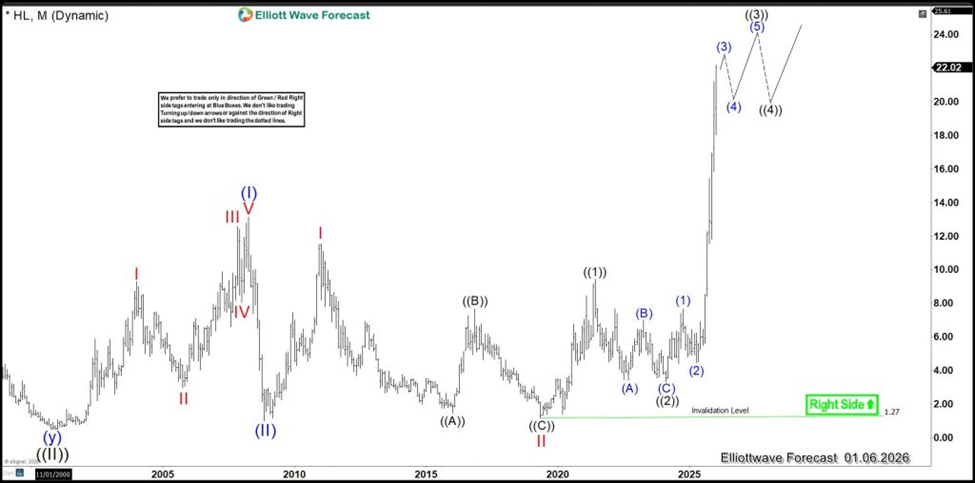
Under this framework, the $47.36 level represents a minimum technical target associated with the completion of three major waves from the secular low. Reaching this level would still not constitute a completed cycle, but rather confirm the strength of the underlying impulsive phase.
Correlation between HL and Silver
While the Elliott Wave structures of Hecla and silver differ in form due to the inherent distinctions between equity and commodity markets, their directional alignment remains clear. Long-term charts demonstrate a strong correlation between HL and XAG/USD, particularly during impulsive phases of the silver cycle. Historically, silver tends to lead, with primary producers lagging initially before delivering leveraged performance as the trend strengthens.
Here is HL and Silver in the same chart:
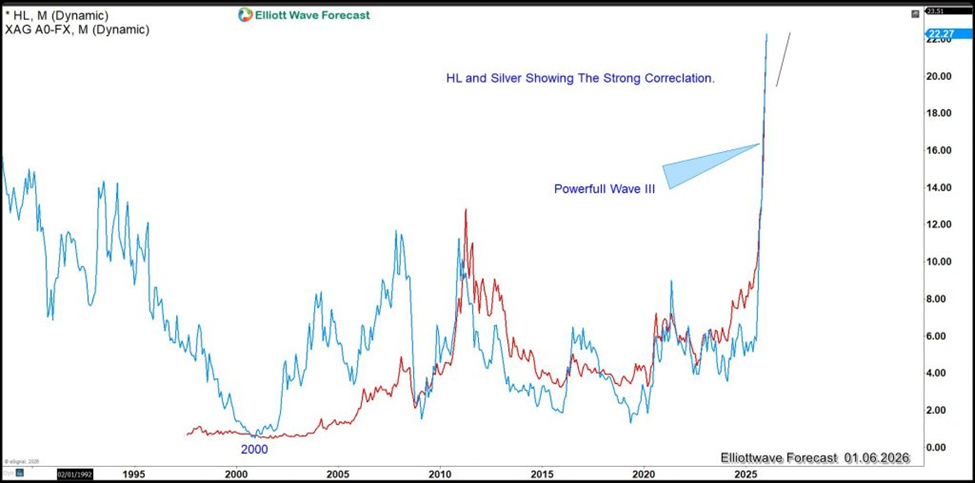
This relationship is evident in the current cycle. Silver has advanced more decisively, while HL remains in a catch-up phase. This reinforces the view that Hecla is positioned for an accelerated move as wave (III) unfolds. At the point HL reaches the $47.36 target, silver is projected to trade within the $91.40–$100.00 range. At this time, both instruments would have completed three waves from their respective all-time lows.
Longer-term outlook: Waves ((4)) and ((5))
Within Elliott Wave methodology, the completion of three waves does not mark the end of a trend. Instead, it implies that a corrective wave ((4)) and a final impulsive wave ((5)) remain ahead within the same Grand Super Cycle. Following the anticipated wave (III) advance, a sizable corrective phase is expected to unfold. Afterwards, the final wave ((5)) could drive Hecla into the $60.00–$65.00 range. Under the same framework, silver could ultimately advance toward the $150.00 level.
These projections highlight the multi-decade nature of the cycle. It reinforces the importance of distinguishing between corrective volatility and structural trend reversals.
Conclusion
Hecla Mining Company represents a leveraged equity exposure to silver within a clearly defined long-term bullish framework. Recent valuation compression reflects cyclical silver price corrections rather than a breakdown in fundamentals. From an Elliott Wave perspective, both HL and XAG/USD appear to be aligned within a powerful Grand Super Cycle advance. Hecla is developing a nesting structure that often precedes explosive wave (III) behavior.
While trading and timing remain inherently challenging, the integration of Elliott Wave analysis, corrective structures, and intermarket correlation provides a disciplined framework for navigating volatility. With time still mid-cycle, the broader path and long-term targets for both Hecla and silver remain clearly defined. It positions HL as a compelling vehicle for participation in a potentially historic silver advance.
Author

Elliott Wave Forecast Team
ElliottWave-Forecast.com