Gores Guggenheim (GGPI) Stock News and Forecast: Polestar SPAC drops with Russia-Ukraine conflict
- GGPI is merging with Chinese EV maker Polestar.
- Gores Guggenheim shares have support at $11.
- The SPAC is selling off in Tuesday premarket due to Russian actions in Ukraine.

Gores Guggenheim (GGPI) shares have been on the upswing for most of February but have dropped about 4% in Tuesday's premarket. At the time of writing, GGPI is down 4.3% at $11.70. The Special Purpose Acquisition Company (SPAC) is set on merging with Chinese electric vehicle maker Polestar, who turned heads two weeks ago after airing an advertisement that poked fun at Volvo and Tesla.
Gores Guggenheim Stock News: Pre-war mood triggers sell-off
GGPI mainly rises and drops based on news from its acquisition target Polestar. Polestar is a sort of EV offshoot of Geely Automotive subsidiary Volvo. Geely Automotive is a Chinese company mostly focused on the domestic space, while Polestar is already retailing its vehicles in Europe and is more focused on foreign markets. Since it will be using some production facilities of Volvo, such as one in South Carolina, it is expected to have much lower capex costs than rivals Rivian (RIVN) and Lucid (LCID).
At the moment though, GGPI seems to be down on the news coming out of Ukraine. After recognising some breakaway regions in Donbass and Lugansk, news has arrived that some Russian troops are now entering these regions that remain legally part of Ukraine. The markets are worried that a full invasion is not far behind. NASDAQ 100 futures, which focuses on growth names, was down as much as 2.5% earlier on Tuesday but is now down 0.4% as of writing.
China's Li Auto (LI) is scheduled to report earnings this Thursday. Though it is a small competitor, it may affect GGPI as part of the world's largest EV market.
Gores Guggenheim Stock Forecast: Needs to retake $12 for bullish momentum
As GGPI drops, it may find refuge at $11. This price offered resistance back in November and then support in December and January. $10.20 is another spot where robust support lies.
To regain momentum, GGPI must retake $12, which has acted as resistance in January. $12.37, the high from January 3, is also significant. Above there stands $14.10, where GGPI price held or opened a number of times back in November.
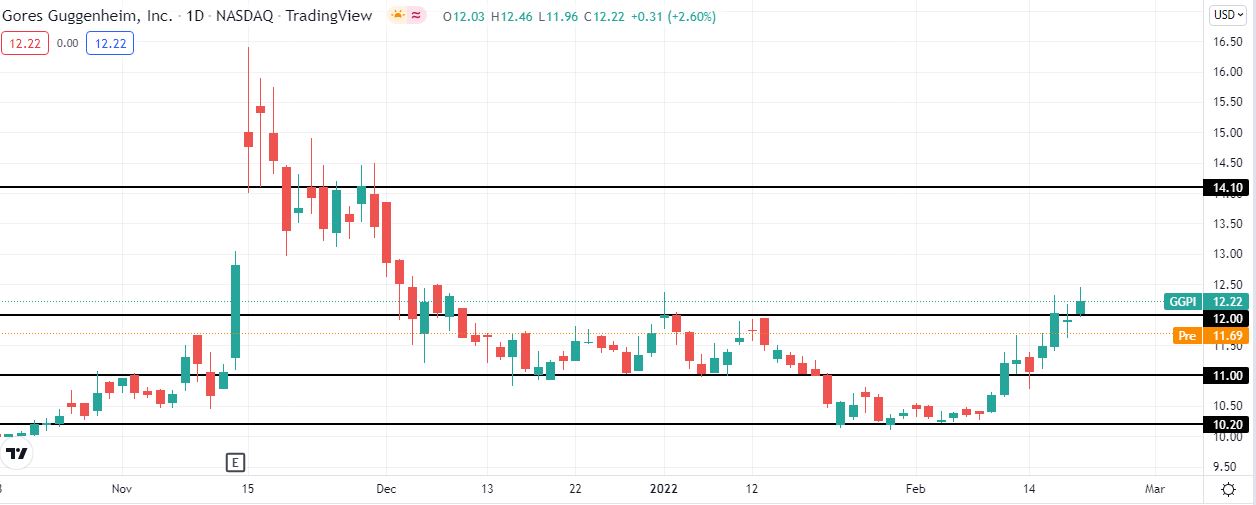
GGPI 1-day chart
Like this article? Help us with some feedback by answering this survey:
Premium
You have reached your limit of 3 free articles for this month.
Start your subscription and get access to all our original articles.
Author

Clay Webster
FXStreet
Clay Webster grew up in the US outside Buffalo, New York and Lancaster, Pennsylvania. He began investing after college following the 2008 financial crisis.