The Euro sinks on its own rate hike
- EUR/USD broke to a fresh multi-week low this week before steadying near a tentative floor.
- The slide came despite the ECB's first rate hike since 2023, a move forced by the energy shock rather than by strength.
- With the eurozone economy contracting, the Euro stays chained to broad Dollar direction into next week's US data.

The Euro did something this week that ought to be impossible: it fell in the same fortnight the European Central Bank (ECB) delivered its first interest rate hike since 2023. EUR/USD slid to a fresh multi-week low near 1.1400 before clawing back to a tentative floor around 1.1450; the lesson is that not every rate hike is a vote of confidence. The ECB tightened because an energy shock forced its hand, not because the eurozone economy is firing. That distinction is why the single currency cannot turn a hawkish central bank into a rally.
A hike that smells like surrender
Look at what the ECB actually did and the bind becomes obvious. It raised the deposit rate for the first time in nearly three years while simultaneously cutting its growth forecasts and lifting its inflation projections, an unambiguous stagflation signal. Euro-area inflation has climbed to its highest in nearly three years on surging energy costs tied to disruptions through the Strait of Hormuz, even as the bloc's economy contracted in the first quarter. Tightening into that mix is a defensive move; currency markets know the difference between a central bank hiking from strength and one hiking because it has no choice.
Out-hawked across the Atlantic
Even on the narrow question of rate differentials, the Euro is losing. The ECB paired its hike with no-preset-path guidance, which markets read as a one-and-watch rather than the start of a campaign; German Bund yields barely budged. The Federal Reserve (Fed), by contrast, held at 3.75% but revised its dot plot higher, pricing toward a hike of its own from a position of relative economic strength, with the US Dollar Index parked at a 13-month high. When both sides lean hawkish, the currency attached to the stronger economy and the firmer conviction wins; right now that is unambiguously the Greenback.
A bounce on a short leash
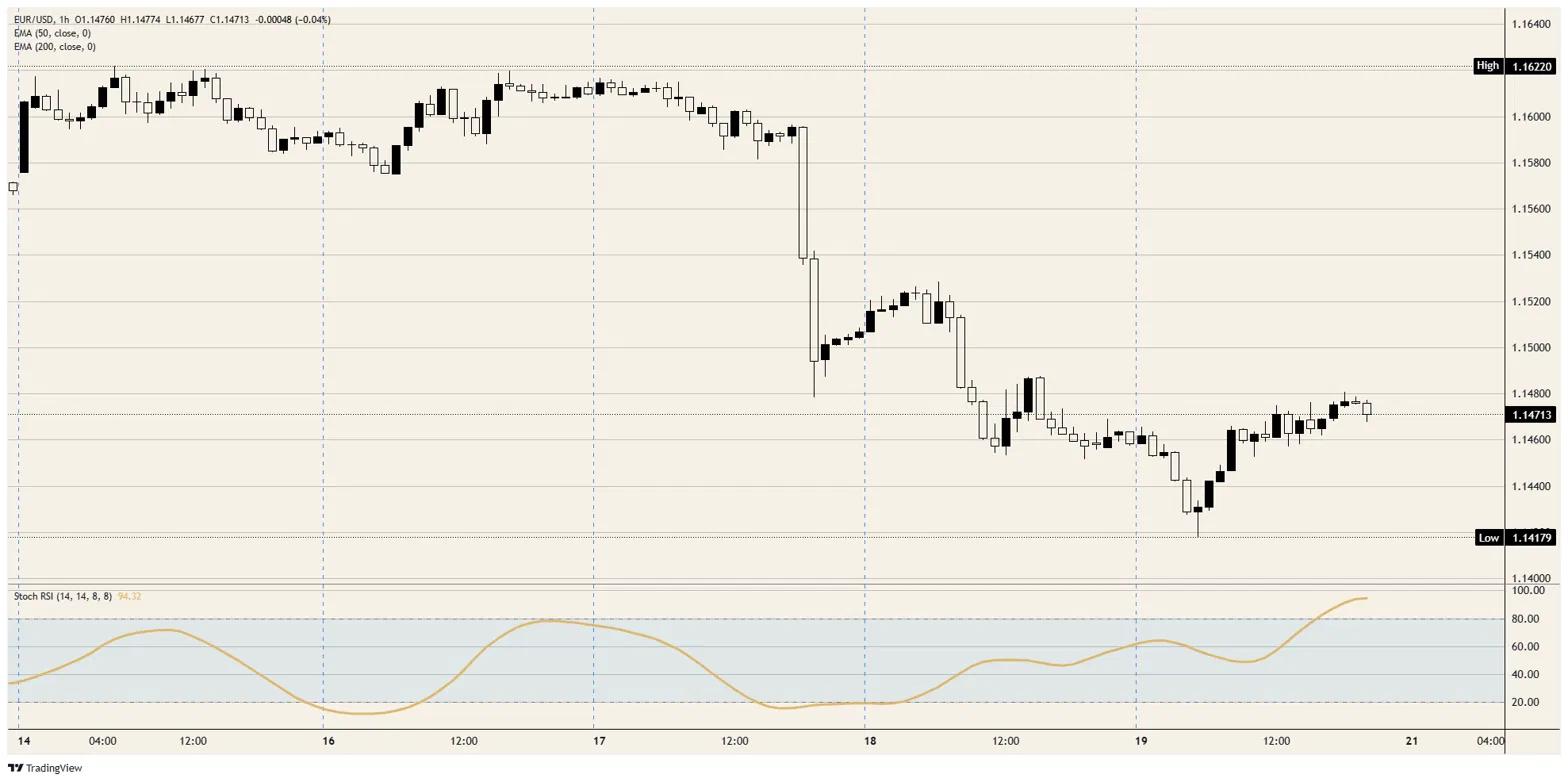
The near-term picture is the one part of the Euro story that favours the bulls, and only just. Price has carved out a tentative floor near 1.1450, with the hourly Stochastic Relative Strength Index (Stoch RSI) pushing into overbought after the bounce off the lows, a sign the immediate move is stretched. There is room for a corrective rally toward the 1.1500 area, though it stays on a short leash: the daily chart sits below both the 50-day and 200-day Exponential Moving Average (EMA), clustered near 1.1600, with the broader trend still pointing lower.
A wall of ECB speakers and Tuesday's still-contractionary flash Purchasing Managers Index (PMI) prints will not change that calculus; whatever bounce the Euro manages is unlikely to survive a hot reading from next Thursday's US data, when the third estimate of first-quarter Gross Domestic Product (GDP) and the May Personal Consumption Expenditures Price Index (PCE) land together at 12:30 GMT.
Resistance: The 1.1500 area is the first test, then 1.1550; the heavier barrier is the 1.1600 zone, where the 50-day and 200-day EMA converge and any recovery would have to prove itself.
Support: The tentative floor near 1.1450 is the level bulls must defend. Below it sit the 1.1400 handle and this week's low; a clean break there reopens the downtrend.
Bias: Tactically neutral with scope for a short-term bounce toward 1.1500 while 1.1450 holds, but bearish on any longer horizon. The Euro remains a hostage to the Dollar; a hot US PCE next week is the most likely trigger to drag it back to 1.1400 and beyond. Only a soft US inflation print gives the bounce real legs.
EUR/USD hourly chart
Euro FAQs
The Euro is the currency for the 20 European Union countries that belong to the Eurozone. It is the second most heavily traded currency in the world behind the US Dollar. In 2022, it accounted for 31% of all foreign exchange transactions, with an average daily turnover of over $2.2 trillion a day. EUR/USD is the most heavily traded currency pair in the world, accounting for an estimated 30% off all transactions, followed by EUR/JPY (4%), EUR/GBP (3%) and EUR/AUD (2%).
The European Central Bank (ECB) in Frankfurt, Germany, is the reserve bank for the Eurozone. The ECB sets interest rates and manages monetary policy. The ECB’s primary mandate is to maintain price stability, which means either controlling inflation or stimulating growth. Its primary tool is the raising or lowering of interest rates. Relatively high interest rates – or the expectation of higher rates – will usually benefit the Euro and vice versa. The ECB Governing Council makes monetary policy decisions at meetings held eight times a year. Decisions are made by heads of the Eurozone national banks and six permanent members, including the President of the ECB, Christine Lagarde.
Eurozone inflation data, measured by the Harmonized Index of Consumer Prices (HICP), is an important econometric for the Euro. If inflation rises more than expected, especially if above the ECB’s 2% target, it obliges the ECB to raise interest rates to bring it back under control. Relatively high interest rates compared to its counterparts will usually benefit the Euro, as it makes the region more attractive as a place for global investors to park their money.
Data releases gauge the health of the economy and can impact on the Euro. Indicators such as GDP, Manufacturing and Services PMIs, employment, and consumer sentiment surveys can all influence the direction of the single currency. A strong economy is good for the Euro. Not only does it attract more foreign investment but it may encourage the ECB to put up interest rates, which will directly strengthen the Euro. Otherwise, if economic data is weak, the Euro is likely to fall. Economic data for the four largest economies in the euro area (Germany, France, Italy and Spain) are especially significant, as they account for 75% of the Eurozone’s economy.
Another significant data release for the Euro is the Trade Balance. This indicator measures the difference between what a country earns from its exports and what it spends on imports over a given period. If a country produces highly sought after exports then its currency will gain in value purely from the extra demand created from foreign buyers seeking to purchase these goods. Therefore, a positive net Trade Balance strengthens a currency and vice versa for a negative balance.
Author

Joshua Gibson
FXStreet
Joshua joins the FXStreet team as an Economics and Finance double major from Vancouver Island University with twelve years' experience as an independent trader focusing on technical analysis.