Gold remains near $4,600 due to Fed rate pause bets, easing tensions
- Gold retreats after reaching a fresh record high of $4,643 in the previous session.
- The non-interest-bearing Gold slips as strong US data bolster expectations that the Fed will keep rates on hold.
- Safe-haven Gold weakens as easing geopolitical tensions emerge after Trump said Iran’s crackdown-related killings are subsiding.
Gold (XAU/USD) loses ground after hitting a fresh record high of $4,643 in the previous session, trading around $4,600 per troy ounce on Thursday. The non-interest-bearing Gold lost ground as a stronger-than-expected United States (US) Producer Price Index (PPI) and Retail Sales, along with last week’s easing Unemployment Rate, reinforced the case for the US Federal Reserve (Fed) to keep interest rates on hold for the coming months.
Safe-haven Gold prices also weaken, partly reflecting easing geopolitical concerns. US President Donald Trump said reports indicated Iran’s crackdown-related killings were subsiding and that no large-scale executions were planned, though he did not rule out potential US military action, noting Washington would continue to monitor developments, according to Reuters.
The safe-haven demand for precious metals, including Gold, may further gain amid renewed concerns over the Fed’s independence. The Federal Reserve Chair Jerome Powell called out the Trump administration's decision to subpoena him, saying it amounted to intimidating the Fed into delivering easier monetary policy. Trump said on Wednesday he has no plans to fire Powell despite the Justice Department's criminal investigation into the Fed chair, but it was "too early" to say what he would ultimately do.
Daily Digest Market Movers: Gold declines as US Dollar strengthens
- The US Dollar Index (DXY), which measures the value of the US Dollar against six major currencies, is gaining ground after registering modest losses in the previous session. The DXY is trading around 99.10 at the time of writing, dampening foreign-currency demand for dollar-denominated Gold.
- The US Census Bureau reported on Wednesday that Retail Sales rose more than expected to $735.9 billion in November, up 0.6%, following a 0.1% contraction in October and beating market expectations of a 0.4% increase. Meanwhile, the Producer Price Index (PPI) came in hot in November, with both headline and core measures reaching 3% year-over-year (YoY).
- Morgan Stanley analysts delayed their expectations for rate cuts to June and September from January and April following Friday’s jobs report.
- Minneapolis Fed President Neel Kashkari said at the Midwest Economic Forecast Forum hosted online by the Wisconsin Bankers Association on Wednesday that the overall economy seems quite resilient and that he has seen less tariff pass-through than expected. Kashkari added that inflation is still too high but is moving the right way.
- Fed Beige Book noted that US economic activity picked up at a "slight to modest pace" in most parts of the country since mid-November. "This marks an improvement over the last three report cycles, where a majority of Fed districts reported little change."
- US Core Consumer Price Index (CPI), excluding food and energy, rose 0.2% in December, below market expectations, while annual core inflation held at 2.6%, matching a four-year low. The data provided a clearer sign of easing inflation after earlier releases were skewed by shutdown effects. Meanwhile, CPI increased by 0.3% month-over-month in December 2025, matching market expectations and repeating the rise seen in September. The annual inflation remains at 2.7% increase as expected.
- The US-based HRANA rights group reported on Wednesday that the death toll from Iran’s protests has reached 2,571. US President Donald Trump has urged Iranians to continue protesting, pledging that help is on the way, per Reuters.
- President Trump said on Monday that he would impose 25% tariffs on goods from any country doing business with Iran, stepping up pressure on Tehran amid widespread domestic protests. He added that the measure would take effect immediately, without providing further details. Trump warned on Sunday that action may be required before any meeting, even as he said Iran’s leadership had reached out seeking “to negotiate” after his military threats.
- US Nonfarm Payrolls (NFP) rose by 50,000 in December, falling short of November's 56,000 (revised from 64,000) and came in weaker than the market expectation of 60,000. However, the Unemployment Rate ticked lower to 4.4% in December from 4.6% in November, while the Average Hourly Earnings climbed to 3.8% YoY in December from 3.6% in the previous reading.
Gold bulls remain intact as holds above the rising nine-day EMA
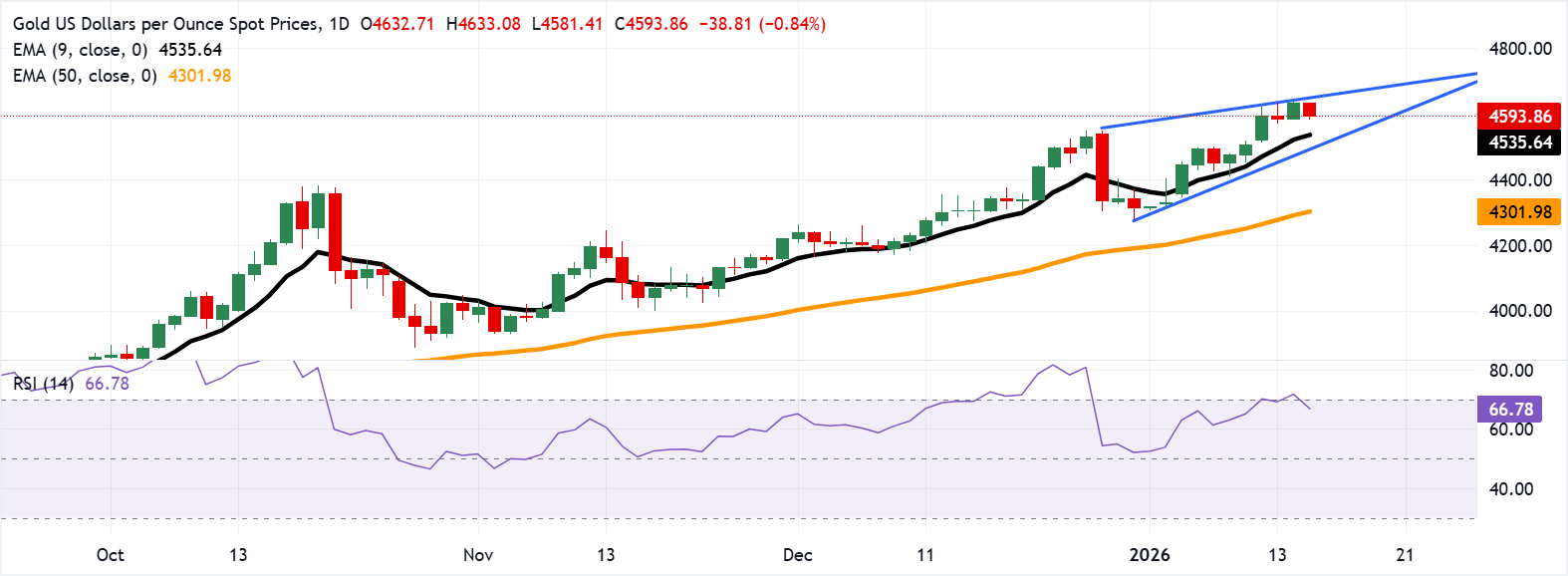
Gold (XAU/USD) is trading around $4,600 on Thursday. The daily chart technical analysis shows the XAU/USD pair remains within an emerging ascending wedge pattern. This formation signals weakening upside momentum and warns of a potential bearish reversal if the price breaks below the lower trendline on strong volume.
Gold price holds above the rising nine-day Exponential Moving Average (EMA), keeping the near-term uptrend intact. The 50-day EMA turns higher and underpins the broader bullish bias. The 14-day Relative Strength Index (RSI) at 66.05 is positive without overbought extremes. RSI could ease toward the midline if momentum cools, but staying elevated would preserve upside pressure.
The immediate resistance appears at the record high of $4,643, followed by the upper boundary of the ascending wedge around $4,660. A break above this confluence resistance zone would lead the XAU/USD pair to the $4,700 level. On the downside, the initial support lies at the nine-day EMA of $4,535.64, followed by the lower ascending wedge boundary around $4,490.00.
(The technical analysis of this story was written with the help of an AI tool.)
Gold FAQs
Gold has played a key role in human’s history as it has been widely used as a store of value and medium of exchange. Currently, apart from its shine and usage for jewelry, the precious metal is widely seen as a safe-haven asset, meaning that it is considered a good investment during turbulent times. Gold is also widely seen as a hedge against inflation and against depreciating currencies as it doesn’t rely on any specific issuer or government.
Central banks are the biggest Gold holders. In their aim to support their currencies in turbulent times, central banks tend to diversify their reserves and buy Gold to improve the perceived strength of the economy and the currency. High Gold reserves can be a source of trust for a country’s solvency. Central banks added 1,136 tonnes of Gold worth around $70 billion to their reserves in 2022, according to data from the World Gold Council. This is the highest yearly purchase since records began. Central banks from emerging economies such as China, India and Turkey are quickly increasing their Gold reserves.
Gold has an inverse correlation with the US Dollar and US Treasuries, which are both major reserve and safe-haven assets. When the Dollar depreciates, Gold tends to rise, enabling investors and central banks to diversify their assets in turbulent times. Gold is also inversely correlated with risk assets. A rally in the stock market tends to weaken Gold price, while sell-offs in riskier markets tend to favor the precious metal.
The price can move due to a wide range of factors. Geopolitical instability or fears of a deep recession can quickly make Gold price escalate due to its safe-haven status. As a yield-less asset, Gold tends to rise with lower interest rates, while higher cost of money usually weighs down on the yellow metal. Still, most moves depend on how the US Dollar (USD) behaves as the asset is priced in dollars (XAU/USD). A strong Dollar tends to keep the price of Gold controlled, whereas a weaker Dollar is likely to push Gold prices up.
Author

Akhtar Faruqui
FXStreet
Akhtar Faruqui is a Forex Analyst based in New Delhi, India. With a keen eye for market trends and a passion for dissecting complex financial dynamics, he is dedicated to delivering accurate and insightful Forex news and analysis.

















