Gold steadies as Trump tariff blitz jolts markets, Fed Minutes in focus
- Gold price dips 0.06%, trades near $3,333 amid renewed US trade tensions.
- Trump threatens 25% tariffs on Korean and Japanese goods, effective August 1.
- Risk-off mood pushes US yields and US Dollar higher, weighing on Bullion.
- China’s central bank adds to Gold reserves for eighth straight month.

Gold price registers minimal losses on Monday as worries about the resumption of a possible trade war increase, following US President Donald Trump's announcement on his social media platforms of the first trade letters sent to South Korea and Japan, which establish duties on goods and products. At the time of writing, XAU/USD trades at $3,333, down 0.06%.
The trade war continues after Trump announced tariffs of 25% on all Korean and Japanese products sent to the US, starting August 1. US Treasury yields have risen as has the US Dollar. Gold prices had seen a recovery but remain down as risk appetite soured with the decline of US equity markets.
In the meantime, economic data proved wrong Trump’s desire for lower interest rates, following last week's strong Nonfarm Payrolls report for June. The print exceeded estimates and May numbers, pushing the Unemployment Rate lower. After the data, traders priced out 14 basis points (bps) to just 50, according to data from the Chicago Board of Trade.
Bullion prices are set to increase as data revealed that China’s central bank added the yellow metal to its reserves in June for the eighth straight month.
Ahead this week, traders will be attentive to the Minutes of the Federal Reserve’s (Fed) latest monetary policy meeting and speeches by a flurry of Fed officials. Alongside this, Initial Jobless Claims numbers for the week ending July 5 would update the status of the US economy.
Daily digest market movers: Gold price on the backfoot as US yields jump
- Gold price uptrend remains stalled due to high US Treasury yields. The US 10-year Treasury bond yield rises four basis points to 4.389%. US real yields are also up four bps at 2.059%.
- The US Dollar Index (DXY), which tracks the Greenback’s performance against a basket of currencies, surged 0.59% to 97.55, closing in on 97.66, the highest level in the last eight days.
- Last week, the US jobs report added 147K, slightly above expectations of 110K and up from May’s revised figure of 144,000. The Unemployment Rate declined to 4.1% from 4.2%, backing Fed Chair Jerome Powell’s cautious, wait-and-see approach as the Fed tracks the potential inflationary impact of trade tariffs.
- The People's Bank of China (BoC) revealed that it has added 70,000 tonnes, meaning that the central bank’s Gold reserves increased by 1.1 million since purchases resumed last November.
- The Bank of America revealed that central banks adding Gold reserves reduce their dependence on the US Dollar, and it is a hedge against inflation and economic uncertainty. Therefore, further upside for Gold is expected.
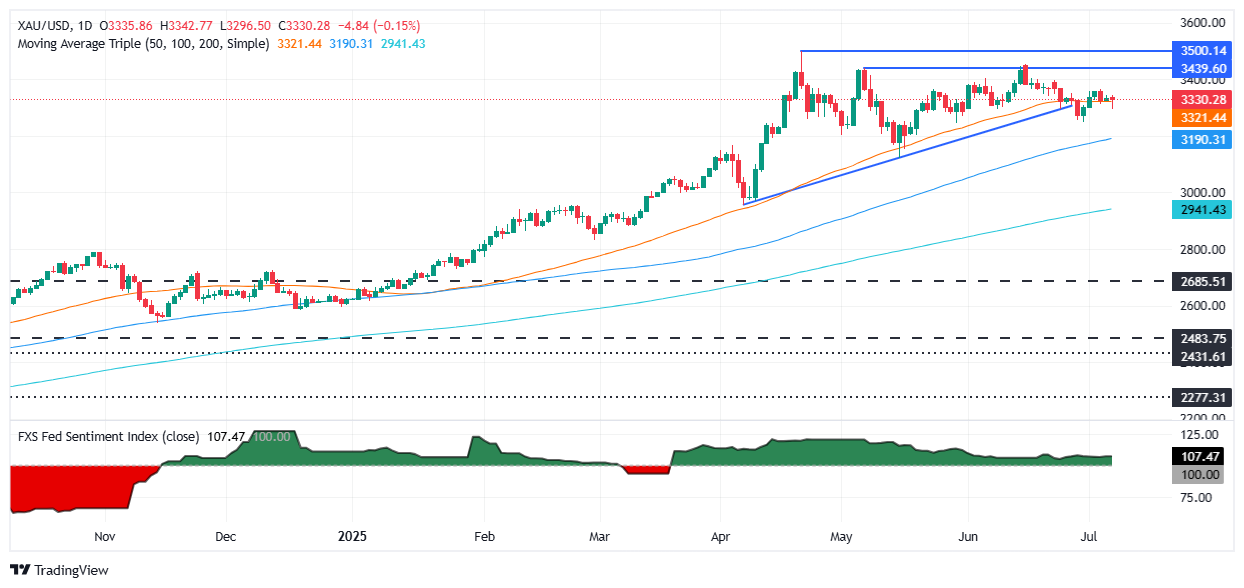
XAU/USD technical outlook: Gold price trades sideways below $3,350
Gold price uptrend remains intact, with the yellow metal currently sitting above the 50-day Simple Moving Average (SMA) at $3,320. This is the first line of support that buyers have been relying on for the past four trading days. Still, a daily close below the latter will expose the $3,300 mark.
The Relative Strength Index (RSI) remains flat, indicating that XAU/USD could be trading at the top/bottom of the $3,300 level in the near term.
If Gold stays above the 50-day SMA, the next resistance would be $3,350, followed by the $3,400 mark. Conversely, expect a test of the $3,300 level, followed by the June 30 swing low of $3,246. This level is critical for buyers because once cleared, the next demand zone would be the May 15 swing low of $3,120.
Gold FAQs
Gold has played a key role in human’s history as it has been widely used as a store of value and medium of exchange. Currently, apart from its shine and usage for jewelry, the precious metal is widely seen as a safe-haven asset, meaning that it is considered a good investment during turbulent times. Gold is also widely seen as a hedge against inflation and against depreciating currencies as it doesn’t rely on any specific issuer or government.
Central banks are the biggest Gold holders. In their aim to support their currencies in turbulent times, central banks tend to diversify their reserves and buy Gold to improve the perceived strength of the economy and the currency. High Gold reserves can be a source of trust for a country’s solvency. Central banks added 1,136 tonnes of Gold worth around $70 billion to their reserves in 2022, according to data from the World Gold Council. This is the highest yearly purchase since records began. Central banks from emerging economies such as China, India and Turkey are quickly increasing their Gold reserves.
Gold has an inverse correlation with the US Dollar and US Treasuries, which are both major reserve and safe-haven assets. When the Dollar depreciates, Gold tends to rise, enabling investors and central banks to diversify their assets in turbulent times. Gold is also inversely correlated with risk assets. A rally in the stock market tends to weaken Gold price, while sell-offs in riskier markets tend to favor the precious metal.
The price can move due to a wide range of factors. Geopolitical instability or fears of a deep recession can quickly make Gold price escalate due to its safe-haven status. As a yield-less asset, Gold tends to rise with lower interest rates, while higher cost of money usually weighs down on the yellow metal. Still, most moves depend on how the US Dollar (USD) behaves as the asset is priced in dollars (XAU/USD). A strong Dollar tends to keep the price of Gold controlled, whereas a weaker Dollar is likely to push Gold prices up.
Author

Christian Borjon Valencia
FXStreet
Markets analyst, news editor, and trading instructor with over 14 years of experience across FX, commodities, US equity indices, and global macro markets.