Gold slips as strong US jobs data offsets trade, Fed uncertainty
- US Initial Jobless Claims beat forecasts, reinforcing Fed's steady rate stance.
- Manufacturing PMI falls, showing early signs of economic softening.
- Trump’s Fed visit, tariff concerns could reignite safe-haven demand for Gold.

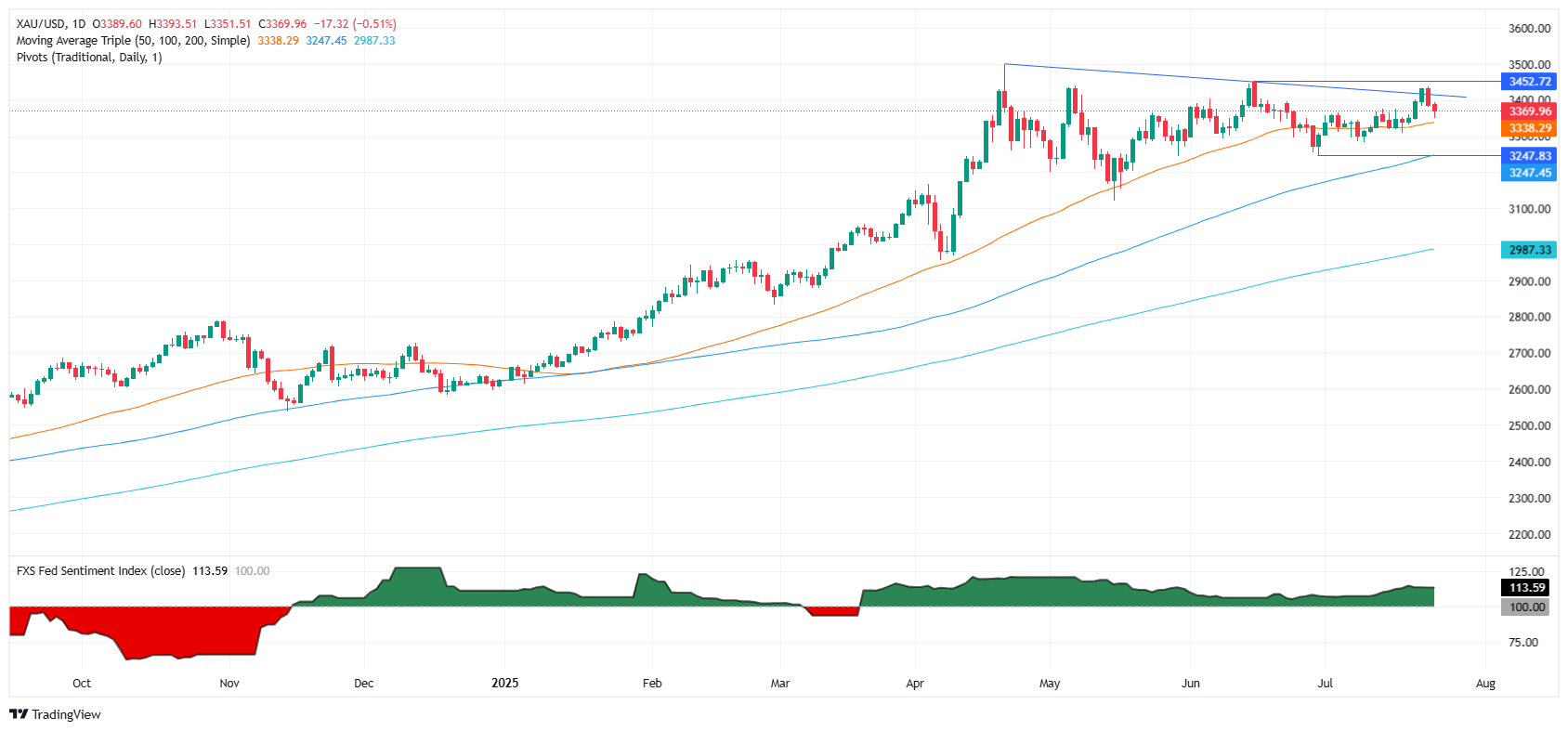
Gold price retreats during the North American session, down by over 0.50% on Thursday following the release of strong labor market data despite weakening manufacturing activity, according to the S&P Global Flash PMI survey. At the time of writing, XAU/USD trades at $3,373 after reaching a daily peak of $3,393.
Data from the United States revealed that the number of Americans filing for unemployment benefits dipped below forecasts, a sign of robustness. However, the S&P Global Manufacturing PMI showed that the economy is losing momentum, having fallen from June’s 37-month high, indicating weakness.
The European Central Bank (ECB) joined the Federal Reserve (Fed) in holding rates unchanged, amid uncertainty stemming from the United States' contentious trade policies. Although recent news revealed an agreement with Japan, fears of not reaching a deal with the European Union (EU), Canada and Mexico could prompt a rise in prices due to higher tariffs above the 30% threshold.
At approximately 20:00 GMT, US President Donald Trump is scheduled to visit a Federal Reserve building that is undergoing renovations amid ongoing criticism of Fed Chair Jerome Powell. Threats to Fed independence could be bullish for Bullion prices, which tend to fare well in times of geopolitical instability.
Alongside Trump’s visit, traders will eye the release of Durable Goods Orders data on Friday ahead of the next Fed monetary policy decision on July 29-30. The Fed is expected to hold rates unchanged, though traders are pricing in over 40 basis points (bps) of easing.
Daily digest market movers: Gold price dives on high US yields
- US Treasury yields rose with the 10-year Treasury note climbing three basis points up to 4.416%. Consequently, US real yields, which are calculated by subtracting inflation expectations from the nominal interest rate, have increased by nearly three and a half basis points to 2.046%.
- The US Dollar Index (DXY), which tracks the buck’s performance against a basket of six currencies, is up 0.17% at 97.37.
- The US Bureau of Labor Statistics (BLS) reported that Initial Jobless Claims fell to 217,000 for the week ending July 19, below the 227,000 expected and down from the prior week’s 221,000. While this marks the lowest level since mid-April, Continuing Claims held steady at 1.96 million — near the highest levels since 2021 — indicating persistent challenges for unemployed workers in securing new employment.
- US business activity showed a mixed performance in July, according to S&P Global. The Manufacturing PMI fell into contraction territory, dropping to 49.5 from June’s 37-month high of 52 and missing expectations of 52.5 — signaling a deterioration in factory conditions. In contrast, the Services PMI rose to 55.2, beating the 53.0 forecasts and improving from 52.9 in June, indicating robust growth in the services sector.
- The ECB kept its three reference interest rates unchanged at the July 24 meeting as the central bank revealed that the bar for cutting rates at the September meeting would be high. Unless there are increasing risks of an economic slowdown, the Governing Council is projected to keep rates on hold.
- Rumors that trade talks between the EU and the US improved were dismissed by the White House, who said that it was considered speculation. Yesterday, an article in the FT revealed that the European Union (EU) could agree to reciprocal tariffs after Trump delivered a letter with 30% duties, which would take effect on August 1.
- Interest rate probability indicates that the Fed will maintain its current rates, with odds standing at 96% for a hold and 4% for a 25-basis-point rate cut at the July 30 meeting.
XAU/USD technical outlook: Gold price to consolidate ahead of the Fed’s meeting
Gold price posts back-to-back bearish sessions with sellers keeping XAU/USD price below $3,400. Despite this, buyers emerged at around $3,350, keeping the yellow metal trading within the $3,350-$3,400 trading range, awaiting a fresh catalyst.
A breach of the top of the range clears the path to test a five-week peak at $3,438, ahead of the June 16 high at $3,452, and ahead of the all-time high (ATH) of $3,500. On the flip side, a drop below $3,350 could clear the path to challenge the 20-day and 50-day Simple Moving Averages (SMAs) at $3,342 and $3,330, respectively, ahead of $3,300.
Gold FAQs
Gold has played a key role in human’s history as it has been widely used as a store of value and medium of exchange. Currently, apart from its shine and usage for jewelry, the precious metal is widely seen as a safe-haven asset, meaning that it is considered a good investment during turbulent times. Gold is also widely seen as a hedge against inflation and against depreciating currencies as it doesn’t rely on any specific issuer or government.
Central banks are the biggest Gold holders. In their aim to support their currencies in turbulent times, central banks tend to diversify their reserves and buy Gold to improve the perceived strength of the economy and the currency. High Gold reserves can be a source of trust for a country’s solvency. Central banks added 1,136 tonnes of Gold worth around $70 billion to their reserves in 2022, according to data from the World Gold Council. This is the highest yearly purchase since records began. Central banks from emerging economies such as China, India and Turkey are quickly increasing their Gold reserves.
Gold has an inverse correlation with the US Dollar and US Treasuries, which are both major reserve and safe-haven assets. When the Dollar depreciates, Gold tends to rise, enabling investors and central banks to diversify their assets in turbulent times. Gold is also inversely correlated with risk assets. A rally in the stock market tends to weaken Gold price, while sell-offs in riskier markets tend to favor the precious metal.
The price can move due to a wide range of factors. Geopolitical instability or fears of a deep recession can quickly make Gold price escalate due to its safe-haven status. As a yield-less asset, Gold tends to rise with lower interest rates, while higher cost of money usually weighs down on the yellow metal. Still, most moves depend on how the US Dollar (USD) behaves as the asset is priced in dollars (XAU/USD). A strong Dollar tends to keep the price of Gold controlled, whereas a weaker Dollar is likely to push Gold prices up.
Author

Christian Borjon Valencia
FXStreet
Markets analyst, news editor, and trading instructor with over 14 years of experience across FX, commodities, US equity indices, and global macro markets.