Gold rebounds after pullback on increasing geopolitical risks
- Gold recovers, aided by a rise in geopolitical risks after a steep sell-off on the previous day.
- Speculation that a BRICS Gold-backed currency could become an alternative to the US Dollar also drives flows.
- XAU/USD continues to look bullish as its overall uptrend remains intact and the commodity keeps making higher highs.

Gold (XAU/USD) recovers to trade back in the $2,720s on Thursday, after a 1.2% sell-off on the previous day, most probably driven by profit-taking. The precious metal is once again on the rise on the back of continued safe-haven flows as the conflict in the Middle East continues with no sign of resolution.
Further, the news that North Korea has sent troops to Russia to potentially participate in the war with Ukraine has ratcheted up geopolitical risks, as has increased election uncertainty in the US.
Gold recovers as major central banks slash interest rates
Gold sees further upside as a result of the Bank of Canada’s (BoC) decision to slash its cash rate by 50 basis points (bps) on Wednesday and increasing speculation the European Central Bank (ECB) might do the same in December, after the release of tepid economic data for the region. With interest rates set to fall rapidly all over the globe, Gold should benefit given this will increase its attractiveness as a non-interest-paying asset.
That said, in the US, market expectations of the trajectory for interest rates have been subject to a substantial revision after the release of robust labor market data reduced the chances of the US Federal Reserve (Fed) aggressively cutting US interest rates.
A further factor helping Gold price higher could be the focus on the BRICS 2024 summit in Kazan, Russia, as members – especially the host Russia – seek to find an alternative to the dominance of the US Dollar (USD), with a currency backed by Gold touted as a viable alternative.
Technical Analysis: Gold pulls back then rebounds
Gold pulled back over 1.2% on Wednesday but rebounds on Thursday, continuing its rally higher.
The yellow metal is in a steady uptrend on all time frames (short, medium and long) which given the technical dictum “the trend is your friend” favors more upside. Having breached $2,750, the next big-figure target level lies at $3,000 (round number and psychological level).
XAU/USD Daily Chart
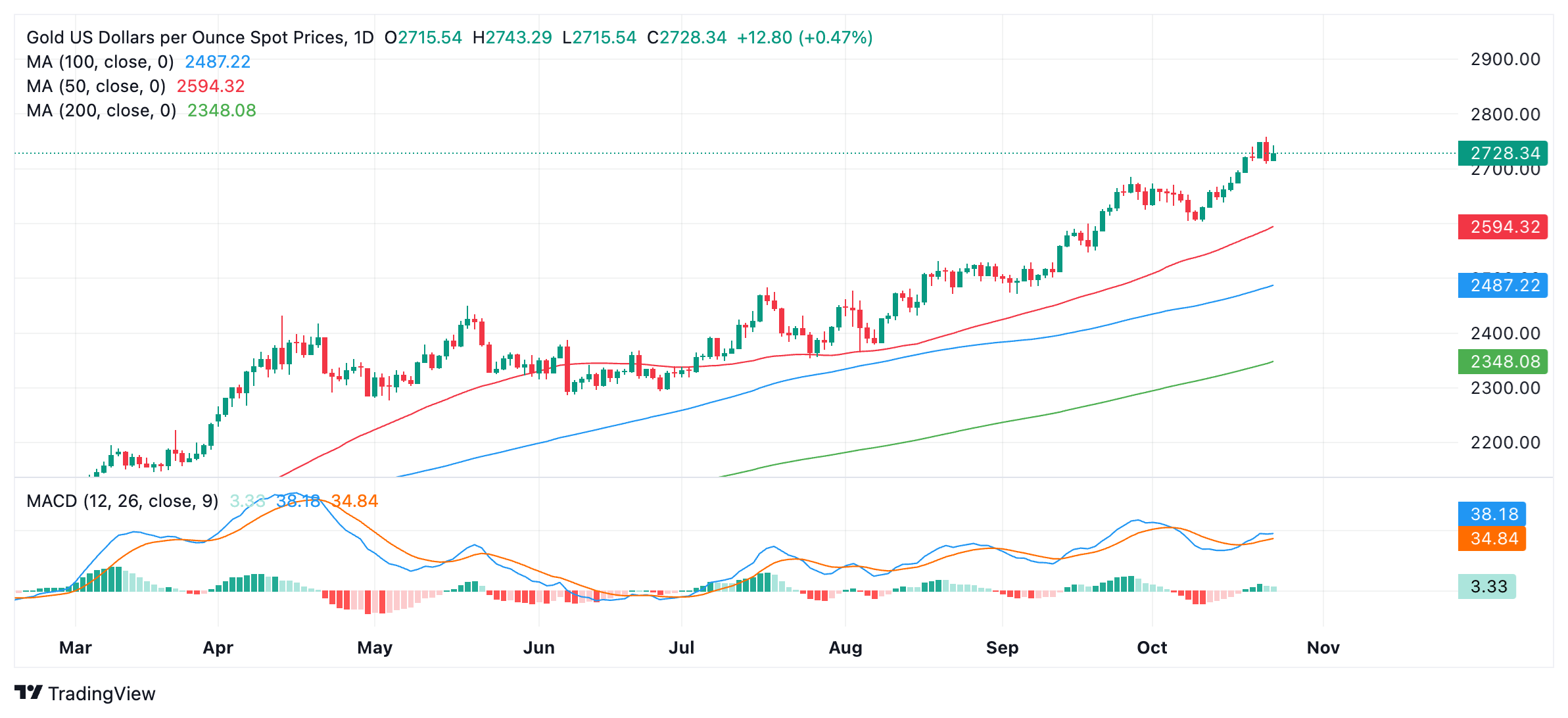
The Relative Strength Index (RSI) has pulled back out of overbought, advising long-holders to close their long positions and open shorts. It is possible this could herald a deeper correction, however, given the strong uptrend it is not enough alone to be certain. Support lies at $2,750, $2,700 (key round-number levels) and $2,685 (September high).
Gold’s overall strong uptrend, however, suggests that any corrections will probably be short-lived, and afterward, the broader bull trend will resume.
Interest rates FAQs
Interest rates are charged by financial institutions on loans to borrowers and are paid as interest to savers and depositors. They are influenced by base lending rates, which are set by central banks in response to changes in the economy. Central banks normally have a mandate to ensure price stability, which in most cases means targeting a core inflation rate of around 2%. If inflation falls below target the central bank may cut base lending rates, with a view to stimulating lending and boosting the economy. If inflation rises substantially above 2% it normally results in the central bank raising base lending rates in an attempt to lower inflation.
Higher interest rates generally help strengthen a country’s currency as they make it a more attractive place for global investors to park their money.
Higher interest rates overall weigh on the price of Gold because they increase the opportunity cost of holding Gold instead of investing in an interest-bearing asset or placing cash in the bank. If interest rates are high that usually pushes up the price of the US Dollar (USD), and since Gold is priced in Dollars, this has the effect of lowering the price of Gold.
The Fed funds rate is the overnight rate at which US banks lend to each other. It is the oft-quoted headline rate set by the Federal Reserve at its FOMC meetings. It is set as a range, for example 4.75%-5.00%, though the upper limit (in that case 5.00%) is the quoted figure. Market expectations for future Fed funds rate are tracked by the CME FedWatch tool, which shapes how many financial markets behave in anticipation of future Federal Reserve monetary policy decisions.
Author

Joaquin Monfort
FXStreet
Joaquin Monfort is a financial writer and analyst with over 10 years experience writing about financial markets and alt data. He holds a degree in Anthropology from London University and a Diploma in Technical analysis.