Gold price erupts as weak payrolls raise odds of imminent Fed cut
- Gold gains 0.39% to $3,375 on rising Fed cut expectations after soft NFP print.
- May–June payrolls revised down by 258K last Friday, sparking renewed dovish shift.
- US 10-year yield falls to 4.20%, extending last week’s 16 bps drop.

Gold price posted modest gains on Monday as expectations that the Federal Reserve (Fed) could cut interest rates rose since last Friday, following last Friday's dismal US Nonfarm Payrolls report. The XAU/USD trades at $3,375, edges up 0.39%.
Expectations that the Fed might cut interest rates are boosting the yellow metal. The odds for the September 17 meeting rate cut are 87%.
Last week’s jobs data revealed the first cracks of a deteriorating labor market. The US Bureau of Labor Statistics (BLS) revised down May and June figures by 258K. Hence, the data vindicated Fed Governor Christopher Waller, who shifted dovishly as he made comments that tariff inflation would be transitory and expressed concerns about achieving the maximum employment mandate.
US Treasury yields are down during the session, a tailwind for the non-yielding metal. The US 10-year T-note is down one basis point (bp) to 4.20%, extending its losses after Friday’s 16-basis-point plunge.
The US Dollar, as depicted by the US Dollar Index (DXY) that tracks the performance of the buck’s value against a basket of six peers, trims some of its earlier gains and is up 0.07% at 98.74.
US Trade Representative Jamieson Greer said that tariffs imposed by US President Trump last week are likely to remain in place as part of continuing negotiations. Last week, Canada, Brazil, India, Taiwan and Switzerland were hit by tariffs between 20% to 39%.
Data revealed that Factory Orders tanked while traders await the release of ISM Services PMI, Jobless Claims, Consumer Sentiment data and Fed speakers.
Daily digest market movers: Gold edges up as manufacturing activity shows signs of slowing
- Factory Orders in June plummeted as commercial aircraft orders plunged, with the print coming at -4.8% MoM as expected, well below May’s 8.2% expansion. Manufacturing activity remains constrained due to tariffs, which triggered a rise in input costs.
- Also, the ISM Manufacturing PMI contracted last week, resuming its downward trend for the second consecutive month.
- Meanwhile, Consumer Sentiment improved by 61.7, though it ticked a tenth lower than the preliminary reading from the University of Michigan (UoM) survey on American households. Inflation Expectations remained within familiar levels at 4.5% for one year and 3.4% for five years.
- Citi updated its Gold forecast for the next three months from $3,300 to $3,500 per troy ounce on Monday. They mentioned in the note that “US growth and tariff-related inflation concerns are set to remain elevated during 2H’25, which, alongside a weaker dollar, are set to drive gold moderately higher, to new all-time highs.”
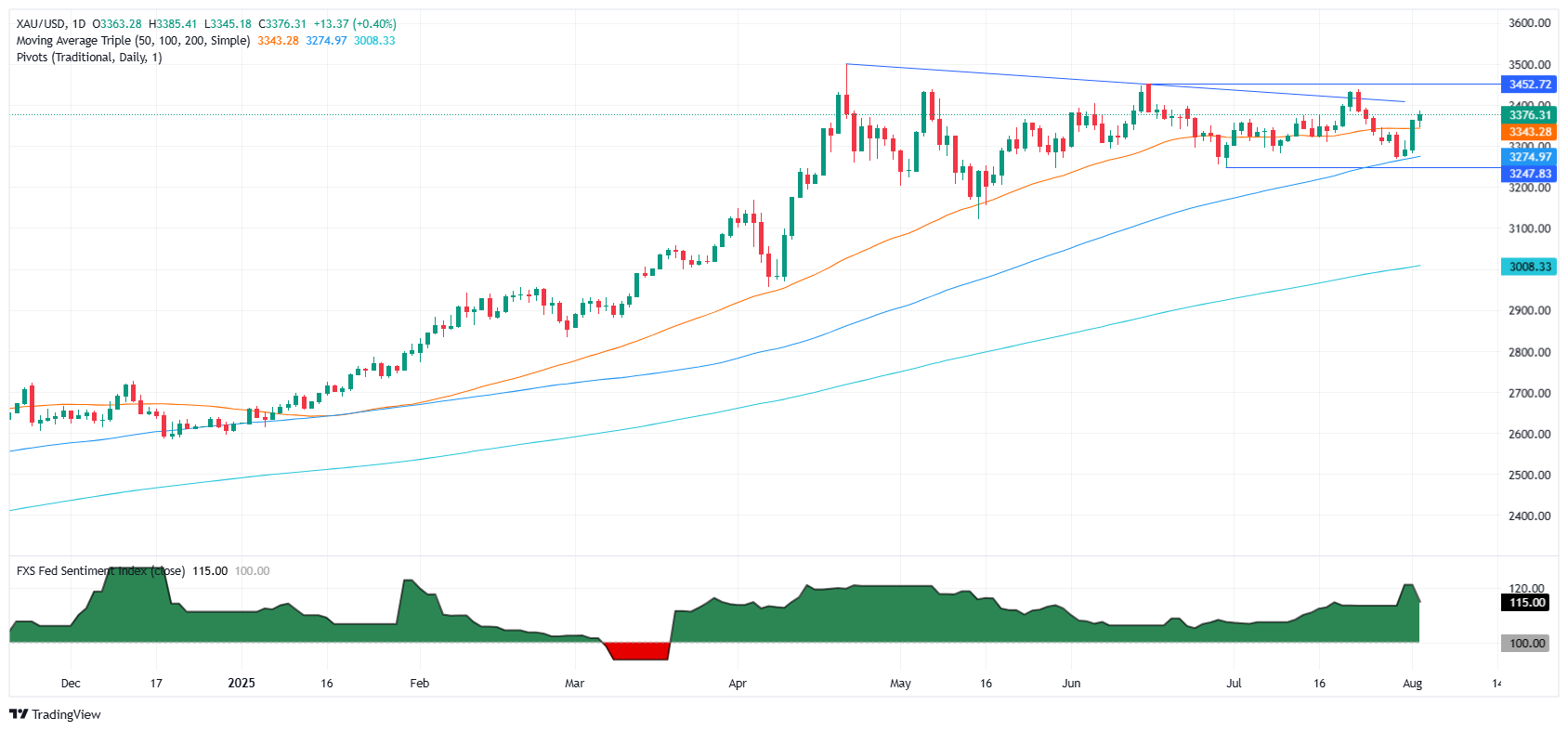
XAU/USD technical outlook: Gold price remains bullish as buyers eye $3,400
After climbing above the confluence of the 50-day and 20-day Simple Moving Averages (SMAs) at $3,342, Gold cleared the $3,350 level as buyers eye a test of the $3,400 mark. Citi’s upward revision to the XAU/USD price could sponsor a re-test of the June 16 peak of $3,452, before bulls assault the year-to-date (YTD) high of $3,500.
On the flip side, if XAU/USD drops below $3,342, the next support would be $3,300, ahead of the 100-day SMA at $3,263.
Fed FAQs
Monetary policy in the US is shaped by the Federal Reserve (Fed). The Fed has two mandates: to achieve price stability and foster full employment. Its primary tool to achieve these goals is by adjusting interest rates. When prices are rising too quickly and inflation is above the Fed’s 2% target, it raises interest rates, increasing borrowing costs throughout the economy. This results in a stronger US Dollar (USD) as it makes the US a more attractive place for international investors to park their money. When inflation falls below 2% or the Unemployment Rate is too high, the Fed may lower interest rates to encourage borrowing, which weighs on the Greenback.
The Federal Reserve (Fed) holds eight policy meetings a year, where the Federal Open Market Committee (FOMC) assesses economic conditions and makes monetary policy decisions. The FOMC is attended by twelve Fed officials – the seven members of the Board of Governors, the president of the Federal Reserve Bank of New York, and four of the remaining eleven regional Reserve Bank presidents, who serve one-year terms on a rotating basis.
In extreme situations, the Federal Reserve may resort to a policy named Quantitative Easing (QE). QE is the process by which the Fed substantially increases the flow of credit in a stuck financial system. It is a non-standard policy measure used during crises or when inflation is extremely low. It was the Fed’s weapon of choice during the Great Financial Crisis in 2008. It involves the Fed printing more Dollars and using them to buy high grade bonds from financial institutions. QE usually weakens the US Dollar.
Quantitative tightening (QT) is the reverse process of QE, whereby the Federal Reserve stops buying bonds from financial institutions and does not reinvest the principal from the bonds it holds maturing, to purchase new bonds. It is usually positive for the value of the US Dollar.
Author

Christian Borjon Valencia
FXStreet
Markets analyst, news editor, and trading instructor with over 14 years of experience across FX, commodities, US equity indices, and global macro markets.














