Gold Price Forecast: XAU/USD holds onto early losses near $4,630, US Yields plunge
- Gold price trades lower to near $4,630 despite a sharp drop in US Treasury Yields.
- US bond yields slump as oil prices fall sharply.
- Investors await the US PCE inflation data and Jackson Hole Symposium.

Gold price (XAU/USD) is down 0.4% to near $4,630 during the European trading session on Tuesday. The precious metal corrects after failing to extend the rally above $4,700 earlier in the day.
The yellow metal struggles to attract bids even as a sharp decline in oil prices has weighed heavily on United States (US) Treasury Yields.
At press time, WTI Oil prices are down 3% to near $82.00. Lower prices diminish fears of high inflation expectations, a scenario that eases interest rate hike risks from global central banks and weighs on US Treasury Yields.
As of writing, 10-year yields on US bonds are down 0.6% to near 4.67%. 30-year US Treasury Yields trade 0.55% lower to near 5.2%.
The scenario of lower yields on US interest-bearing assets improves the appeal of non-yielding assets, such as Gold.
Going forward, investors will focus on the US Personal Consumption Expenditures (PCE) inflation data for July and the outcome of the Jackson Hole Symposium.
Gold Technical Analysis
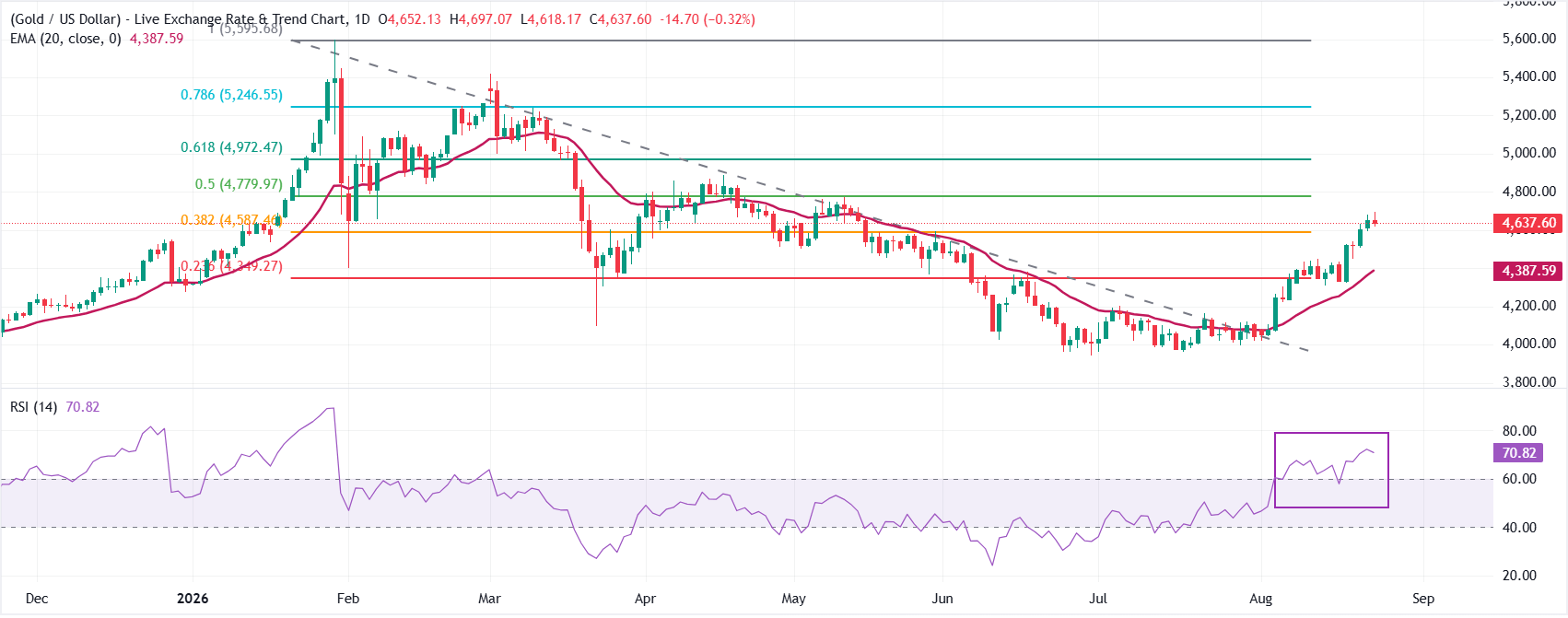
In the daily chart, XAU/USD trades at $4,637.77, keeping a bullish near-term tone as it holds above the 20-day exponential moving average (EMA) at roughly $4,387.61 and above key Fibonacci retracement supports. The Relative Strength Index (RSI) stands around 70.8, placing the metal in overbought territory and hinting that upside momentum remains strong but increasingly vulnerable to consolidation or a corrective pause.
On the topside, immediate resistance emerges at the 50% Fibonacci retracement at about $4,779.97, followed by the 61.8% retracement near $4,972.47, with higher barriers seen at $5,246.55 and $5,595.68. On the downside, initial support is aligned with the 38.2% retracement around $4,587.46, ahead of the 23.6% level at $4,349.27 and the 20-day EMA near $4,387.61, where a deeper pullback could look to stabilize while the broader bullish structure remains intact above these levels.
(The technical analysis of this story was written with the help of an AI tool. Know more.)
Gold FAQs
Gold has played a key role in human’s history as it has been widely used as a store of value and medium of exchange. Currently, apart from its shine and usage for jewelry, the precious metal is widely seen as a safe-haven asset, meaning that it is considered a good investment during turbulent times. Gold is also widely seen as a hedge against inflation and against depreciating currencies as it doesn’t rely on any specific issuer or government.
Central banks are the biggest Gold holders. In their aim to support their currencies in turbulent times, central banks tend to diversify their reserves and buy Gold to improve the perceived strength of the economy and the currency. High Gold reserves can be a source of trust for a country’s solvency. Central banks added 1,136 tonnes of Gold worth around $70 billion to their reserves in 2022, according to data from the World Gold Council. This is the highest yearly purchase since records began. Central banks from emerging economies such as China, India and Turkey are quickly increasing their Gold reserves.
Gold has an inverse correlation with the US Dollar and US Treasuries, which are both major reserve and safe-haven assets. When the Dollar depreciates, Gold tends to rise, enabling investors and central banks to diversify their assets in turbulent times. Gold is also inversely correlated with risk assets. A rally in the stock market tends to weaken Gold price, while sell-offs in riskier markets tend to favor the precious metal.
The price can move due to a wide range of factors. Geopolitical instability or fears of a deep recession can quickly make Gold price escalate due to its safe-haven status. As a yield-less asset, Gold tends to rise with lower interest rates, while higher cost of money usually weighs down on the yellow metal. Still, most moves depend on how the US Dollar (USD) behaves as the asset is priced in dollars (XAU/USD). A strong Dollar tends to keep the price of Gold controlled, whereas a weaker Dollar is likely to push Gold prices up.
Author

Sagar Dua
FXStreet
Sagar Dua is associated with the financial markets from his college days. Along with pursuing post-graduation in Commerce in 2014, he started his markets training with chart analysis.
















