Gold Price Forecast: XAU/USD trims a part of intraday gains, back below $1,800 ahead of Powell
- Gold price jumps on mixed cues, geopolitical risks.
- Treasury yields ease despite Fed’s hawkish view ahead of Powell.
- Gold to stay in consolidation ahead of Jackson Hole.

Update: Gold struggled to capitalize on its modest intraday gains and has now retreated a bit from the daily swing highs, around the $1,805 region. Currently trading below the $1,800 mark, the underlying bullish sentiment in the financial markets acted as a tailwind for the safe-haven XAU/USD. Apart from this, speculations that the Fed might still begin rolling back its pandemic-era stimulus later this year capped the upside for the non-yielding gold. The market speculations for an early move by the Fed were reinforced by St. Louis Fed President James Bullard and Dallas Fed President Robert Kaplan's hawkish comments on Thursday.
Meanwhile, a softer tone around the US Treasury bond yields kept the US dollar bulls on the defensive. This, in turn, extended some support and should help limit any meaningful slide for the dollar-denominated commodity. Investors also seemed reluctant to place any aggressive bets ahead of Fed Chair Jerome Powell's highly-anticipated speech at the Jackson Hole Symposium. Market participants will look for clues about the timing of the Fed's plans to reduce the pace of massive bond purchases, which, in turn, provide some meaningful impetus to gold.
Even from a technical perspective, bulls, so far, have struggled to make it through the 100-day/200-day SMAs confluence hurdle, currently around the $1,810 region. This should now act as a key pivotal point for short-term traders and help determine the next leg of a directional move for gold.
Previous update: Well, the Fed speculation on monetary policy normalization has once again turned in favor of the hawks heading into Chair Jerome Powell’s Jackson Hole showdown. However, the Kabul airport bombing, escalating Delta covid variant concerns and pre-Powell anxiety are keeping the sentiment around safe-haven gold underpinned.
It remains to be seen if Powell joins his colleagues James Bullard and Robert Kaplan in calling for taper in the final quarter of this year. Gold price is likely to suffer on any hints on withdrawal of the monetary policy support.
Read: Fed Chair Powell’s Jackson Hole Speech: Caution will win out
Gold Price: Key levels to watch
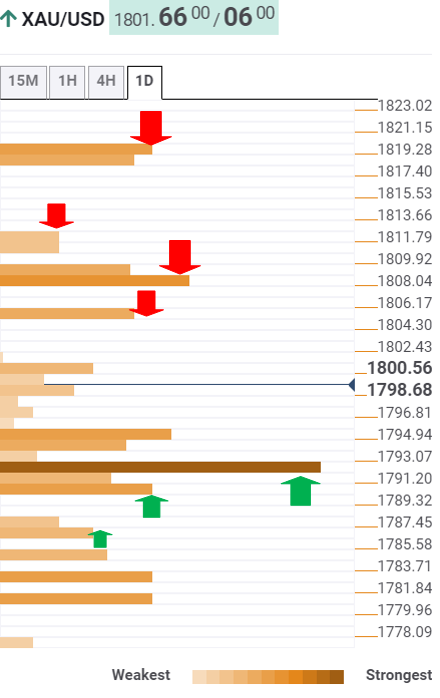
The Technical Confluences Detector shows that gold is extending the previous bounce towards a minor resistance at $1805, above which the confluence of the Fibonacci 38.2% one-month and pivot point one-week R2 at $1808 could be tested.
Buying pressure is likely to intensify above the latter calling for a test of the SMA200 and SMA100 one-day intersection at $1810.
Gold bulls will then take off towards the next significant upside barrier at $1819, the convergence of the Fibonacci 23.6% one-month, pivot point one-day R3 and pivot point one-week R3.
On the downside, gold sellers target $1795 as a strong cushion, the confluence of the Fibonacci 23.6% one-day, SMA200 four-hour and pivot point one-week R1.
The convergence of the Fibonacci 61.8% one-month and Fibonacci 38.2% one-day forms fierce support at $1792.
Acceptance below the latter could call for a test of $1790, where the Fibonacci 23.6% one-week and SMA10 one-day coincide.
The next best safety net for gold is seen at $1786, the Fibonacci 38.2% one-week.
Here is how it looks on the tool
About Technical Confluences Detector
The TCD (Technical Confluences Detector) is a tool to locate and point out those price levels where there is a congestion of indicators, moving averages, Fibonacci levels, Pivot Points, etc. If you are a short-term trader, you will find entry points for counter-trend strategies and hunt a few points at a time. If you are a medium-to-long-term trader, this tool will allow you to know in advance the price levels where a medium-to-long-term trend may stop and rest, where to unwind positions, or where to increase your position size.
Author

Dhwani Mehta
FXStreet
Residing in Mumbai (India), Dhwani is a Senior Analyst and Manager of the Asian session at FXStreet. She has over 10 years of experience in analyzing and covering the global financial markets, with specialization in Forex and commodities markets.