Gold Price Forecast: XAU/USD bears struggle to keep the reins ahead of US Nonfarm Payrolls
- Gold price pares intraday losses after falling in the last two consecutive weeks.
- US Dollar hesitantly cheers risk-off mood, recovery in United States Treasury bond yields and puts a floor under the XAU/USD prices.
- United States Nonfarm Payrolls eyed to confirm recently easing hawkish bias among Fed policymakers and can propel the Gold price.
- Headlines about China, banking also become important for XAU/USD traders.

Gold Price (XAU/USD) consolidates intraday losses around $1,963 as US Dollar retreats from a daily high, despite sour sentiment and firmer yields, as markets brace for the key US Nonfarm Payrolls (NFP).
It’s worth noting that the Gold price dropped in the last two consecutive weeks, even as the US Dollar remained pressured, amid easing fears of the banking crisis and downbeat headlines surrounding the major XAU/USD consumer China. The latest fears in the market, however, allowed the greenback to pare previous losses as the key week comprising United States activity data and the jobs report for March begins.
Gold price fails to cheer US Dollar weakness
Gold price remains despite the latest rebound in Gold price, the precious metal remained downbeat in the last two consecutive weeks even as the US Dollar dropped. The reason could be linked to the easing banking fears and downbeat headlines about one of the world’s biggest Gold consumers, namely China. Though, the latest price fears emanating from the Organization of the Petroleum Exporting Countries (OPEC) and allies led by Russia, known as OPEC+, prod the XAU/USD bulls.
That said, OPEC+ announced a surprise output cut and offered an upbeat start to the US Dollar Index (DXY), up 0.25% near 102.85 at the latest. However, the easing fears of the banking crisis and the mixed US data join easing hawkish bias on the Federal Reserve’s (Fed) moves to weigh on the US Dollar and keep the Gold buyers hopeful.
Talking about the data, the US Core Personal Consumption Expenditures (PCE) Price Index, the Fed’s preferred gauge of inflation, declined to 4.6% YoY in February from 4.7% expected and prior. On a monthly basis, Core PCE inflation rose 0.3% while easing below the market expectation of 0.4% and a downwardly revised 0.5% previous reading. Further, the Chicago PMI reading for March was stronger than expected at 43.8pts, but this is still a relatively weak level and consistent with the slowing of the manufacturing sector in the US. On the same line, the final readings of the University of Michigan's (UoM) Consumer Confidence Index dropped to 62.0 in March, versus 63.4 flash estimations and 63.2 market forecasts. Current Economic Conditions fell from 70.7 in February to 66.3 and the Index of Consumer Expectations declined from 64.7 to 59.2.
The UoM report mentioned regarding inflation that the year-ahead expectations “receded from 4.1% in February to 3.6%, the lowest reading since April 2021, but remained well above the 2.3-3.0% range seen in the two years prior to the pandemic.” Five-year expectations came in at 2.9% for the fourth consecutive month.
Previously, the final readings of the US fourth quarter (Q4) Gross Domestic Product (GDP), also known as the Real GDP, marked an easy Annualized growth number of 2.6% versus 2.7% previous forecasts. Though, the data published by the Conference Board showed that the Consumer Confidence Index in the US improved slightly to 104.2 in March from 103.4 in February.
Following the data, US President Joe Biden delivered a statement following the February PCE report, highlighting the progress in the “fight against inflation”. On the same line, Federal Reserve Bank of Boston President Susan Collins and New York Fed President John C. Williams cited easing in inflation but highlighted the incoming data to determine the Fed’s next moves.
Elsewhere, China's top diplomat Wang Yi said on Friday that the US and China relations are facing challenges and difficulties. “I urge the US to stop suppression, decoupling is wrong,” Wang added. The world’s top two economies previously argued about the US links with Taiwan and the dragon nation’s ties with Russia.
Amid these plays, the CME’s FedWatch Tool suggests near 52% chances of the Fed’s 0.25% rate hike in May and puts a floor under the Gold price. On the other hand, the S&P 500 Futures print mild losses while the United States Treasury bond yields consolidate the latest losses and challenge the XAU/USD bulls.
United States Purchasing Managers’ Indexes, Employment report eyed
Looking ahead, Gold price will depend on the United States Purchasing Managers’ Indexes, employment data for March, not to forget headlines surrounding China and banking. Given the fresh hopes of firmer inflation, mainly due to the OPEC+ moves, the incoming data may weigh on the Gold price should they print strong numbers and allow the US Dollar to keep the latest gains.
Also read: Gold Price Weekly Forecast: XAU/USD could break out of range on NFP
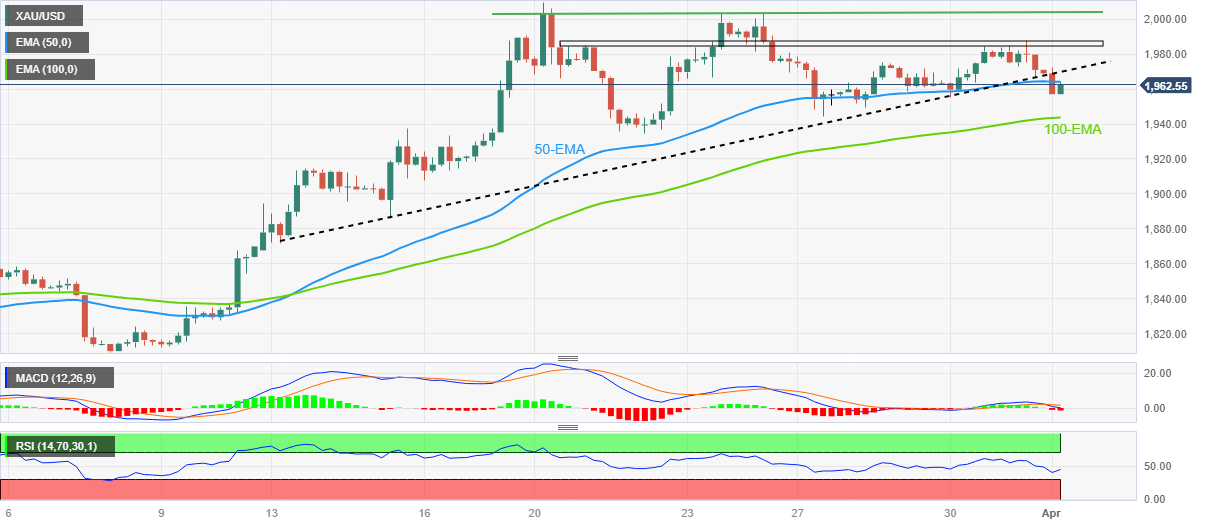
Gold price technical analysis
Gold price stays depressed in the last two consecutive weeks after witnessing rejection from the $2,000 threshold. The metal’s latest weakness, however, justifies a downside break of of the 50-bar Exponential Moving Average (EMA), as well as a three-week-old ascending trend line.
It’s worth noting that the bearish signals from the Moving Average Convergence and Divergence (MACD) indicator join downbeat prints of the Relative Strength Index (RSI) line, placed at 14, to keep Gold sellers hopeful.
However, the 100-EMA level surrounding $1,943 and the $1,900 round figure could test the XAU/USD bears during the quote’s latest weakness, not to forget mentioning the latest swing low surrounding $1,957.
On the contrary, the 50-EMA and support-turned-resistance line, respectively near $1,965 and $1,970, guard the quote’s immediate upside ahead of a fortnight-long horizontal area surrounding $1,985-87. Following that, the all-important $2,000 mark will gain the Gold buyer’s attention.
In a case where the XAU/USD remains firmer past $2,000, the previous monthly high of around $2,010 and the $2,050 threshold could test the Gold buyers before directing them to the last yearly peak of around $2,070.
Gold price: Four-hour chart
Trend: Further downside expected
Author

Anil Panchal
FXStreet
Anil Panchal has nearly 15 years of experience in tracking financial markets. With a keen interest in macroeconomics, Anil aptly tracks global news/updates and stays well-informed about the global financial moves and their implications.