Gold price remains stuck in multi-day-old trading range near all-time peak
- Gold price continues to draw support from persistent worries about Trump’s tariff plans.
- The emergence of fresh USD selling and inflation concerns also underpin the XAU/USD.
- Hawkish Fed expectations keep a lid on further gains for the non-yielding yellow metal.

Gold price (XAU/USD) continues with its struggle to gain any meaningful traction and remains confined in a multi-day-old trading range through the first half of the European session on Monday. Investors remain worried that US President Donald Trump's trade tariffs would trigger a global trade war, which, in turn, continues to act as a tailwind for the safe-haven bullion. Furthermore, worries that Trump's protectionist policies would boost inflation further benefit the commodity's status as a hedge against rising prices.
Meanwhile, worries about the US consumer health and economic growth outlook drag the US Dollar (USD) to its lowest level since December 10. This, along with geopolitical tensions, turn out to be other factors underpinning the Gold price. However, the growing acceptance that the Federal Reserve (Fed) will keep interest rates higher for longer amid sticky inflation caps the upside for the non-yielding yellow metal. Traders also opt to wait for the release of the US Personal Consumption Expenditures (PCE) Price Index on Friday.
Gold price struggles for a firm near-term direction; bullish potential seems intact
- Concerns about the potential economic fallout from US President Donald Trump's tariff plans assisted the safe-haven Gold price in registering gains for the eighth straight week and hit a fresh record high last week.
- Trump imposed a 25% tariff on steel and aluminum, and an additional 10% tariff on Chinese imports since taking office, and said last week that he would announce fresh tariffs over the next month or sooner.
- Data released on Friday fueled worries about the US growth outlook and dragged the US Dollar to its lowest level since December 10, which turns out to be another factor underpinning demand for the commodity.
- The flash S&P Global US Composite PMI dropped to 50.4 in February, from 52.7 in January, pointing to a weaker expansion in overall business activity across the private sector amid worries about Trump's tariff plans.
- Separately, the University of Michigan reported that its US Consumer Sentiment Index dropped more than expected, to a 15-month low level of 64.7 in February compared to the previous month's final reading of 71.7.
- Moreover, households saw inflation surging to 4.3% - the highest since November 2023 - over the next year, which turns out to be another factor that benefits the precious metal's status as a hedge against rising prices.
- Stronger US consumer inflation figures, along with hawkish FOMC minutes, suggest that the Federal Reserve will keep rates steady for an extended period and act as a headwind for the non-yielding yellow metal.
- The release of the US Personal Consumption Expenditures (PCE) Price Index on Friday will play a key role in influencing market expectations about the Fed's rate outlook and provide a fresh impetus to the XAU/USD.
- This week's US economic docket also features the release of Prelim US Q4 GDP print and Durable Goods Orders on Thursday, which, along with speeches by influential FOMC members, will drive the USD demand.
Gold price remains confined in a familiar range amid slightly overbought daily RSI
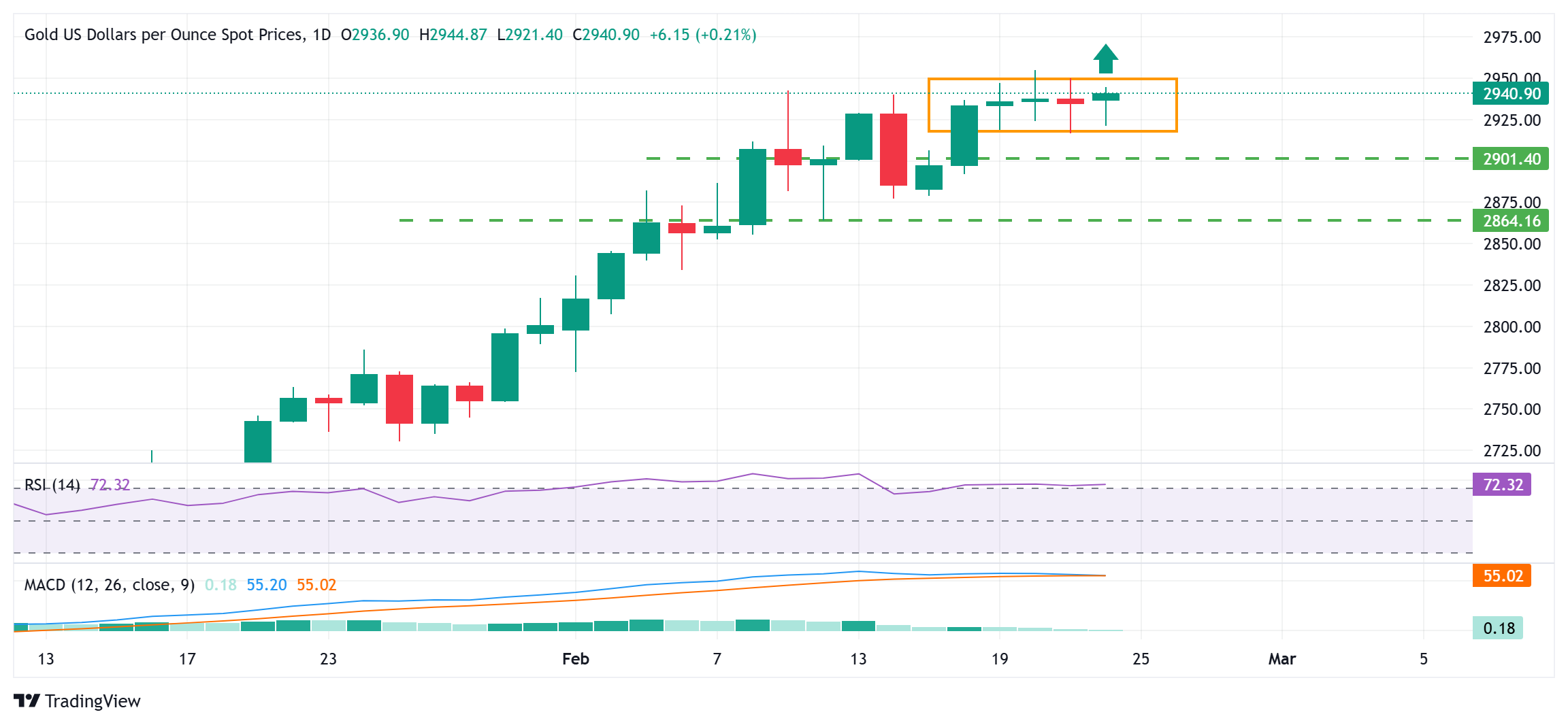
From a technical perspective, the daily Relative Strength Index (RSI) holds above the 70 mark and points to slightly overbought conditions. This might hold back traders from placing fresh bullish bets around the Gold price, which supports prospects for an extension of the range-bound price action. That said, some follow-through buying beyond the $2,950-2,955 area, or the all-time peak, would be seen as a fresh trigger for bulls and assist the XAU/USD to build on its recent well-established uptrend witnessed over the past two months or so.
Meanwhile, any corrective pullback might continue to attract some dip-buyers around the $2,920-2,915 region, or the lower end of a multi-day-old trading range. This is followed by the $2,900 mark and support near the $2,880 region, which if broken decisively could drag the Gold price to the $2,860-2,855 area en route to the $2,834 zone and eventually to the $2,800 mark.
Interest rates FAQs
Interest rates are charged by financial institutions on loans to borrowers and are paid as interest to savers and depositors. They are influenced by base lending rates, which are set by central banks in response to changes in the economy. Central banks normally have a mandate to ensure price stability, which in most cases means targeting a core inflation rate of around 2%. If inflation falls below target the central bank may cut base lending rates, with a view to stimulating lending and boosting the economy. If inflation rises substantially above 2% it normally results in the central bank raising base lending rates in an attempt to lower inflation.
Higher interest rates generally help strengthen a country’s currency as they make it a more attractive place for global investors to park their money.
Higher interest rates overall weigh on the price of Gold because they increase the opportunity cost of holding Gold instead of investing in an interest-bearing asset or placing cash in the bank. If interest rates are high that usually pushes up the price of the US Dollar (USD), and since Gold is priced in Dollars, this has the effect of lowering the price of Gold.
The Fed funds rate is the overnight rate at which US banks lend to each other. It is the oft-quoted headline rate set by the Federal Reserve at its FOMC meetings. It is set as a range, for example 4.75%-5.00%, though the upper limit (in that case 5.00%) is the quoted figure. Market expectations for future Fed funds rate are tracked by the CME FedWatch tool, which shapes how many financial markets behave in anticipation of future Federal Reserve monetary policy decisions.
Author

Haresh Menghani
FXStreet
Haresh Menghani is a detail-oriented professional with 10+ years of extensive experience in analysing the global financial markets.