Gold price explores past $3,400 as Trump-Powell clash sparks Fed independence fears
- Gold hits fresh all-time high as Trump attacks Powell, calling him “a major loser” for delaying rate cuts.
- DXY plunges to 97.92 as Fed independence is questioned and stagflation risks remain in focus.
- Traders brace for key Fed speeches this week from Jefferson, Harker, and Kashkari amid growing policy uncertainty.

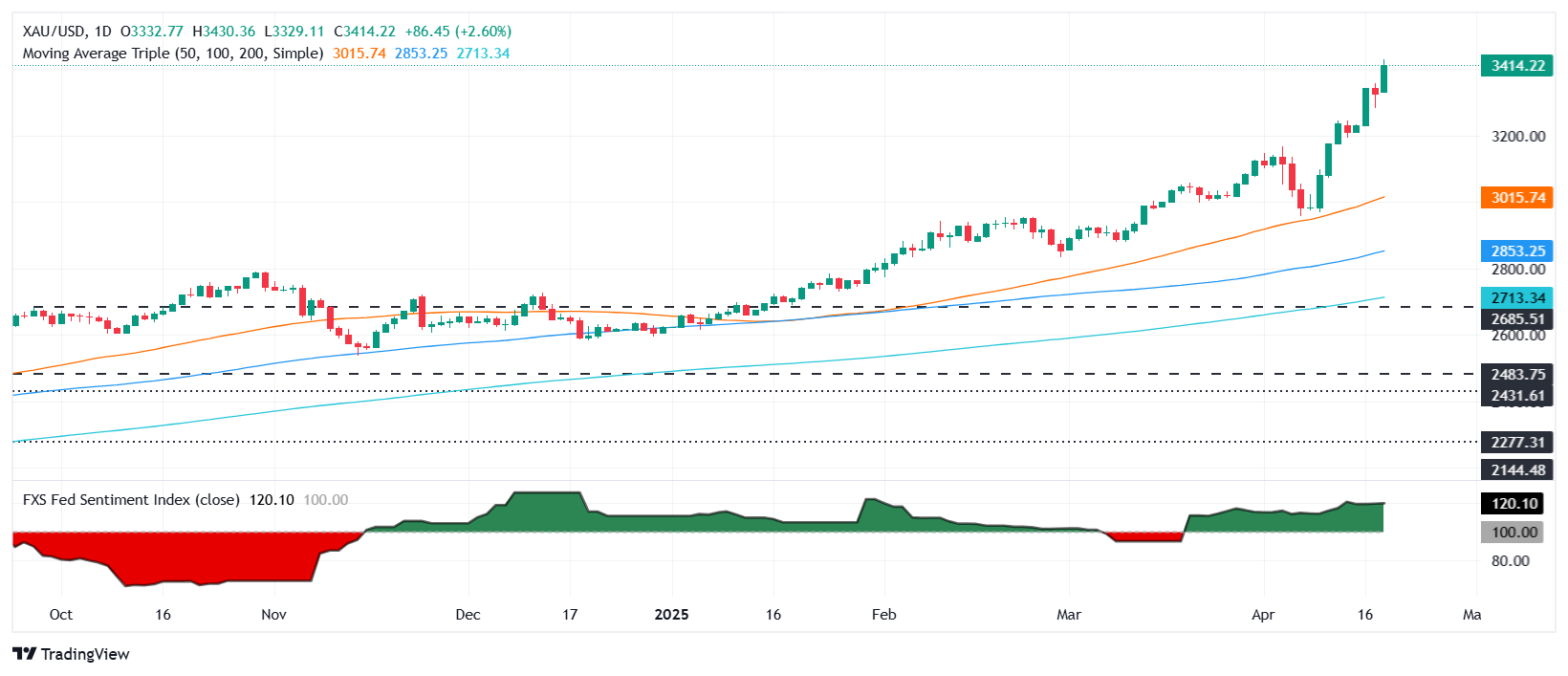
Gold price begins the week on a higher note, gaining over 2.56% and refreshing a previous record high as the precious metal hits $3,430 on uncertainty about comments that threat to curtail the Federal Reserve’s (Fed) independence. At the time of writing, XAU/USD trades at $3,419 after hitting a daily low of $3,329.
Demand for bullion has increased as United States (US) President Donald Trump continues to exert pressure on the Fed. He called Fed Chair Jerome Powell a “major loser” and said he is always too late to reduce borrowing costs.
Last week, Powell said the US central bank is in wait-and-see mode and even flagged the chance of a stagflationary scenario, acknowledging, “We may find ourselves in the challenging scenario in which our dual-mandate goals are in tension.”
Growing tensions between Trump and Powell, along with controversial trade policies, weighed on the Greenback, which, according to the US Dollar Index (DXY), has fallen to three-year lows of 97.92.
Data-wise, the US economic docket is absent, though it would gather traction mainly supported by Fed speakers. Vice-Chair Philip Jefferson, Philadelphia Fed Patrick Harker, and Minneapolis Neel Kashkari are all set to deliver remarks on Tuesday.
Daily digest market movers: Gold price soars to record high amid high US yields
- The US 10-year Treasury yield rises four basis points to 4.373% yet fails to cap Bullion prices.
- US real yields followed suit, climbing three and a half bps to 2.14%, as shown by the US 10-year Treasury Inflation-Protected Securities yields
- In rates markets, money market traders have priced in 94.5 basis points of Fed rate cuts by the end of 2025, with the first cut expected in July.
- Data-wise, this week the US economic docket will be packed by a flurry of Fed speakers, S&P Global Flash PMIs, Durable Goods Orders and the University of Michigan Consumer Sentiment final reading.
XAU/USD technical outlook: Gold price poised to challenge $3,450 in the near term
The uptrend in Gold prices remains in play, even with the chance of testing the $3,500 level touted by Citi to be reached in the next three months. The Relative Strength Index (RSI) turned overbought, an indication that the precious metal could be set for a pullback, but a breach of the latest peak suggests that bulls could reach $3,450 in the near term.
Conversely, if XAU/USD tumbles below $3,400, the first support would be the April 17 high of $3,357, followed by $3,300.
Gold FAQs
Gold has played a key role in human’s history as it has been widely used as a store of value and medium of exchange. Currently, apart from its shine and usage for jewelry, the precious metal is widely seen as a safe-haven asset, meaning that it is considered a good investment during turbulent times. Gold is also widely seen as a hedge against inflation and against depreciating currencies as it doesn’t rely on any specific issuer or government.
Central banks are the biggest Gold holders. In their aim to support their currencies in turbulent times, central banks tend to diversify their reserves and buy Gold to improve the perceived strength of the economy and the currency. High Gold reserves can be a source of trust for a country’s solvency. Central banks added 1,136 tonnes of Gold worth around $70 billion to their reserves in 2022, according to data from the World Gold Council. This is the highest yearly purchase since records began. Central banks from emerging economies such as China, India and Turkey are quickly increasing their Gold reserves.
Gold has an inverse correlation with the US Dollar and US Treasuries, which are both major reserve and safe-haven assets. When the Dollar depreciates, Gold tends to rise, enabling investors and central banks to diversify their assets in turbulent times. Gold is also inversely correlated with risk assets. A rally in the stock market tends to weaken Gold price, while sell-offs in riskier markets tend to favor the precious metal.
The price can move due to a wide range of factors. Geopolitical instability or fears of a deep recession can quickly make Gold price escalate due to its safe-haven status. As a yield-less asset, Gold tends to rise with lower interest rates, while higher cost of money usually weighs down on the yellow metal. Still, most moves depend on how the US Dollar (USD) behaves as the asset is priced in dollars (XAU/USD). A strong Dollar tends to keep the price of Gold controlled, whereas a weaker Dollar is likely to push Gold prices up.
Author

Christian Borjon Valencia
FXStreet
Markets analyst, news editor, and trading instructor with over 14 years of experience across FX, commodities, US equity indices, and global macro markets.

















