Gold price recovers early lost ground, climbs back closer to $2,800 amid risk-off mood
- Gold price attracts fresh buyers following an intraday slide to the $2,772 area.
- Concerns over Trump’s new trade tariffs offer support to the XAU/USD pair.
- Broad-based USD strength might cap the commodity ahead of the US ISM PMI.

Gold price (XAU/USD) recovers a major part of intraday losses and climbs back closer to the $2,800 mark during the first half of the European session on Monday. The safe-haven commodity remains within striking distance of the all-time peak touched on Friday and continues to draw support from concerns about the potential economic fallout from US President Donald Trump's trade tariffs.
This, along with trade war fears, temper investors' appetite for riskier assets, and acts as a tailwind for the safe-haven Gold price. Furthermore, speculations that Trump's protectionist policies would boost inflation could further benefit the precious metal's status as a hedge against rising prices. This, in turn, suggests that the path of least resistance for the bullion remains to the upside.
Meanwhile, the US Dollar (USD) jumps back closer to over a two-year top in reaction to Trump's decision to impose tariffs on Canada, Mexico, and China. Adding to this, speculations that the Federal Reserve (Fed) could delay cutting interest rates for some time this year, amid a rise in prices and surging consumer spending, might contribute to capping gains for the non-yielding Gold price.
Gold price attracts dip-buyers amid trade war fears; sliding US bond yields
- The US Dollar (USD) spiked in reaction to US President Donald Trump's move to impose a 25% tariff on Canadian and Mexican imports, and a 10% tariff on goods from China, which, in turn, weighed heavily on the Gold price.
- The US Commerce Department reported on Friday that inflation closed out 2024 on a strong note and consumer spending surged in December, pushing back expectations for more aggressive easing by the Federal Reserve.
- The Personal Consumption Expenditures (PCE) Price Index edged higher to 2.6% on a yearly basis in December from 2.4%, while the core gauge climbed 2.8%, matching November's reading and consensus estimates.
- Moreover, investors remain worried that Trump's new tariffs, if sustained, could significantly worsen inflation in the US and validate hawkish Fed expectations, further undermining the non-yielding yellow metal.
- US Treasury Secretary Scott Bessent, who pushed for new universal tariffs on US imports to start at 2.5% and rise gradually, said that tariffs are inflationary and would continue to strengthen the US Dollar.
- Trump's demand for lower interest rates, along with the prospects for further policy easing by the Fed, keeps the US Treasury bond yields depressed and could help limit any meaningful downside for the commodity.
- Furthermore, worries that Trump's new tariffs could impact the global economy temper investors' appetite for riskier assets and warrant some caution before placing bearish bets around the safe-haven XAU/USD.
- Traders now look to this week's important US macro data scheduled for the beginning of a new month, starting with the release of the ISM Manufacturing PMI, to determine the near-term trajectory for the precious metal.
Gold price bulls now await a move and aceptance beyond the $2,800 mark
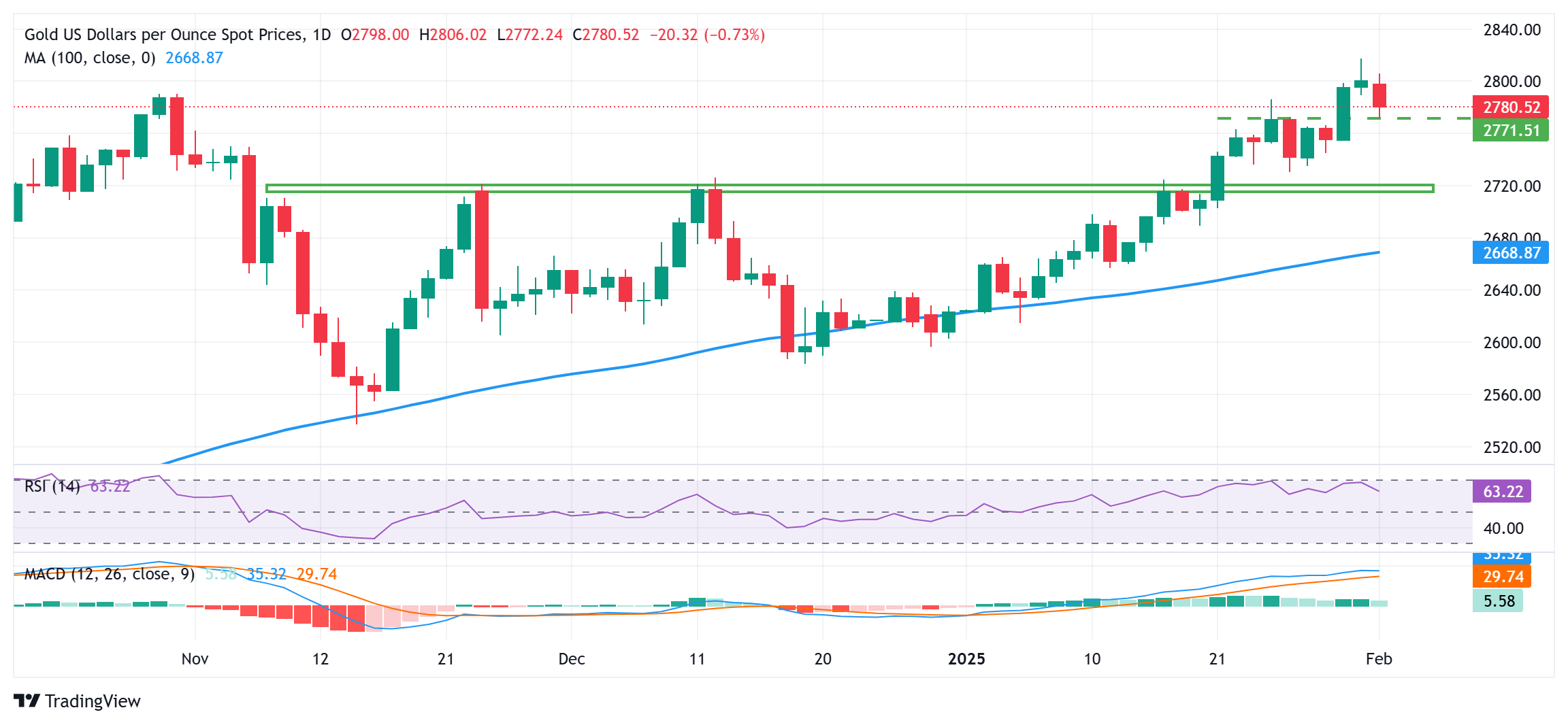
From a technical perspective, the intraday slide finds some support near the $2,772 horizontal resistance breakpoint. The said area should now act as a key pivotal point, which if broken might prompt some technical selling and drag the Gold price to the next relevant support near the $2,755 region. The corrective decline could extend further towards the $2,740 intermediate support en route to the $2,725-2,720 area. This is followed by the $2,700 round figure, which if broken decisively could pave the way for deeper losses.
On the flip side, the $2,790-2,800 zone now seems to act as an immediate hurdle ahead of the record high, around the $2,817 region. Given that oscillators on the daily chart are holding comfortably in positive territory and are still away from being in the overbought zone, some follow-through buying will be seen as a fresh trigger for bullish traders. This, in turn, will set the stage for an extension of the recent well-established uptrend from the December monthly swing low.
Tariffs FAQs
Tariffs are customs duties levied on certain merchandise imports or a category of products. Tariffs are designed to help local producers and manufacturers be more competitive in the market by providing a price advantage over similar goods that can be imported. Tariffs are widely used as tools of protectionism, along with trade barriers and import quotas.
Although tariffs and taxes both generate government revenue to fund public goods and services, they have several distinctions. Tariffs are prepaid at the port of entry, while taxes are paid at the time of purchase. Taxes are imposed on individual taxpayers and businesses, while tariffs are paid by importers.
There are two schools of thought among economists regarding the usage of tariffs. While some argue that tariffs are necessary to protect domestic industries and address trade imbalances, others see them as a harmful tool that could potentially drive prices higher over the long term and lead to a damaging trade war by encouraging tit-for-tat tariffs.
During the run-up to the presidential election in November 2024, Donald Trump made it clear that he intends to use tariffs to support the US economy and American producers. In 2024, Mexico, China and Canada accounted for 42% of total US imports. In this period, Mexico stood out as the top exporter with $466.6 billion, according to the US Census Bureau. Hence, Trump wants to focus on these three nations when imposing tariffs. He also plans to use the revenue generated through tariffs to lower personal income taxes.
Author

Haresh Menghani
FXStreet
Haresh Menghani is a detail-oriented professional with 10+ years of extensive experience in analysing the global financial markets.