Gold Price Analysis: A breach of $1775 critical support exposes XAU/USD to $1750 – Confluence Detector

Gold breached the critical $1775 support starting out a fresh week and refreshed four-month lows below $1770, as last week’s sell-off resumed. The yellow metal remains on track to book the worst month in four years after yielding a weekly close below $1800 for the first time since mid-July.
The risk rally in the global stocks amid coronavirus vaccine-led expectations of a faster economic turnaround weighs on gold’s safe-haven appeal. Further, month-end flows combined with reduced need for more stimulus also adds to the vulnerability in gold.
How is gold positioned on the charts heading into the NFP week?
Gold: Key resistances and supports
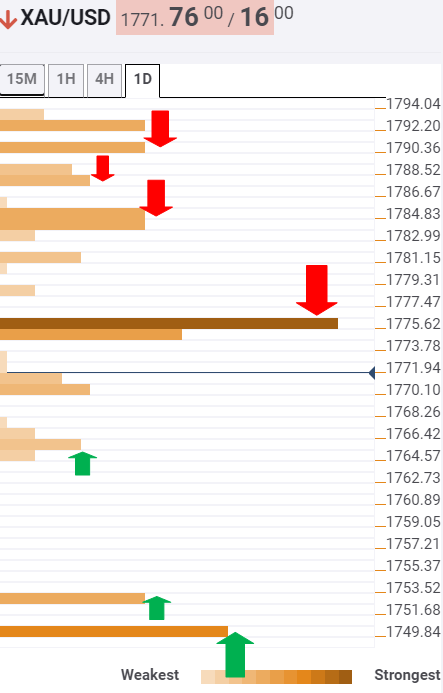
The Technical Confluences Indicator shows that the XAU/USD pair remains exposed to further downside risks amid a lack of healthy support levels.
The four-month lows of $1765 will challenge the bears’ commitment once again, opening floors for a test of the Pivot Point one-day S2 at $1752.50.
The next critical cushion is seen at $1750, which is the Pivot Point one-week S1.
Alternatively, recapturing the strong $1775 resistance is critical to reviving the recovery momentum. That level is the intersection of the SMA10 15-minutes, Pivot Point one-month S3 and Friday’s low.
Further up, the XAU bulls could face stiff resistance at $1783, where the Fibonacci 23.6% one-day coincides with the Bollinger Band one-day Lower.
The Fibonacci 38.2% one-day at $1790 could guard the further upside ahead of the SMA5 four-hour barrier aligned at $1787.
Here is how it looks on the tool
About Confluence Detector
The TCI (Technical Confluences Indicator) is a tool to locate and point out those price levels where there is a congestion of indicators, moving averages, Fibonacci levels, Pivot Points, etc. Knowing where these congestion points are located is very useful for the trader, and can be used as a basis for different strategies.
Author

Dhwani Mehta
FXStreet
Residing in Mumbai (India), Dhwani is a Senior Analyst and Manager of the Asian session at FXStreet. She has over 10 years of experience in analyzing and covering the global financial markets, with specialization in Forex and commodities markets.