Gold holds below $3,400 as trade tensions rise, Fed rate cut bets grow
- Gold stalls below the $3,400 barrier but clings to intraday gains amid trade tension and Fed rate cut bets.
- Global trade tensions flare up again after US President Trump imposes new tariffs, including 100% duties on semiconductors and higher levies on Indian goods.
- US Gold demand drops 34% in Q2, but robust ETF inflows and strong Bullion exports keep the market fundamentally supported.

Gold (XAU/USD) continues to consolidate within this week’s established range, trading near $3,380 at the start of the American trading session following mixed US labor market data. The metal saw early gains during the Asian session, peaking at $3,397, but momentum faded as bulls struggled to overcome the $3,400 psychological barrier.
Gold's sideways price action echoes the broader tone of indecision seen all week, with bulls struggling to gain traction, while bears show little urgency to drag prices lower. That said, downside appears limited as the metal remains underpinned by a confluence of supportive factors, including safe-haven flows amid escalating global trade tensions, subdued US Treasury yields, a weaker US Dollar, and growing speculation that the Federal Reserve (Fed) will lower interest rates at its next meeting in September.
Trade tensions resurfaced late Wednesday after US President Trump announced additional levies, including a 100% tariff on imported semiconductors, excluding firms with US-based production, and a doubling of tariffs on Indian goods to 50%, citing India’s continued purchases of Russian Oil. These aggressive measures come on top of the broader “Liberation Day” tariffs, which officially came into effect on Thursday. Signed via executive order last week, the reciprocal tariffs target imports from over 60 countries, with duties ranging from a baseline 10% to as high as 50%, scaled according to perceived trade imbalances.
Market movers: Gold supported by Fed cut bets, steady yields, and central bank demand
- US economic data delivered a mixed signal on Thursday. Initial Jobless Claims rose to 226K, higher than the forecast of 221K and up from the previous reading of 218K, suggesting labor market cooling. Nonfarm Productivity for the second quarter preliminary reading increased by 2.4%, just below the expected 2.5%, but sharply higher than the -1.8% print in Q1. Meanwhile, Unit Labor Costs eased to 1.6%, slightly above the 1.5% forecast but well below the 6.9% increase seen in the first quarter.
- Markets are increasingly pricing in a September rate cut by the Fed, a shift driven by a string of soft US economic releases. A weaker-than-expected Nonfarm Payrolls (NFP) report, coupled with a disappointing ISM Services PMI, has fueled speculation that the Fed will adopt a more accommodative stance to counter mounting signs of a slowdown. According to the CME FedWatch Tool, the probability of a rate cut next month now exceeds 90%. This has kept US Treasury yields under pressure and added to downward momentum in the US Dollar, both of which remain supportive for non-yielding assets like Gold.
- US Treasury yields held steady on Thursday, with the 10-year near 4.28% and the 30-year slightly softer at 4.81%, offering little fresh direction for Gold. Lower yields continue to support demand for non-yielding assets amid ongoing macro uncertainty.
- According to a Bloomberg report, the People’s Bank of China extended its Gold buying streak for a ninth consecutive month in July, adding 60,000 troy ounces and bringing total purchases since November to around 36 tonnes, according to data released Thursday. The sustained accumulation highlights continued efforts to diversify away from the US Dollar and has been a key driver of Bullion’s 30% rally this year.
- A report published on August 6 by the World Gold Council (WGC) showed that US Gold demand fell 34% QoQ to 124 tonnes in Q2, but this was offset by strong ETF inflows. North American ETFs attracted $21 billion in H1, with another $2 billion added in July, putting 2025 on track for the second-strongest year on record. Meanwhile, US Bullion exports are off to a strong start, with nearly 268 tonnes shipped through May, well on pace to exceed 2024 levels.
- Fed officials struck a cautious tone on Wednesday, signaling growing concern over recent data. Fed Governor Lisa Cook said the latest jobs report was “concerning” and urged we must be cautious and humble when looking at data. San Francisco Fed President Mary Daly said the labor market has softened and warned that additional slowing would be “unwelcome.” While she downplayed the inflationary impact of tariffs, Daly noted that policy will likely need to be adjusted in the coming months, adding that the Fed must recalibrate its stance to match evolving risks and that it still has more work to do to bring inflation back to 2%.
Technical analysis: XAU/USD holds above 50-day SMA as bulls eye $3,400 breakout
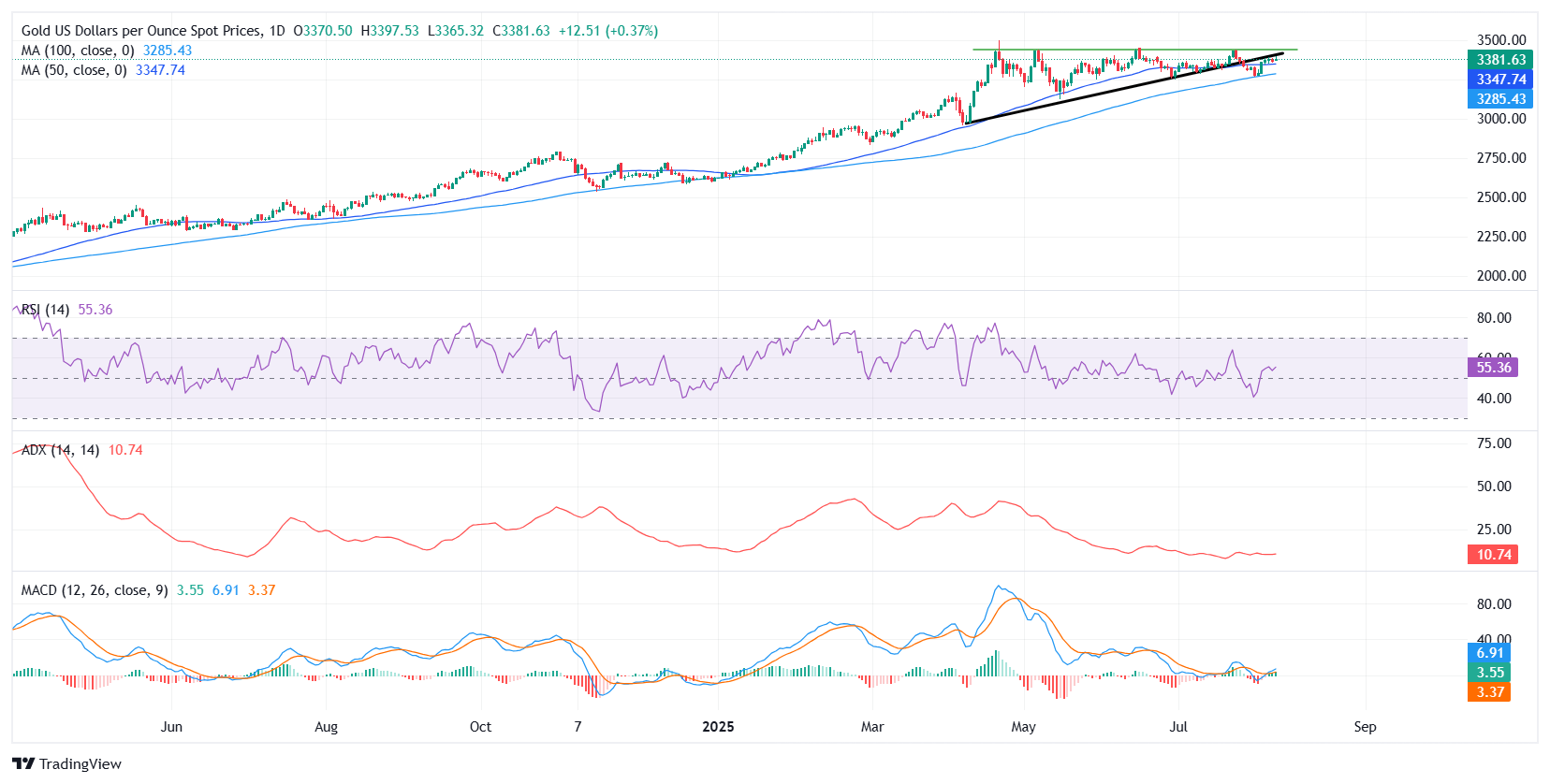
From a technical perspective, Gold remains subdued below the lower boundary of the ascending triangle, signaling a lack of strong bullish conviction in the near term. Last week, the price briefly fell below this support line but found a strong floor near the 100-day Simple Moving Average (SMA) around $3,285. Since then, Gold has recovered and is now holding above the 50-day SMA, which acts as immediate support and helps maintain the broader uptrend.
The Relative Strength Index (RSI) on the daily chart is near 55, showing a balanced market with a slight bullish tilt, and the Moving Average Convergence Divergence (MACD) indicator has turned positive, hinting at improving momentum. However, the Average Directional Index (ADX) remains low, suggesting the current trend lacks strength.
A decisive daily close above the $3,390 to $3,400 resistance band would invalidate the triangle breakdown and open the door for a potential run toward $3,450, with all-time highs around $3,500 back on the radar.
Author

Vishal Chaturvedi
FXStreet
I am a macro-focused research analyst with over four years of experience covering forex and commodities market. I enjoy breaking down complex economic trends and turning them into clear, actionable insights that help traders stay ahead of the curve.