Gold sinks as blowup NFP shatters Fed cut narrative
- Gold tumbles 0.80% to $3,332 as robust jobs data lifts US Dollar.
- Unemployment Rate nears 4%, challenging weak hiring seen in ADP report.
- Traders now price in only two Fed cuts in 2025, down from 65 bps earlier.
- Bessent: Fed rate call is theirs; Powell’s successor to be picked in fall.

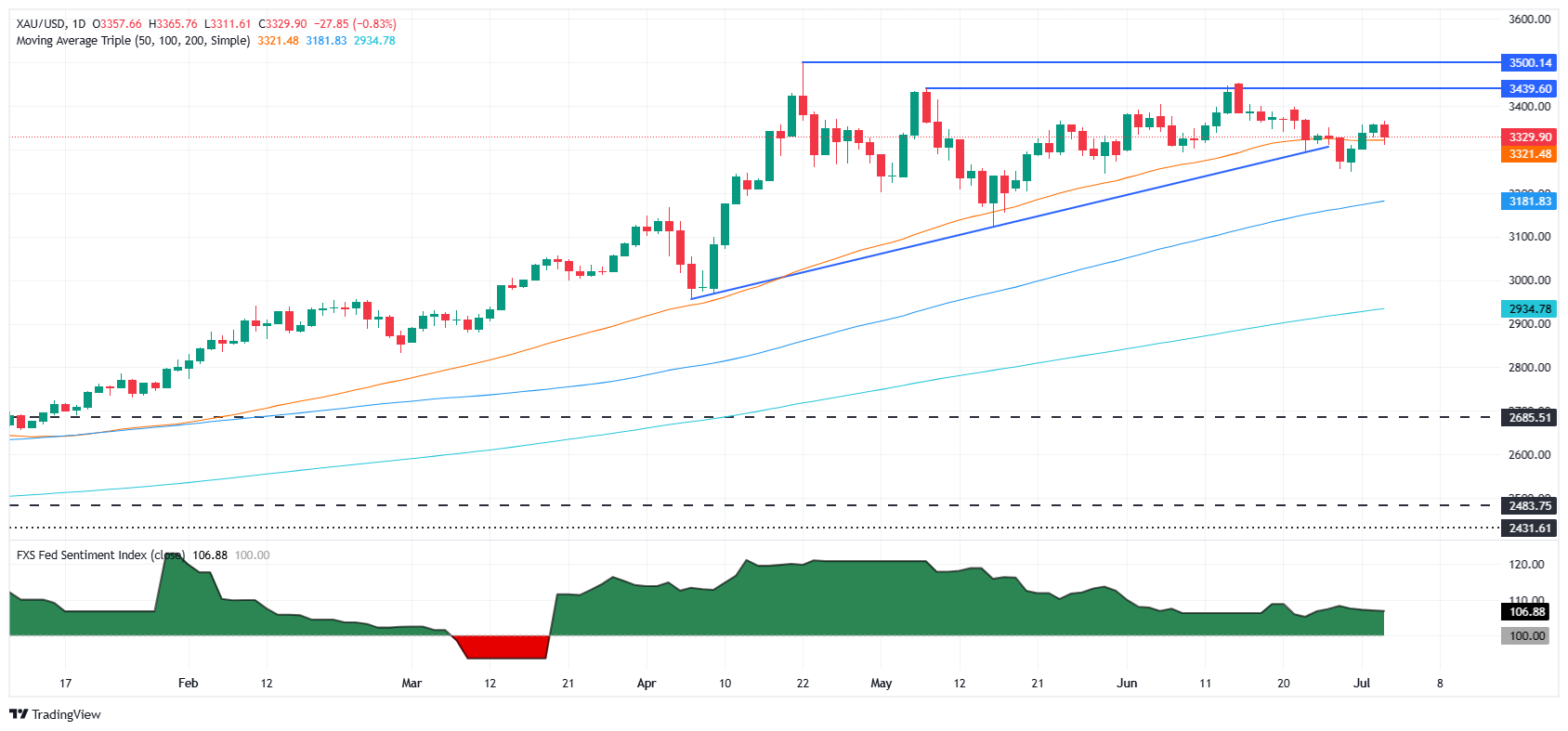
Gold price fell 0.80% on Thursday as a strong US Nonfarm Payrolls report strengthened the US Dollar, leading market participants to believe it unlikely that the Fed could cut rates at the July meeting. At the time of writing, the XAU/USD trades at $3,332, having reached a daily high of $3,365.
June’s US employment report crushed estimates and also exceeded May’s figures. Worth noting that the Unemployment Rate fell toward the 4% threshold, indicating that the labor market remains solid. The data questions Wednesday’s ADP National Employment Change report, which showed that private companies decreased hiring by -33K.
Consequently, the Greenback rose, underpinned by a jump in US Treasury yields. Money market futures data showed that investors are pricing in two rate cuts by the end of 2025, contrary to 65 basis points (bps) of easing, priced at the start of July.
The data reaffirmed the Federal Reserve's (Fed) stance to hold rates flat until it sees signs of weakness in the labor market or a resumption of the deflationary process.
Aside from this, US Treasury Secretary Scott Bessent announced that more trade deals are expected to materialize, following the announcement of the Vietnam agreement. He added that the Fed is the one to decide on rates and hinted that the administration would begin working on Powell's replacement in the fall.
In the meantime, the US House of Representatives passed Trump’s “One Big Beautiful Bill” toward a final vote. The fiscal budget is expected to increase the US debt by $3.3 trillion over the next decade.
Daily digest market movers: Gold price retreats as US yields and US Dollar advance
- Gold price is on the defensive as US Treasury yields and the US Dollar rise. The US 10-year Treasury bond yield is up five basis points a 4.334%. US real yields are also up five bps at 2.034%. Furthermore, the US Dollar Index (DXY), which tracks the Greenback’s performance against a basket of currencies, is up 0.34% at 97.10.
- The US Bureau of Labor Statistics (BLS) reported that the economy added 147,000 jobs in June, slightly above expectations of 110,000 and up from May’s revised figure of 144,000. The Unemployment Rate declined to 4.1% from 4.2%. The data supports Fed Chair Jerome Powell’s cautious, wait-and-see approach as the central bank monitors the potential inflationary impact of trade tariffs.
- Initial Jobless Claims for the week ending June 28 fell to 233,000, below the expected 240,000 and lower than the previous week’s reading, signaling a resilient labor market. Meanwhile, the ISM Services PMI rose to 50.8 in June from 49.9 in May, indicating the sector has returned to expansion territory.
- Aside from this, the US House of Representatives is likely to pass Donald Trump’s fiscal package bill on Thursday. Once done, this will allow Trump’s self-imposed deadline on July 4 to sign the bill.
- Atlanta Fed President Raphael Bostic said that he favors a wait-and-see stance to monetary policy due to uncertainty over economic policy. He added that increases to prices, tariff-related, could cause a jump in inflation readings over the next year.
- The World Gold Council said that central banks added 20 tonnes of the yellow metal in May, with Kazakhstan leading the way. The National Bank of Kazakhstan reported 7 tonnes, followed by the Central Bank of Turkey, which reported 6 tonnes, alongside the National Bank of Poland.
- Money markets suggest that traders are pricing in 50 basis points of easing toward the end of the year, according to Prime Market Terminal data.
XAU/USD technical outlook: Gold price trades sideways near $3,350
Gold price is poised to consolidate amid buyers’ lack of commitment to conquer the $3,400 figure despite price action still exhibiting a successive series of higher highs and higher lows. However, traders must clear the June 16 high at $3,452 if they are to challenge the $3,500 record high figure in the near term.
Conversely, if XAU/USD tumbles below $3,300, the next support would be the June 30 swing low of $3,246.
Economic Indicator
Nonfarm Payrolls
The Nonfarm Payrolls release presents the number of new jobs created in the US during the previous month in all non-agricultural businesses; it is released by the US Bureau of Labor Statistics (BLS). The monthly changes in payrolls can be extremely volatile. The number is also subject to strong reviews, which can also trigger volatility in the Forex board. Generally speaking, a high reading is seen as bullish for the US Dollar (USD), while a low reading is seen as bearish, although previous months' reviews and the Unemployment Rate are as relevant as the headline figure. The market's reaction, therefore, depends on how the market assesses all the data contained in the BLS report as a whole.
Read more.Last release: Thu Jul 03, 2025 12:30
Frequency: Monthly
Actual: 147K
Consensus: 110K
Previous: 139K
Source: US Bureau of Labor Statistics
America’s monthly jobs report is considered the most important economic indicator for forex traders. Released on the first Friday following the reported month, the change in the number of positions is closely correlated with the overall performance of the economy and is monitored by policymakers. Full employment is one of the Federal Reserve’s mandates and it considers developments in the labor market when setting its policies, thus impacting currencies. Despite several leading indicators shaping estimates, Nonfarm Payrolls tend to surprise markets and trigger substantial volatility. Actual figures beating the consensus tend to be USD bullish.
Author

Christian Borjon Valencia
FXStreet
Markets analyst, news editor, and trading instructor with over 14 years of experience across FX, commodities, US equity indices, and global macro markets.
















