Gold dives below $4,100 as blowout NFP underpins Fed hike odds
- Gold drops nearly 1% to $4,060 after peaking at $4,106.
- US payrolls surge 165K versus 65K expected, Unemployment falls to 4.1%.
- December Fed hike odds jump to 77% as US Dollar reclaims 102.00.

Gold price retreats after peaking at $4,106, drifting lower nearly 1% on Friday as the US employment report crushed forecasts and increased the chances that the Federal Reserve (Fed) could increase rates at the December meeting. The XAU/USD trades at $4,060 at the time of writing.
XAU/USD reverses course on strong US jobs data; eyes on next week’s US CPI
Sentiment remains positive as investors bought the dip in US equities with October Nonfarm Payrolls (NFP) hurdling forecasts at 65K to reach 165K. NFP figures from a month ago were upwardly revised from 29K to 60K as well. Consequently, the Unemployment Rate dipped from 4.2% to 4.1% as employers added jobs across a broad range of sectors.
This US jobs data and an upbeat US Consumer Sentiment report from the University of Michigan show that the economy remains resilient despite volatility in energy prices. November’s Consumer Sentiment Index edged up from 48 in October to 51, while inflation expectations for one year cooled from 4.7% to 4.3%.
The US Dollar Index (DXY), which tracks the performance of the buck against a basket of six currencies, is up 0.62% above the 102.00 threshold, a level reclaimed after the NFP report.
Investors had increased their hawkish bets that the Federal Reserve (Fed) will hike at the December meeting, with odds edging up from 67% on Thursday to 77%, according to the CME FedWatch Tool.
St. Louis Fed President Alberto Musalem said that “people remain concerned about inflation at the current level,” adding that inflation expectations remain anchored and that current excess inflation is due to energy shocks and the AI buildout.
Despite this, US Treasury yields retreated from intraday highs with the 10-year T-note yielding 4.840%, up 0.1%.
In the meantime, negotiations between the US and Iran continued, with newswires reporting that there’s a chance of an agreement. However, the Houthis continued their attack on Saudi Arabia.
Despite ongoing talks, reports say Tehran is preparing for a possible escalation. Al Arabiya, citing Israeli press, reported that “America is planning an intensive and rapid operation against Iran to reach a nuclear agreement on better terms.”
Aside from this, Gold traders’ eyes are on next week's US inflation figures, jobless claims, and Fed officials' comments.
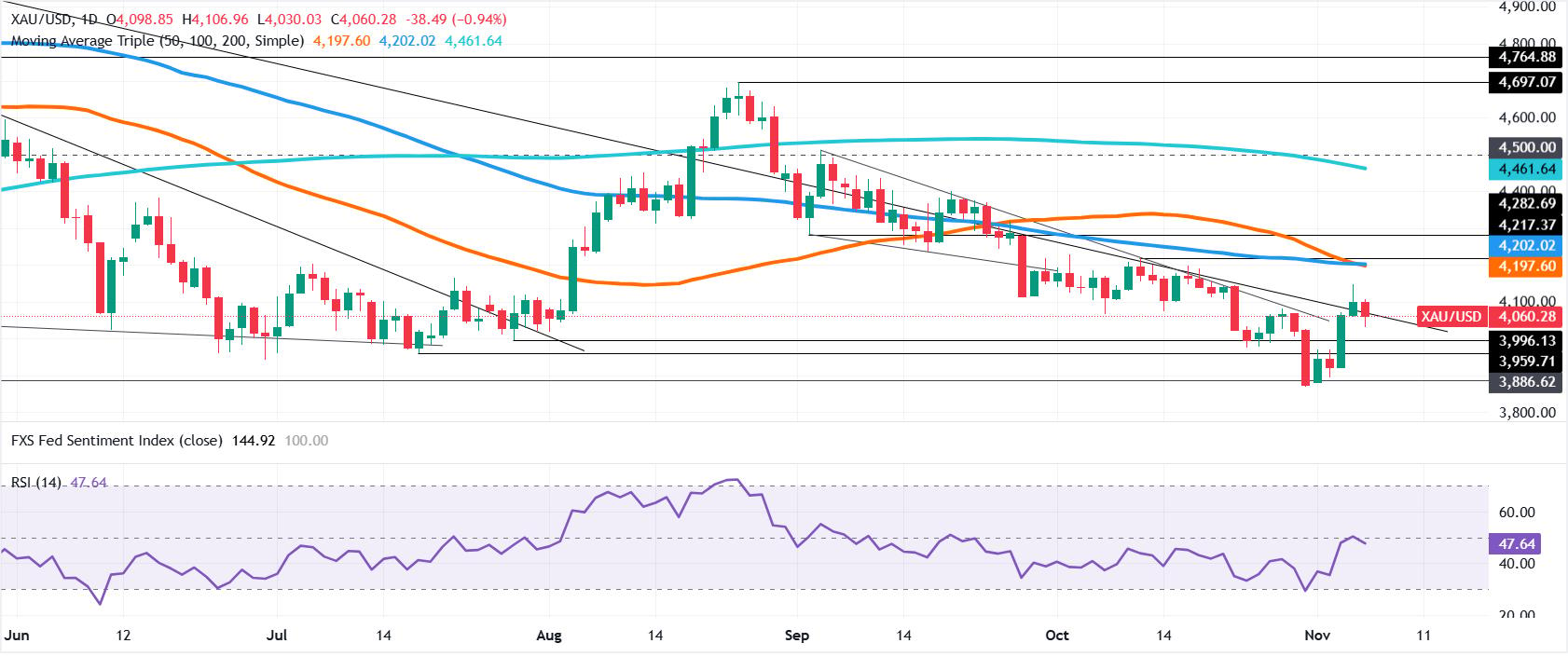
XAU/USD technical outlook: Gold struggles at $4,100 and retreats
Gold prices have retreated after hitting a weekly high of $4,146 on Thursday. Since then, XAU/USD has fallen below $4,100, with the bias remaining unclear but tilted to the downside. Momentum has shifted bearish with the Relative Strength Index (RSI) making a U-turn near its neutral level. Therefore, the yellow metal is expected to end the week near familiar levels, within the $4,050-$4,150 range, as it eyes next week’s US inflation data.
For a bullish continuation, the non-yielding metal must clear the confluence of the 100-day and 50-day Simple Moving Averages (SMAs), at $4,197 and $4,202, respectively. Once done, this opens the door to challenge $4,300.
If sellers want to regain control, Gold must fall below 4,000. A breach of the latter could exacerbate the downtrend with the next key support levels seen at the November 4 daily low at $3,919, followed by the October 30 year-to-date low at $3,879.
Gold FAQs
Gold has played a key role in human’s history as it has been widely used as a store of value and medium of exchange. Currently, apart from its shine and usage for jewelry, the precious metal is widely seen as a safe-haven asset, meaning that it is considered a good investment during turbulent times. Gold is also widely seen as a hedge against inflation and against depreciating currencies as it doesn’t rely on any specific issuer or government.
Central banks are the biggest Gold holders. In their aim to support their currencies in turbulent times, central banks tend to diversify their reserves and buy Gold to improve the perceived strength of the economy and the currency. High Gold reserves can be a source of trust for a country’s solvency. Central banks added 1,136 tonnes of Gold worth around $70 billion to their reserves in 2022, according to data from the World Gold Council. This is the highest yearly purchase since records began. Central banks from emerging economies such as China, India and Turkey are quickly increasing their Gold reserves.
Gold has an inverse correlation with the US Dollar and US Treasuries, which are both major reserve and safe-haven assets. When the Dollar depreciates, Gold tends to rise, enabling investors and central banks to diversify their assets in turbulent times. Gold is also inversely correlated with risk assets. A rally in the stock market tends to weaken Gold price, while sell-offs in riskier markets tend to favor the precious metal.
The price can move due to a wide range of factors. Geopolitical instability or fears of a deep recession can quickly make Gold price escalate due to its safe-haven status. As a yield-less asset, Gold tends to rise with lower interest rates, while higher cost of money usually weighs down on the yellow metal. Still, most moves depend on how the US Dollar (USD) behaves as the asset is priced in dollars (XAU/USD). A strong Dollar tends to keep the price of Gold controlled, whereas a weaker Dollar is likely to push Gold prices up.
Author

Christian Borjon Valencia
FXStreet
Markets analyst, news editor, and trading instructor with over 14 years of experience across FX, commodities, US equity indices, and global macro markets.

















