Gold retreats from intraday high, trades heavy below $3,330
- Gold edges lower on Tuesday, easing from an intraday high of $3,345 as increased risk appetite and a firmer US Dollar weigh on sentiment.
- A stable US Dollar and slightly lower Treasury yields are offering mixed signals for Gold, limiting strong directional moves during the American session.
- Technically, XAU/USD is trading below the $3,330 threshold, reinforcing a bearish bias and paving the way for further downside toward $3,300.

Gold (XAU/USD) edges lower during the American session on Tuesday, pressured by a firmer US Dollar and improved risk sentiment. The metal is trading near $3,320, close to the 12-day low marked during early Asian trade. Earlier in the day, Gold had briefly rebounded from overnight weakness following Monday’s White House summit between US President Donald Trump, Ukrainian President Volodymyr Zelenskyy, and key European leaders. While the talks signaled diplomatic unity, the lack of a ceasefire continues to keep geopolitical uncertainty elevated, providing some underlying support to safe-haven flows.
A stronger US Dollar is capping Gold's recovery attempts, while slightly lower Treasury yields after three days of gains are offering only limited support. Looking ahead, focus shifts to Wednesday’s release of the FOMC meeting minutes and the upcoming Jackson Hole Symposium, both of which could shape expectations for the Federal Reserve’s next policy move. Markets are still pricing in a rate cut in September, and any dovish rhetoric could help revive demand for non-yielding assets like Gold.
While markets welcomed signs of diplomatic coordination, the Trump-Zelenskyy summit offered little in the way of immediate breakthroughs, keeping investors on edge. Leaders pledged continued military and economic support for Ukraine, with talks centering around a proposed “coalition of the willing” to oversee future defense arrangements. President Trump revealed he had already spoken with Russian President Vladimir Putin and signaled early preparations for a potential trilateral summit. “It would be two presidents, plus myself,” he noted, referring to a possible meeting with both Zelenskyy and Putin. Trump also emphasized that the United States would work closely with European partners to establish long-term security guarantees for Ukraine.
Market movers: Dollar, yields pull back as focus turns to Fed Minutes
- The US Dollar Index (DXY), which measures the Greenback against a basket of six major currencies, is holding steady near 98.17 on Tuesday, after briefly rising to a four-day high of 98.32 during Asian trading hours.
- US Treasury yields are easing slightly on Tuesday. The benchmark 10-year yield is currently at 4.312% and the 30-year at 4.913%, both retreating from two-week highs reached on Monday.
- S&P Global Ratings reaffirmed the United States' long-term sovereign credit rating at AA+ with a stable outlook. The agency noted that recent increases in tariff revenue are helping to offset fiscal pressures caused by expanded government spending and earlier tax cuts. While fiscal challenges persist, the stable outlook reflects confidence in the US economy’s resilience.
- UBS has increased its Gold price outlook, forecasting $3,600 per ounce (up from $3,500) by the end of March 2026, and now expects prices to reach $3,700 per ounce by June and September 2026. This upward revision is rooted in mounting US macroeconomic risks, accelerating de-dollarization, and robust demand from ETFs and central banks. The bank anticipates global Gold demand rising 3% to 4,760 metric tons in 2025, the highest level since 2011
- Goldman Sachs also maintains a bullish long-term outlook on Gold, projecting prices could reach $3,700 by end‑2025 and $4,000 by mid‑2026, citing sustained demand from “conviction buyers” including central banks and long-term investors.
- The latest US economic data offers a mixed macro signal but remains consistent with a moderating growth narrative enough to keep rate cut expectations alive, though not urgent. Retail Sales came in firm, pointing to resilient consumer demand, but a dip in consumer sentiment and rising long-term inflation expectations suggest households are becoming more cautious. Markets have responded by slightly paring back expectations for aggressive easing, yet a September rate cut remains the dominant base case.
- According to the CME FedWatch Tool, markets are pricing in an 83% chance of a 25 basis point rate cut at the Federal Reserve’s September 17 meeting. However, a Reuters poll published on August 15 reveals a more cautious stance among economists. Out of 110 surveyed, 67 expect a quarter-point cut next month, up from 53% in July, while just one forecasts a 50 basis point move. The remaining 42 economists see the Fed holding steady. While over 60% of respondents expect one or two cuts in total this year, there was no consensus on where the federal funds rate will stand by the end of 2025.
- Tuesday’s US economic calendar is relatively light, with Housing Starts being the only notable release. No major market-moving data is scheduled later in the day, though traders will keep an eye on remarks from Fed Vice Chair for Supervision of the Board of Governors Michelle Bowman for any fresh policy cues. Focus will turn to Wednesday’s release of the FOMC meeting minutes, which could provide further clarity on the Fed’s policy outlook.
Technical analysis: Gold consolidates in a narrow band, breakout hinges on $3,370
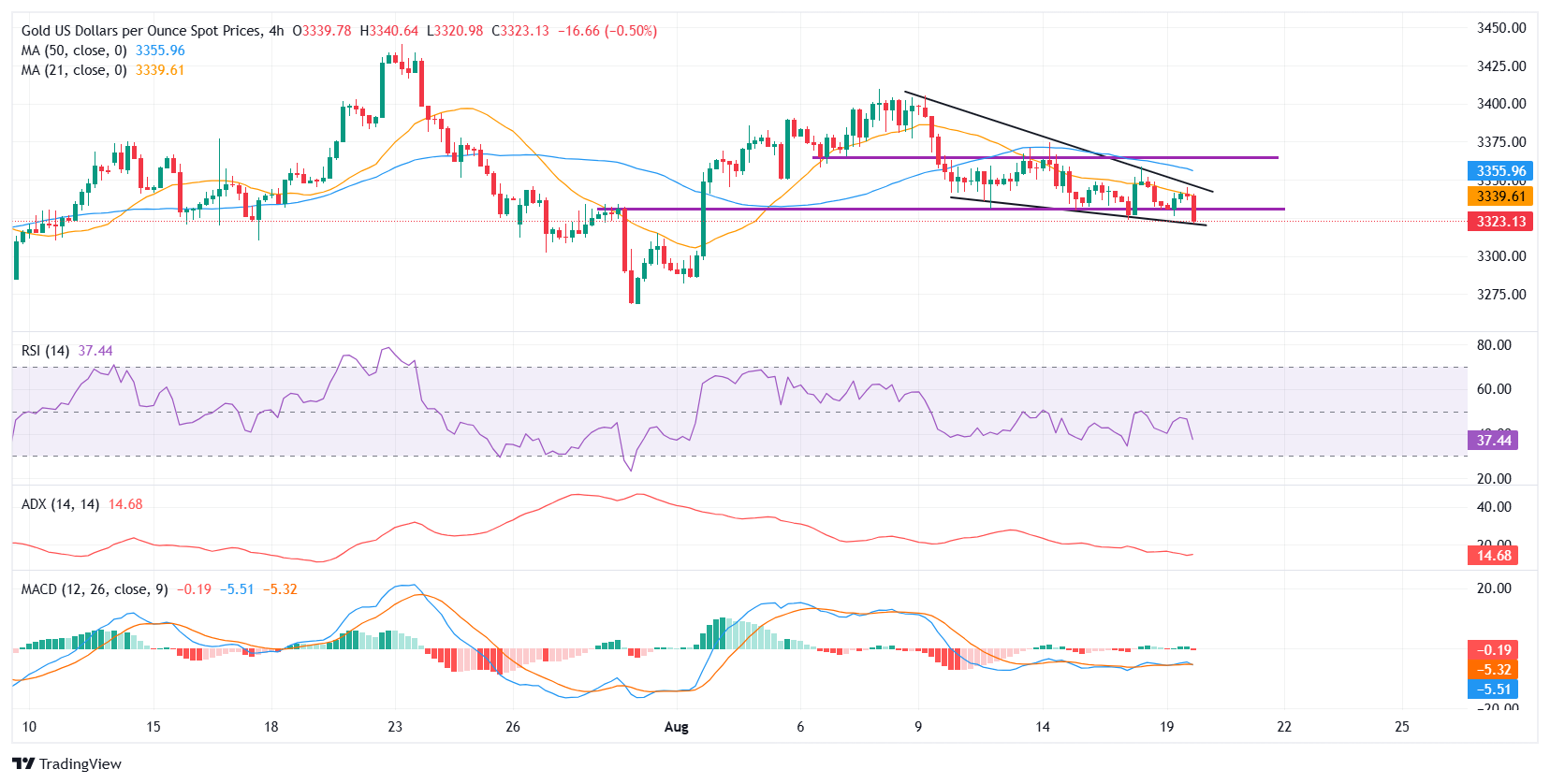
Gold (XAU/USD) is trading near $3,325 on Tuesday, slipping below the $3,330 support zone and testing its lowest level in nearly two weeks. While the metal had largely been confined to a horizontal range between $3,330 and $3,370 over the past week, the recent breakdown suggests growing downside pressure.
The failure to reclaim the 100-period Simple Moving Average (SMA) on the 4-hour chart, currently around $3,348, reinforces the bearish tilt.
At the same time, the 4-hour chart shows a falling wedge formation developing within this broader sideways range, a chart pattern that typically signals potential bullish breakout risk.
The Relative Strength Index (RSI) has slipped to 38, indicating building bearish momentum and reinforcing the downside bias in the near term.
A decisive break above $3,370 and wedge resistance could spark fresh upside momentum toward $3,400 psychological level. On the downside, a sustained move below $3,330 could expose the next support at $3,300, with further downside risk if that level gives way.
Gold FAQs
Gold has played a key role in human’s history as it has been widely used as a store of value and medium of exchange. Currently, apart from its shine and usage for jewelry, the precious metal is widely seen as a safe-haven asset, meaning that it is considered a good investment during turbulent times. Gold is also widely seen as a hedge against inflation and against depreciating currencies as it doesn’t rely on any specific issuer or government.
Central banks are the biggest Gold holders. In their aim to support their currencies in turbulent times, central banks tend to diversify their reserves and buy Gold to improve the perceived strength of the economy and the currency. High Gold reserves can be a source of trust for a country’s solvency. Central banks added 1,136 tonnes of Gold worth around $70 billion to their reserves in 2022, according to data from the World Gold Council. This is the highest yearly purchase since records began. Central banks from emerging economies such as China, India and Turkey are quickly increasing their Gold reserves.
Gold has an inverse correlation with the US Dollar and US Treasuries, which are both major reserve and safe-haven assets. When the Dollar depreciates, Gold tends to rise, enabling investors and central banks to diversify their assets in turbulent times. Gold is also inversely correlated with risk assets. A rally in the stock market tends to weaken Gold price, while sell-offs in riskier markets tend to favor the precious metal.
The price can move due to a wide range of factors. Geopolitical instability or fears of a deep recession can quickly make Gold price escalate due to its safe-haven status. As a yield-less asset, Gold tends to rise with lower interest rates, while higher cost of money usually weighs down on the yellow metal. Still, most moves depend on how the US Dollar (USD) behaves as the asset is priced in dollars (XAU/USD). A strong Dollar tends to keep the price of Gold controlled, whereas a weaker Dollar is likely to push Gold prices up.
Author

Vishal Chaturvedi
FXStreet
I am a macro-focused research analyst with over four years of experience covering forex and commodities market. I enjoy breaking down complex economic trends and turning them into clear, actionable insights that help traders stay ahead of the curve.