Gold climbs over 1% despite strong US data fueling mixed market mood
- XAU/USD rebounds from a $3,929 low as strong ISM Services, ADP jobs data lift volatility across assets.
- ISM Prices Paid hits its highest since 2022, signaling inflation persistence, while Fed officials strike a cautiously dovish tone.
- Risk-on sentiment caps upside, but Gold remains underpinned by rate-cut expectations and geopolitical uncertainty.

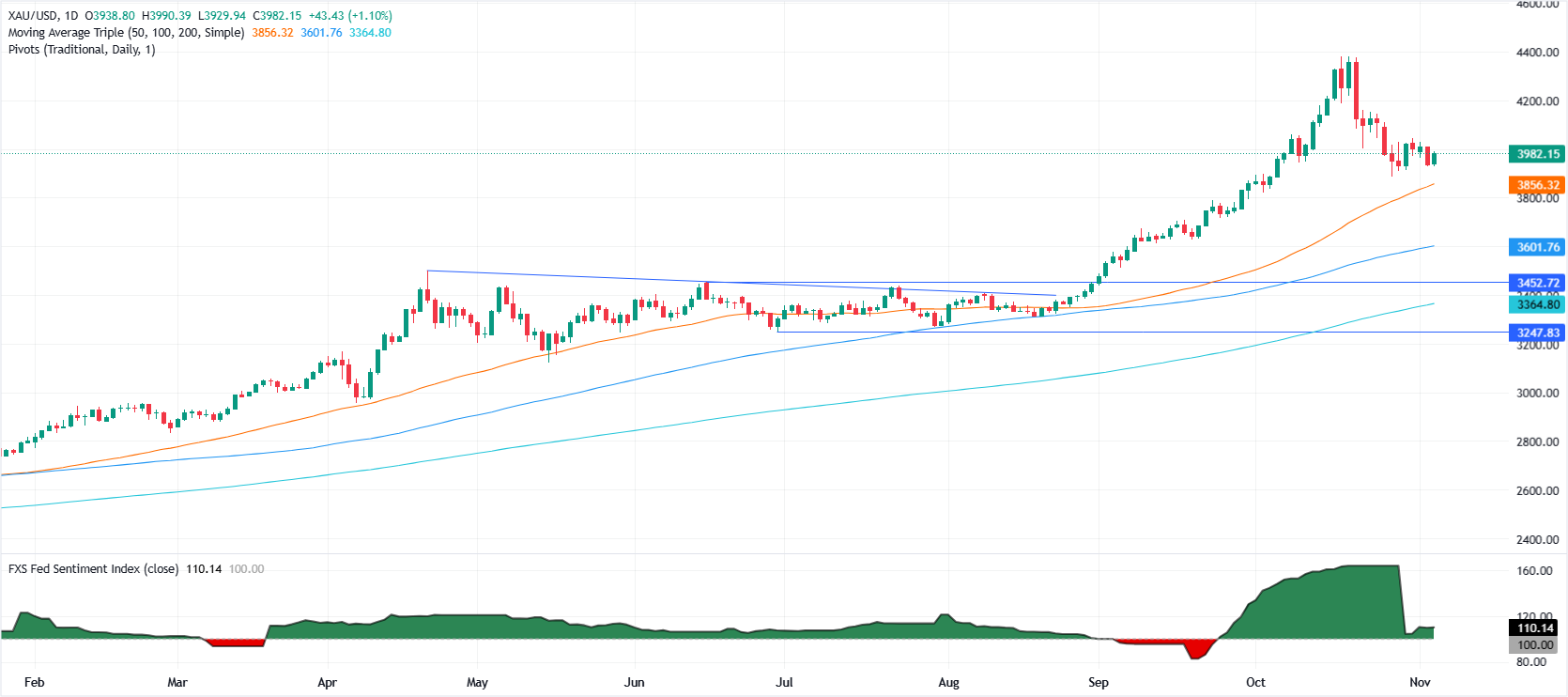
Gold (XAU/USD) price rises more than 1% on Wednesday after a slew of economic data was released in the United States (US), which strengthened the US Dollar (USD), but also the yellow metal, which trades at around $3,980 after hitting a daily low of $3,929.
Safe-haven demand and dovish Fed remarks keep bullion near $3,980
Lately, the ISM Services in October expanded as expected, crushing estimates. Despite this, the Prices Paid sub-component showed that inflation is rising, as the index rose to its highest level since October 2022.
Before that data, ADP revealed that private companies hired more people than expected, indicating that the job market remains strong. Initially, Wall Street reacted negatively, but a risk-on mood capped Gold price advance, remaining shy of testing $4,000.
In the meantime, Federal Reserve (Fed) officials had crossed the wires, like Governor Stephen Miran, who cheered ADP data but indicated that rates should be lower. On Monday, Chicago Fed Austan Goolsbee said that inflationary pressures remain persistent, while Fed Governor Lisa Cook stated that the labor market shows signs of vulnerability.
Daily market movers: Traders will be attentive to the US Supreme Court hearing on tariffs
- Earlier, the US Supreme Court was scheduled to host a hearing later in the day on the legality of President Donald Trump's tariffs, after a lower court ruled the administration had overstepped authority by imposing levies under an emergency law.
- The Institute for Supply Management (ISM) revealed that business activity in the services sector improved in October. The ISM Services PMI rose from 50 in September to 52.4, exceeding estimates. From the sub-components of the PMI, Prices Paid hit its highest level since October 2022 at 70, an indication that prices are climbing.
- The ADP National Employment Change revealed that non-farm jobs exceeded estimates of 25K and increased by 42K in October, up from September, downward revised by -29K.
- After the data release, money markets trimmed the chances of a 25-basis point rate cut by the Fed at the upcoming December meeting, with odds down to 62% from 68% prior to the release of the ADP report.
- The US Dollar Index (DXY), which tracks the performance of the buck versus six currencies, climbs 0.07% to 100.22.
- Conversely, US Treasury yields surge, as depicted by the 10-year Treasury note yield rising by six basis points to 4.15%. US real yields — which correlate inversely to Gold prices — climb nearly nine basis points to 1.86%.
Technical outlook: Gold price climbs towards $4,000
Gold price edges higher as it seems to have bottomed out around $3,929, but buyers must clear the $4,000 if they wish to regain control and push the yellow metal higher.
The Relative Strength Index (RSI) shows that buyers are gathering traction but remain shy of clearing the 50-neutral level.
If XAU/USD climbs above $4,000, the next resistance will be the 20-day SMA at $4,082. Conversely, if Gold tumbles below the October 28 low at $3,886, sellers could challenge the 50-day SMA near $3,854.
Gold FAQs
Gold has played a key role in human’s history as it has been widely used as a store of value and medium of exchange. Currently, apart from its shine and usage for jewelry, the precious metal is widely seen as a safe-haven asset, meaning that it is considered a good investment during turbulent times. Gold is also widely seen as a hedge against inflation and against depreciating currencies as it doesn’t rely on any specific issuer or government.
Central banks are the biggest Gold holders. In their aim to support their currencies in turbulent times, central banks tend to diversify their reserves and buy Gold to improve the perceived strength of the economy and the currency. High Gold reserves can be a source of trust for a country’s solvency. Central banks added 1,136 tonnes of Gold worth around $70 billion to their reserves in 2022, according to data from the World Gold Council. This is the highest yearly purchase since records began. Central banks from emerging economies such as China, India and Turkey are quickly increasing their Gold reserves.
Gold has an inverse correlation with the US Dollar and US Treasuries, which are both major reserve and safe-haven assets. When the Dollar depreciates, Gold tends to rise, enabling investors and central banks to diversify their assets in turbulent times. Gold is also inversely correlated with risk assets. A rally in the stock market tends to weaken Gold price, while sell-offs in riskier markets tend to favor the precious metal.
The price can move due to a wide range of factors. Geopolitical instability or fears of a deep recession can quickly make Gold price escalate due to its safe-haven status. As a yield-less asset, Gold tends to rise with lower interest rates, while higher cost of money usually weighs down on the yellow metal. Still, most moves depend on how the US Dollar (USD) behaves as the asset is priced in dollars (XAU/USD). A strong Dollar tends to keep the price of Gold controlled, whereas a weaker Dollar is likely to push Gold prices up.
Author

Christian Borjon Valencia
FXStreet
Markets analyst, news editor, and trading instructor with over 14 years of experience across FX, commodities, US equity indices, and global macro markets.