Germany ZEW Survey - Economic Sentiment turns positive 10.5 in June: What it means for EUR/USD?

German ZEW Survey - Economic Sentiment turns positive to 10.5 in June after remaining negative in May. The data was expected to come in better at -6.0 from the previous reading of -10.2.
The ZEW Survey - Current Situation unexpectedly deteriorates to -81.0 from the previous reading of -77.8. It was expected to improve slightly to -77.5.
In the Eurozone, the ZEW Survey - Economic Sentiment also turns positive. The sentiment data has arrived at 9.5, better than -7.2 estimates, and the prior release of -9.1.
There has been no immediate response observed in the Euro (EUR), following the German data release. However, EUR/USD has gained significantly in the European trade as the peace deal signing between the United States (US) and Iran has diminished the US Dollar’s safe-haven demand.
Euro Price Today
The table below shows the percentage change of Euro (EUR) against listed major currencies today. Euro was the strongest against the Canadian Dollar.
| USD | EUR | GBP | JPY | CAD | AUD | NZD | CHF | |
|---|---|---|---|---|---|---|---|---|
| USD | -0.10% | -0.02% | -0.02% | 0.09% | 0.09% | -0.03% | 0.05% | |
| EUR | 0.10% | 0.09% | 0.11% | 0.20% | 0.19% | 0.08% | 0.17% | |
| GBP | 0.02% | -0.09% | 0.02% | 0.11% | 0.10% | 0.00% | 0.08% | |
| JPY | 0.02% | -0.11% | -0.02% | 0.08% | 0.07% | -0.02% | 0.07% | |
| CAD | -0.09% | -0.20% | -0.11% | -0.08% | -0.01% | -0.13% | -0.04% | |
| AUD | -0.09% | -0.19% | -0.10% | -0.07% | 0.00% | -0.10% | -0.01% | |
| NZD | 0.03% | -0.08% | 0.00% | 0.02% | 0.13% | 0.10% | 0.08% | |
| CHF | -0.05% | -0.17% | -0.08% | -0.07% | 0.04% | 0.01% | -0.08% |
The heat map shows percentage changes of major currencies against each other. The base currency is picked from the left column, while the quote currency is picked from the top row. For example, if you pick the Euro from the left column and move along the horizontal line to the US Dollar, the percentage change displayed in the box will represent EUR (base)/USD (quote).
What does significant improvement in Germany/Eurozone ZEW Survey - Economic Sentiment data means for EUR/USD?
The Germany/Eurozone ZEW Survey - Economic Sentiment reflects the sentiment of institutional investors towards the economy. The data shows the difference between the share of investors who are optimistic and the share of analysts who are pessimistic.
Generally, better-than-projected sentiment data improves the appeal of the EUR/USD, while soft figures weigh on the same.
The impact of the data has remained significant in the past few months due to Middle East conflicts, which prompted energy prices and increased pressure on households’ spending.
Technical Analysis: EUR/USD remains inside Symmetrical Triangle formation
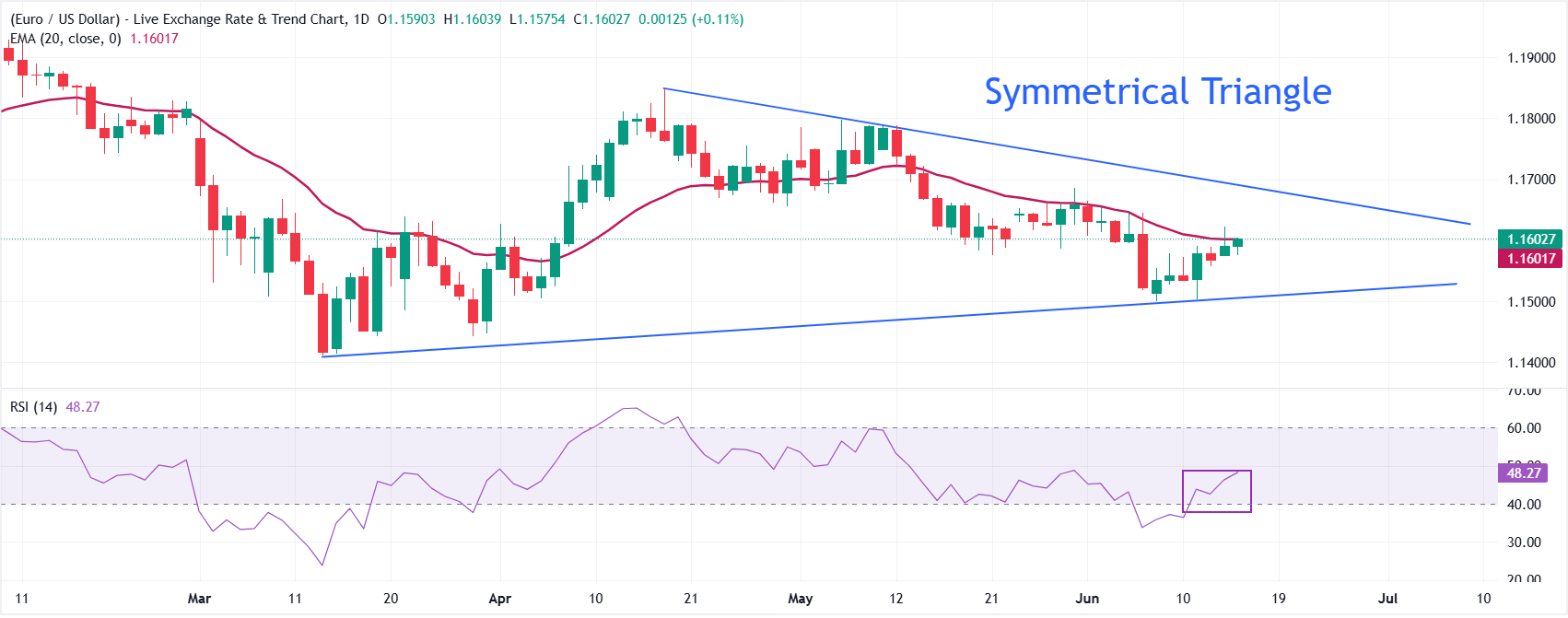
EUR/USD trades 0.1% higher at around 1.1603 at press time. The pair holds just above the 20-day exponential moving average (EMA) at 1.1602, which lends modest near-term support, but it remains well below the descending trend-line barrier drawn from 1.1849, keeping the broader tone capped.
The Relative Strength Index (14) at 48 sits near neutral territory, hinting at a lack of clear momentum while price consolidates between supportive short-term averages and the still-dominant downward trend structure.
On the topside, initial resistance is seen at the downtrend break level near 1.1687, with the descending trend line from 1.1849 reinforcing a higher resistance zone. On the downside, the former uptrend break area around 1.1506 is the major support zone ahead of stronger structural support near the original rising trend-line anchor at 1.1409.
(The technical analysis of this story was written with the help of an AI tool.)
Economic Indicator
ZEW Survey – Economic Sentiment
The Economic Sentiment published by the Zentrum für Europäische Wirtschaftsforschung measures the institutional investor sentiment, reflecting the difference between the share of investors that are optimistic and the share of analysts that are pessimistic. Generally speaking, an optimistic view is considered as positive (or bullish) for the EUR, whereas a pessimistic view is considered as negative (or bearish).
Read more.Last release: Tue Jun 16, 2026 09:00
Frequency: Monthly
Actual: 10.5
Consensus: -6
Previous: -10.2
Author

Sagar Dua
FXStreet
Sagar Dua is associated with the financial markets from his college days. Along with pursuing post-graduation in Commerce in 2014, he started his markets training with chart analysis.

















