GBP/USD Price Forecast: Needs decisive break above 1.3420 for fresh upside leg
- GBP/USD surrenders early gains and flattens at around 1.3373 as the US Dollar rebounds slightly.
- The Fed is expected to leave interest rates steady on Wednesday.
- Investors expect the BoE to tighten monetary policy conditions next week.
The British Pound (GBP) gives back its early gains and flattens at around 1.3373 against the US Dollar (USD) during the European trading session on Monday. The GBP/USD pair flattens as the US Dollar recovers some of its early losses.
As of writing, the US Dollar Index (DXY), which tracks the Greenback’s value against six major currencies, trades marginally lower to near 101.70.
This week, investors will pay close attention to the Federal Reserve’s (Fed) monetary policy announcement on Wednesday. The Fed is almost certain to leave interest rates unchanged in the 3.75%-4.00% range, according to the CME FedWatch tool. The tool also shows that the United States (US) central bank will raise them in the December meeting.
Apart from the Fed’s policy, investors will also focus on the preliminary Q3 Gross Domestic Product (GDP) and Personal Consumption Expenditure (PCE) Price Index data for September, which are scheduled for Thursday. The US economy is expected to have grown at an annualized pace of 3.2%, faster than the previous reading of 2.2%.
On GBP front, the major trigger will be the Bank of England’s (BoE) monetary policy announcement next week. The BoE is highly anticipated to hike interest rates by 25 basis points (bps) to 4%.
GBP/USD Technical Analysis
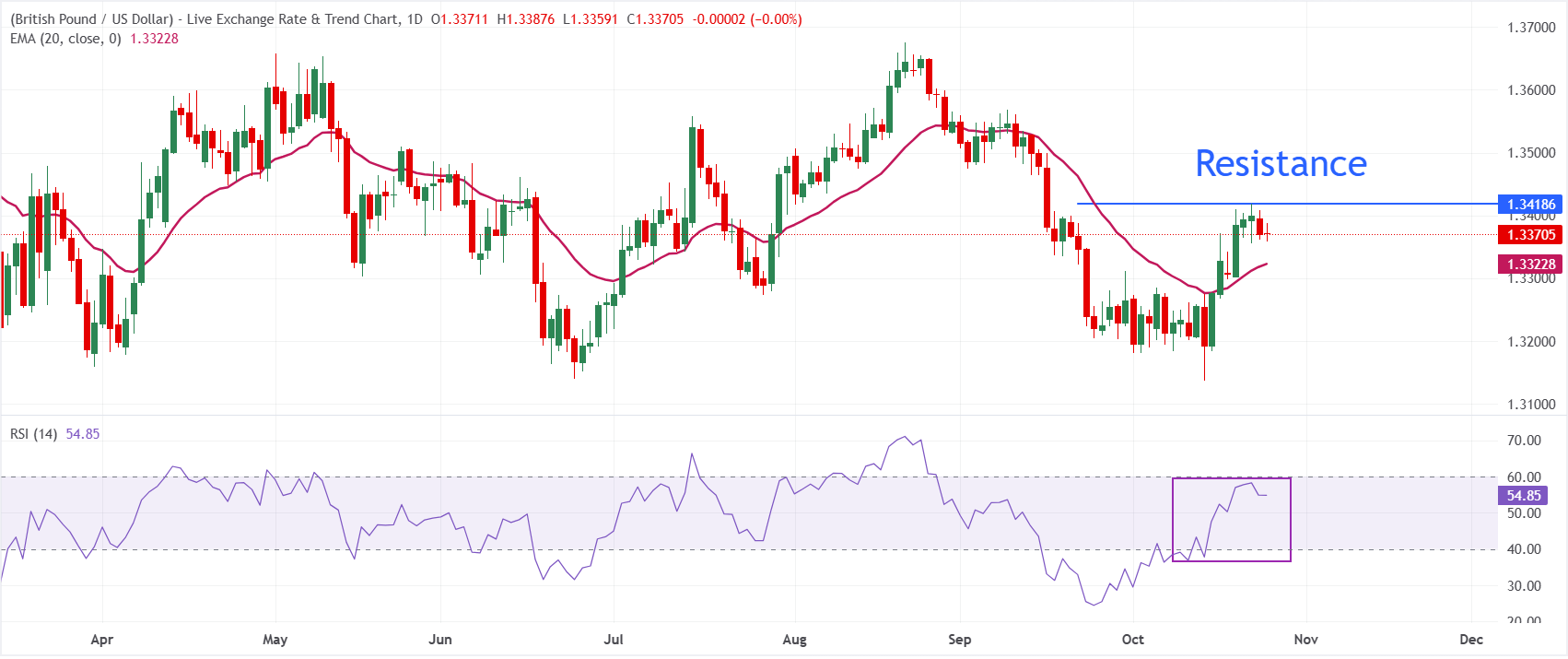
In the daily chart, GBP/USD trades at 1.3370. The pair holds above the 20-day exponential moving average (EMA) at 1.3323, which suggests a mildly constructive near-term tone as buyers defend the recent recovery. The Relative Strength Index (RSI) at 54.8 stands in neutral-to-positive territory, hinting that momentum remains supportive without yet reaching overbought conditions.
On the downside, immediate support is seen at the 20-day EMA near 1.3323, where a break would likely soften the bullish bias and expose deeper pullbacks. Looking up, the previous week high near 1.3420 is the immediate hurdle; a decisive break above that would open the door for further updie towards 1.3500.
(The technical analysis of this story was written with the help of an AI tool. Know more.)
Economic Indicator
Fed Interest Rate Decision
The Federal Reserve (Fed) deliberates on monetary policy and makes a decision on interest rates at eight pre-scheduled meetings per year. It has two mandates: to keep inflation at 2%, and to maintain full employment. Its main tool for achieving this is by setting interest rates – both at which it lends to banks and banks lend to each other. If it decides to hike rates, the US Dollar (USD) tends to strengthen as it attracts more foreign capital inflows. If it cuts rates, it tends to weaken the USD as capital drains out to countries offering higher returns. If rates are left unchanged, attention turns to the tone of the Federal Open Market Committee (FOMC) statement, and whether it is hawkish (expectant of higher future interest rates), or dovish (expectant of lower future rates).
Read more.Next release: Wed Oct 28, 2026 18:00
Frequency: Irregular
Consensus: 4%
Previous: 4%
Source: Federal Reserve
Author

Sagar Dua
FXStreet
Sagar Dua is associated with the financial markets from his college days. Along with pursuing post-graduation in Commerce in 2014, he started his markets training with chart analysis.

















