|

GBP/USD Price Analysis: Oscillates in a range below the 1.2500 mark, eyes on UK GDP, US CPI

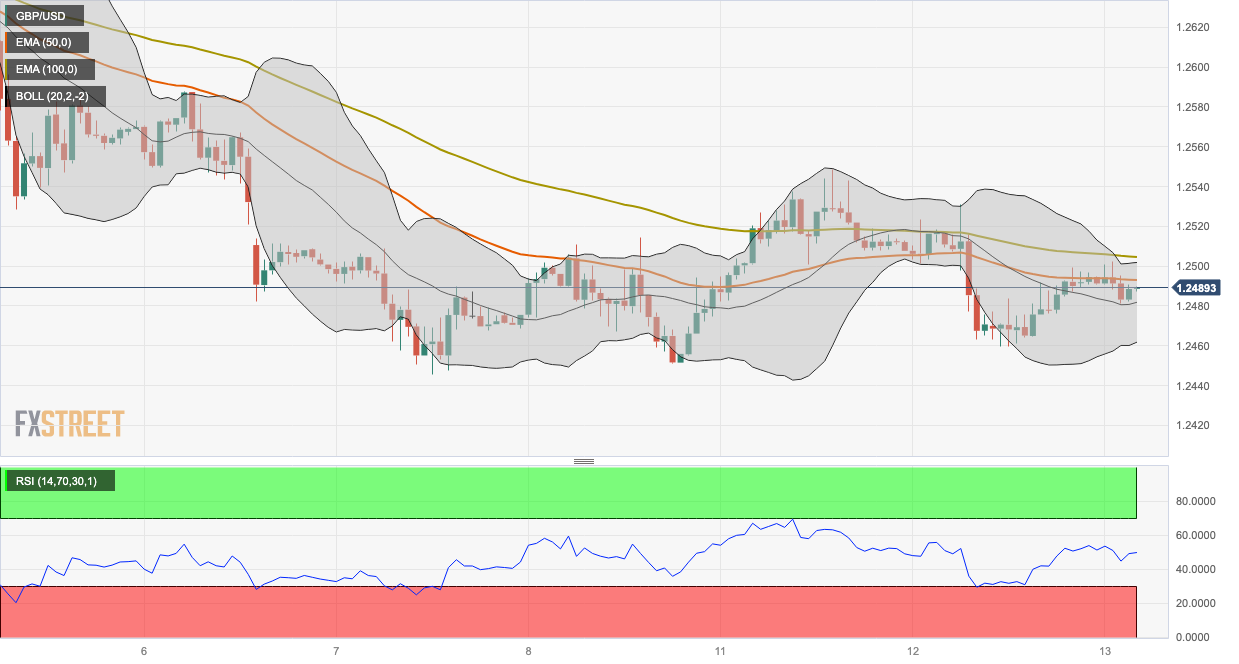
  • GBP/USD oscillates in the 1.2480-1.2502 region in a trading band.
  • The pair holds below the 50- and 100-hour EMAs on the one-hour chart; the RSI stands below 50. 
  • The critical resistance level is seen at the 1.2500-1.2505 zone; 1.2460 acts as an initial support level. 

The GBP/USD pair consolidates in a familiar range below the 1.2500 barrier during the Asian session on Wednesday. The major pair currently trades near 1.2488, losing 0.01% on the day. Market players prefer to wait on the sidelines ahead of the UK Gross Domestic Product (GDP) data for July and the highly anticipated US Consumer Price Index (CPI) data. These figures could trigger the volatility in the pair. 

The Bank of England (BoE) policymaker Catherine Mann remarked on Monday that it was too early for the central bank to pause interest rates and that it was better for the central bank to err on the side of rising rates too high rather than suspending them too soon. The hawkish comments by BoE governors may restrict the British Pound's fall and serve as a tailwind for GBP/USD.

About the data, the UK’s Office for National Statistics reported on Tuesday that the UK Unemployment Rate in the three months to July came in at 4.3% from 4.2% in the previous reading, in line with the market consensus. 

From the technical perspective, GBP/USD holds below the 50- and 100-hour Exponential Moving Averages (EMAs) on the one-hour chart, which means further downside looks favorable. Meanwhile, the Relative Strength Index (RSI) stands below 50, within bearish territory, suggesting that sellers are likely to retain control in the near term.

The critical resistance level for GBP/USD emerges at the 1.2500-1.2505 region, presenting a confluence of the upper boundary of the Bollinger Band, a psychological round figure, and the 100-hour EMA. The additional upside filter is located at 1.2530 (a high of September 12). Further north, 1.2548 will be the next barrier for the pair, followed by a psychological mark at 1.2600. 

On the downside, any follow-through selling below the lower limit of the Bollinger Band and a low of September 12 at 1.2460 will challenge the next contention at 1.2440 (a low of May 12) en route to 1.2390 (a low of June 6) and finally at 1.2350 (a low of May 31).
 

GBP/USD one-hour chart
GBP/USD

Overview
Today last price1.2489
Today Daily Change-0.0001
Today Daily Change %-0.01
Today daily open1.249
 
Trends
Daily SMA201.2624
Daily SMA501.2753
Daily SMA1001.2656
Daily SMA2001.243
 
Levels
Previous Daily High1.2531
Previous Daily Low1.2459
Previous Weekly High1.2643
Previous Weekly Low1.2446
Previous Monthly High1.2841
Previous Monthly Low1.2548
Daily Fibonacci 38.2%1.2487
Daily Fibonacci 61.8%1.2504
Daily Pivot Point S11.2456
Daily Pivot Point S21.2422
Daily Pivot Point S31.2385
Daily Pivot Point R11.2527
Daily Pivot Point R21.2565
Daily Pivot Point R31.2599

Author

Lallalit Srijandorn

Lallalit Srijandorn is a Parisian at heart. She has lived in France since 2019 and now becomes a digital entrepreneur based in Paris and Bangkok.


More from Lallalit Srijandorn
Share:

Editor's Picks

AUD/USD bulls regain control above 0.6950 amid USD retreat

AUD/USD regains traction and extends the previous day's bounce from the weekly low, aiming for 0.7000 in Asia on Friday. The overnight pullback in US bond yields keeps the US Dollar below an 18-month high, which in turn offers some support to the pair. Meanwhile, hawkish RBA expectations also keep the major underpinned.

USD/JPY holds gains near 158.00 after Japan's weak Household Spending data

USD/JPY clings to gains around 158.00 after data showed on Friday that Japan's Household Spending fell for the ninth straight month, undermining the Japanese Yen. Meanwhile, the US Dollar remains depressed as the overnight fall in US bond yields counters a hawkish Fed and geopolitical uncertainties, could cap any downside in the pair.

Gold remains range-bound below $4,200

Gold has given up some ground after an initial bullish attempt to reach weekly highs, returning to below the $4,200 mark per troy ounce on Friday. The US Dollar’s strong upside momentum, combined with rising US Treasury yields across the curve, seems to keep further gains in the yellow metal under scrutiny.

Has Bitcoin really escaped the macro forces it was built to fight?
Over 17 years ago, Satoshi Nakamoto designed Bitcoin (BTC) on the back of a global financial crisis as an alternative to the global monetary system outside the control of central banks, governments and traditional intermediaries. This raises a key question: has Bitcoin really become independent of the macroeconomic forces it was built to challenge?
The Euro is not the sick man of Europe. France's bond market is
EUR/USD remains under pressure, near the 17-month low of 1.1161 reached on Monday. The pair has lost more than 7% since its yearly peak, as concerns over France's public finances increasingly weigh on the single currency. But behind the weakness of the Euro (EUR), the problem does not necessarily lie with the European economy as a whole.
Has Bitcoin really escaped the macro forces it was built to fight?
Over 17 years ago, Satoshi Nakamoto designed Bitcoin (BTC) on the back of a global financial crisis as an alternative to the global monetary system outside the control of central banks, governments and traditional intermediaries. This raises a key question: has Bitcoin really become independent of the macroeconomic forces it was built to challenge?














