|

GBP/USD Price Analysis: 15-week-old rising trendline on bears’ radar

  • GBP/USD remains weak around the seven-day low.
  • Prices continue the pullback from 50-day SMA amid bearish MACD.
  • An ascending trend line from early-November 2019, 50% Fibonacci retracement can question the sellers.

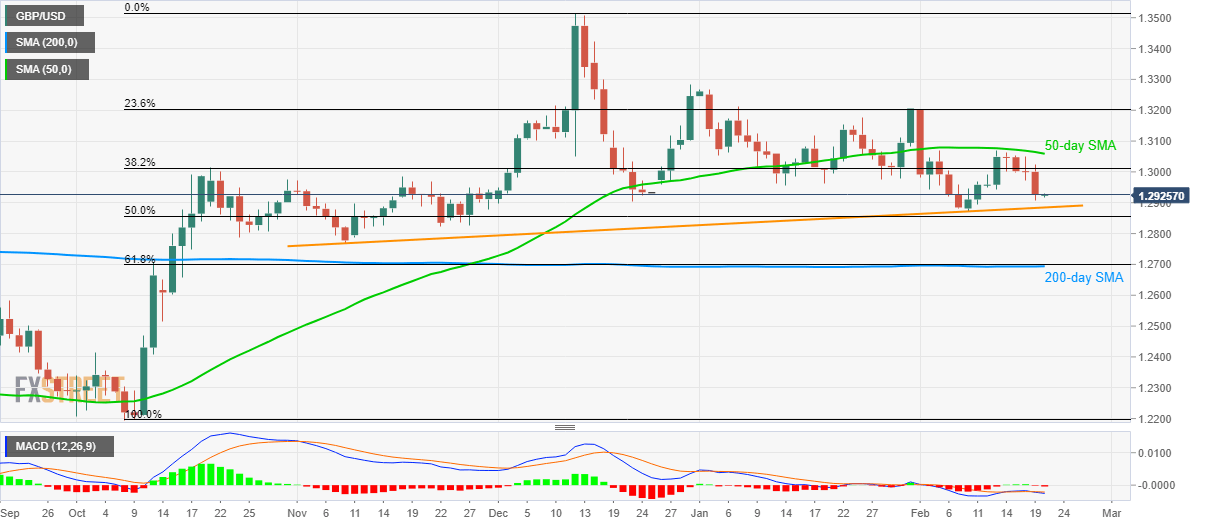
GBP/USD declines to 1.2920 during Thursday’s Asian session. In doing so, the pair extends its U-turn from 50-day SMA while nearing the key support trend line from November 2019. Also supporting the odds of the pair’s further declines could be the bearish MACD.

As a result, sellers target the multi-week-old support line, at 1.2885 as the immediate support ahead of aiming the 50% Fibonacci retracement of the pair’s October-December 2019 upside, at 1.2855.

However, the pair’s further downside below 1.2855 can only have November 2019 low of 1.2770 to please the sellers ahead of challenging them with 1.2700/2695 confluence that includes 61.8% Fibonacci retracement and 200-day SMA.

On the contrary, a clear upside beyond 50-day SMA level of 1.3060 enables the buyers to aim for the monthly high near 1.3070 ahead of confronting 1.3200 resistance, comprising the 23.6% Fibonacci retracement.

GBP/USD daily chart
Trend: Bearish

Additional important levels

Overview
Today last price1.2926
Today Daily Change2 pips
Today Daily Change %0.02%
Today daily open1.2924
 
Trends
Daily SMA201.3013
Daily SMA501.3058
Daily SMA1001.2949
Daily SMA2001.2693
 
Levels
Previous Daily High1.3024
Previous Daily Low1.2907
Previous Weekly High1.307
Previous Weekly Low1.2872
Previous Monthly High1.3281
Previous Monthly Low1.2954
Daily Fibonacci 38.2%1.2952
Daily Fibonacci 61.8%1.2979
Daily Pivot Point S11.2879
Daily Pivot Point S21.2835
Daily Pivot Point S31.2762
Daily Pivot Point R11.2996
Daily Pivot Point R21.3069
Daily Pivot Point R31.3113

Author

Anil Panchal

Anil Panchal

FXStreet

Anil Panchal has nearly 15 years of experience in tracking financial markets. With a keen interest in macroeconomics, Anil aptly tracks global news/updates and stays well-informed about the global financial moves and their implications.


More from Anil Panchal
Share:

Editor's Picks

GBP/USD hovers around 1.3400 following BoE decision

GBP/USD holds the bounce above 1.3350 in the European session on Thursday. The Bank of England decided to maintain the benchmark rate unchanged at 3.75%. The MPC voted 6-3 in favor of keeping rates on hold, with the 3 dissenters favoring a rate hike.

EUR/USD nears 1.1500 after upbeat German, EU GDP data

EUR/USD recovered its bullish poise in the European session on Thursday, helped by the better-than-expected German and Eurozone GDP data and renewed US Dollar weakness. Traders now brace for preliminary readings of the second-quarter GDP from the US. 


Gold stable below $4,100 as USD resumes decline

Gold hovers around its daily open ahead of the U.S. open on Thursday, trimming early losses. The Greenback enjoyed some near-term demand following Wednesday's post-FOMC downfall, but was unable to retain its gains. Market players now waiting for US Q2 GDP.


Mixed signals leave XRP and XLM at crossroads

Ripple and Stellar are trading at critical technical levels on Thursday. XRP has stabilized above the psychological $1.00 support, while XLM is testing support at $0.173. Traders should be cautious as mixed derivatives metrics keep the outlook uncertain for both altcoins. Derivatives data shows mixed sentiment among traders. CoinGlass’ long-to-short ratio for XRP reads 1.02 on Thursday.

US GDP expected to grow at 2.1% in Q2, unshaken by  Iran conflict
The United States (US) Bureau of Economic Analysis (BEA) is set to publish its preliminary estimate of second-quarter Gross Domestic Product (GDP) on Thursday, with analysts expecting the data to show annualised growth at a solid 2.1%, a modest cooling from the 2.1% expansion recorded in the previous quarter.
US Dollar mid-year outlook: Exceptional currency, exceptional risks?
The US Dollar enters the second half of 2026 in a markedly different position from a year ago. The King currency has recovered, reflecting persistent US inflation, changing expectations for Fed policy, geopolitical tensions and renewed demand for defensive assets.