GBP/USD dips as Dollar stays bid on Warsh Fed pick, strong ISM data
- GBP/USD falls by around 0.17% as the US Dollar extends gains for a second day following the sharp precious metals selloff.
- Trump’s nomination of Kevin Warsh as the next Fed Chair reinforces expectations of a firmer, less-dovish Fed stance.
- US ISM Manufacturing PMI jumps into expansion at 52.6, boosting Treasury yields and Dollar demand.

The Pound Sterling (GBP) dives some 0.17% on Monday as the US Dollar (USD) extends its gains to two straight days, following the precious metals rout that pushed Gold prices down by over $1,000 after reaching a record high near $5,600. GBP/USD trades at 1.3662 after reaching a daily high of 1.3715.
Sterling weakens ahead of the BoE meeting as markets reprice a less-dovish Fed and US data beats expectations
Last Friday, US President Donald Trump nominated Kevin Warsh to be the new Fed Chair since June 2026. After the announcement, markets priced in a less 'dovish' US central bank as Warsh, a former governor at the Fed, was usually hawkish in his previous stint.
Data-wise, the US economic docket featured S&P Global Manufacturing PMI for January, showing an expansion in the sector. The ISM Manufacturing PMI crushed forecasts of a 48.5 reading and expanded by 52.6 in January, up from December’s 47.9 contraction.
In the UK, traders' focus is on the Bank of England’s (BoE) monetary policy decision, in which the central bank is expected to hold the Bank Rate steady at 3.75% on Thursday. Market participants’ attention will be on the vote split, as members have been divided during the last couple of meetings.
Worth noting that although the UK jobs market had shown signs of weakness, inflation remains the highest among the G7 industrialized countries. Therefore, the BoE could refrain from supporting the labor market.
S&P Global reported that manufacturing activity in January in the country improved the most since August 2024, indicating the economy is picking up. The Purchasers Managers Index (PMI) rose from 51.6 to 51.8, exceeding estimates.
Ahead in the week, the UK docket will feature the BoE’s monetary policy and speeches by BoE members. Across the pond, Fed officials will grab the headlines, along with Services PMI data by S&P Global and the ISM, jobless claims and January’s Nonfarm Payrolls report.
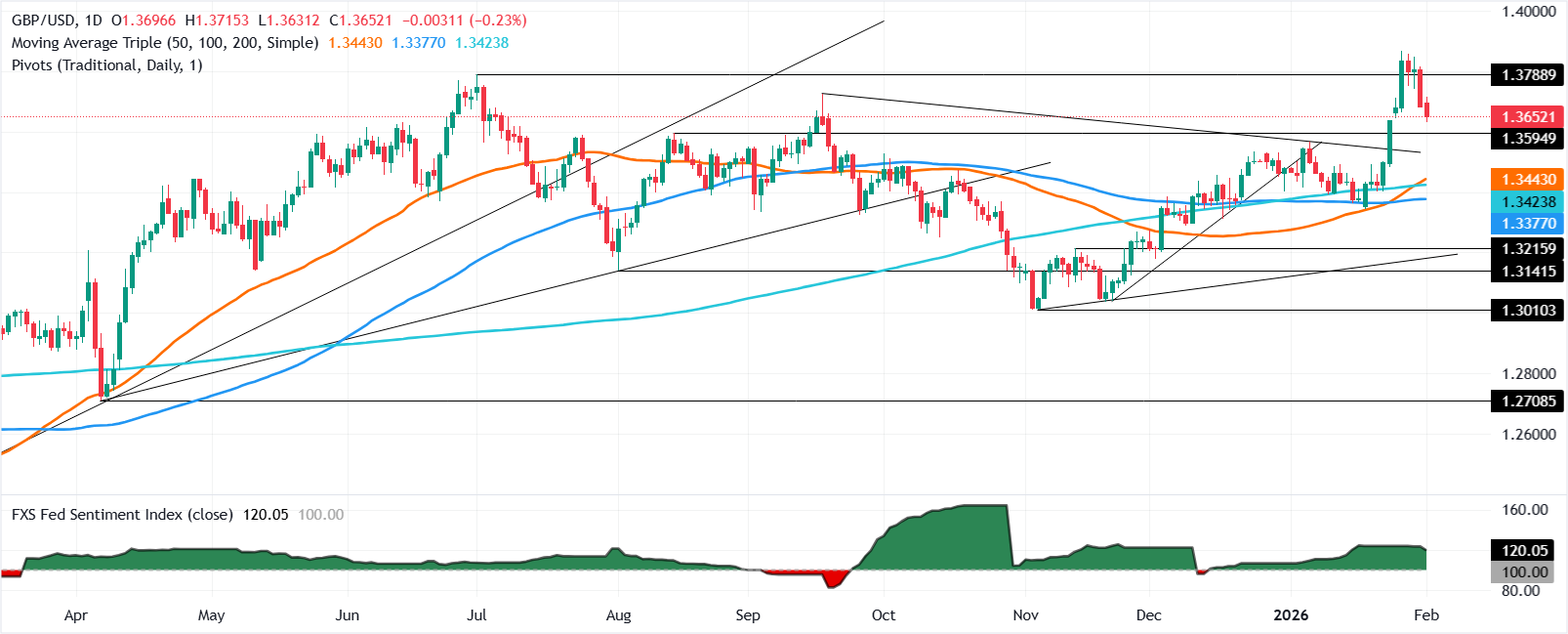
GBP/USD Price Forecast: Technical outlook
After clearing 1.3700 support, GBP/USD is poised to consolidate within the 1.3600-1.3700 area. Bullish momentum is fading as depicted by the Relative Strength Index (RSI) aiming towards its neutral level.
For a bullish continuation, buyers must clear 1.3700 and challenge 1.3750. On further strength, 1.3800 lies overhead. Conversely, if GBP/USD tumbles below 1.3650, it could exacerbate the drop to 1.3600. A breach of the latter will expose the 20-day SMA at 1.3538.
Pound Sterling Price This week
The table below shows the percentage change of British Pound (GBP) against listed major currencies this week. British Pound was the strongest against the Swiss Franc.
| USD | EUR | GBP | JPY | CAD | AUD | NZD | CHF | |
|---|---|---|---|---|---|---|---|---|
| USD | 0.35% | 0.33% | 0.36% | 0.41% | -0.05% | 0.13% | 1.08% | |
| EUR | -0.35% | -0.07% | 0.06% | 0.05% | -0.40% | -0.17% | 0.73% | |
| GBP | -0.33% | 0.07% | -0.02% | 0.12% | -0.34% | -0.15% | 0.79% | |
| JPY | -0.36% | -0.06% | 0.02% | 0.04% | -0.44% | -0.21% | 0.44% | |
| CAD | -0.41% | -0.05% | -0.12% | -0.04% | -0.43% | -0.27% | 0.67% | |
| AUD | 0.05% | 0.40% | 0.34% | 0.44% | 0.43% | 0.19% | 1.13% | |
| NZD | -0.13% | 0.17% | 0.15% | 0.21% | 0.27% | -0.19% | 0.95% | |
| CHF | -1.08% | -0.73% | -0.79% | -0.44% | -0.67% | -1.13% | -0.95% |
The heat map shows percentage changes of major currencies against each other. The base currency is picked from the left column, while the quote currency is picked from the top row. For example, if you pick the British Pound from the left column and move along the horizontal line to the US Dollar, the percentage change displayed in the box will represent GBP (base)/USD (quote).
Author

Christian Borjon Valencia
FXStreet
Markets analyst, news editor, and trading instructor with over 14 years of experience across FX, commodities, US equity indices, and global macro markets.