GBP/USD consolidates as US shutdown optimism and BoE data drive sentiment
- GBP/USD steady as the US Senate's progress boosts optimism over ending the prolonged government shutdown.
- Fed officials deliver mixed signals, while markets price 60% odds of a December rate cut.
- BoE’s dovish hold and upcoming UK GDP and jobs data keep traders focused on Bailey’s policy stance.

GBP/USD consolidates during the North American session on Monday, remaining steady at around 1.3150 amid growing speculation that the US government shutdown might end soon, a tailwind for the US Dollar (USD), which trimmed some earlier losses.
Sterling holds firm despite Dollar recovery; traders eye BoE data, December rate expectations on both sides of the Atlantic
On Sunday, the US Senate passed a measure setting the stage for a reopening of the Federal Government, which has the support of some Democratic lawmakers. The decision was cheered by President Donald Trump, who said that it looks “like we’re getting very close to the shutdown ending.”
The lack of economic data due to the BLS being shut keeps investors leaning on Federal Reserve (Fed) speakers. Recently, St. Louis Fed Alberto Musalem said that the economy has been resilient, emphasizing that inflation is closer to 3% than 2%. Earlier, San Francisco Fed Mary Daly said that inflation has been pretty contained in goods prices, adding that the rate cut helped the labor markets while putting pressure on inflation.
In the meantime, money markets had priced in a 60% chance of a rate cut by the Federal Reserve at the December meeting, following the Chair Jerome Powell remarks at his press conference following the FOMC’s decision, saying that a reduction in December is far from a sure thing.
Across the pond, last Thursday, the Bank of England (BoE) kept rates unchanged on a 5-4 vote split, which was perceived as a dovish hold. Since then, money markets have been more likely to price in a rate cut in December than not.
The docket in the UK would be crucial as BoE Governor Andrew Bailey adopted a data-dependent approach. Hence, traders would be keen on employment figures and GDP for Q3 during the week, looking for cues about what the BoE might do next.
Traders are also awaiting the UK's November budget in which most economists expect Rachel Reeves, the finance minister, to raise rates to fulfill her fiscal rules.
GBP/USD Price Forecast: Technical outlook
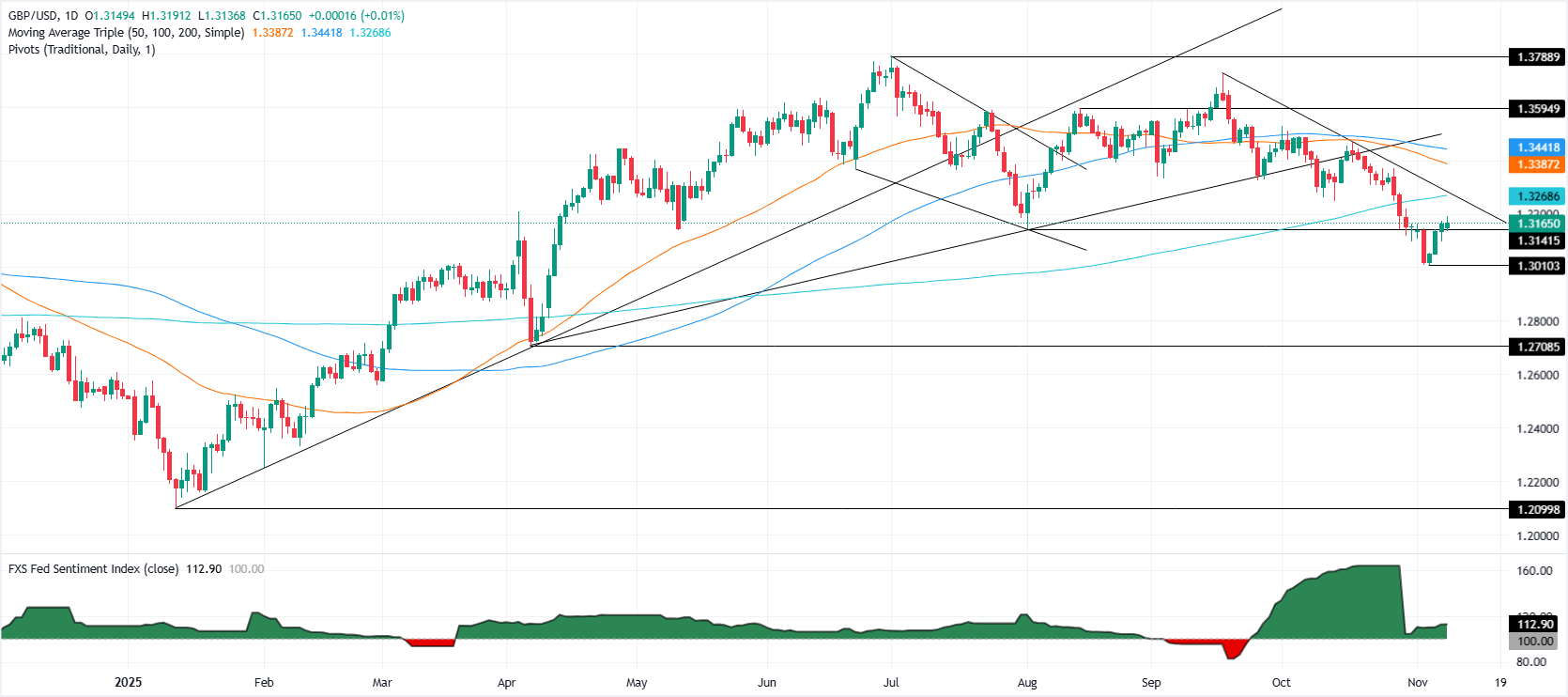
GBP/USD remains bearish, with spot prices sitting below the confluence of the 20-day and 200-day SMAs at around 1.3254/65, respectively. If buyers want to regain control, they must claim 1.3200 before testing 1.3250 and the previously mentioned confluence. Conversely, bears have the upper hand, but they’ve lacked the strength to push prices lower. They must clear 1.3100 if they wish to remain hopeful of challenging the latest cycle low of 1.3020 hit on November 4.
Pound Sterling Price This Month
The table below shows the percentage change of British Pound (GBP) against listed major currencies this month. British Pound was the strongest against the New Zealand Dollar.
| USD | EUR | GBP | JPY | CAD | AUD | NZD | CHF | |
|---|---|---|---|---|---|---|---|---|
| USD | 0.07% | -0.03% | -0.06% | 0.31% | 0.53% | 1.93% | 0.50% | |
| EUR | -0.07% | -0.11% | -0.11% | 0.25% | 0.45% | 1.86% | 0.43% | |
| GBP | 0.03% | 0.11% | 0.00% | 0.35% | 0.54% | 1.97% | 0.54% | |
| JPY | 0.06% | 0.11% | 0.00% | 0.30% | 0.53% | 1.93% | 0.48% | |
| CAD | -0.31% | -0.25% | -0.35% | -0.30% | 0.15% | 1.61% | 0.19% | |
| AUD | -0.53% | -0.45% | -0.54% | -0.53% | -0.15% | 1.41% | -0.00% | |
| NZD | -1.93% | -1.86% | -1.97% | -1.93% | -1.61% | -1.41% | -1.41% | |
| CHF | -0.50% | -0.43% | -0.54% | -0.48% | -0.19% | 0.00% | 1.41% |
The heat map shows percentage changes of major currencies against each other. The base currency is picked from the left column, while the quote currency is picked from the top row. For example, if you pick the British Pound from the left column and move along the horizontal line to the US Dollar, the percentage change displayed in the box will represent GBP (base)/USD (quote).
Author

Christian Borjon Valencia
FXStreet
Markets analyst, news editor, and trading instructor with over 14 years of experience across FX, commodities, US equity indices, and global macro markets.














