GBP/JPY continues to grind higher, sets fresh 16-year peak
- GBP/JPY gained 0.72% on Wednesday as Yen continues to plummet.
- Thin data leaves central bank talkers as the driver of market sentiment.
- BoE remains captive to inflation data looking forward.


GBP/JPY continues to grind out fresh 16-year highs in unrelenting Yen pressure, and the Guppy found a new peak above 207.80 on Wednesday. A lack of notable data from Japan leaves the Yen at the bottom of a very deep rate differential hole, and a bounce in market hopes for a rate cut from the Bank of England (BoE) gave the Pound Sterling a leg up across the board.
Despite cautionary statements from two BoE policymakers on Wednesday, the warning tones weren’t cautious enough, and markets bolstered the GBP on expectations of a BoE rate cut in August. UK inflation has made plenty of progress since peaking in the double digits, price growth remains a key stumbling block for the UK’s central bank.
Coming up on Thursday, UK Industrial and Manufacturing Production figures for May will either help or hinder rate cut hopes. MoM Industrial Production is expected to rebound to 0.2% from the previous -0.9% contraction, while Manufacturing Production is forecast to recover to 0.4% from the previous -1.4% decline.
Read more from BoE:
BoE's Mann: We need to see sustained slower service inflation
BoE's Pill: Open question whether time for cutting rates is now upon us
GBP/JPY technical outlook
The Guppy continues to break into fresh highs on the charts, shattering any technical resistance before it even gets the chance to finish forming. The pair is already on pace to chalk in another firmly green weekly candle, and GBP/JPY has seen a week-on-week gain for all but one of the last nine consecutive trading weeks.
GBP/JPY hourly chart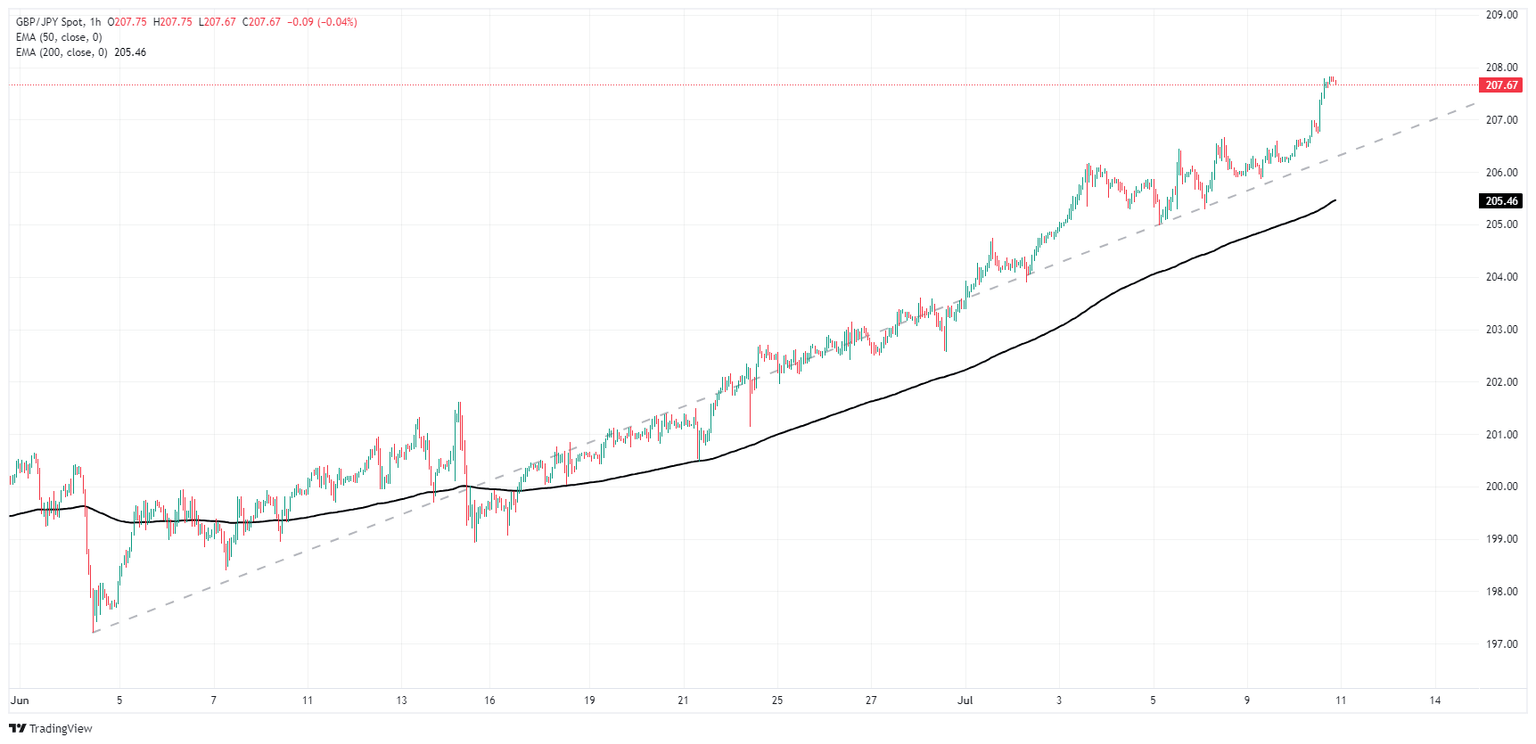
GBP/JPY daily chart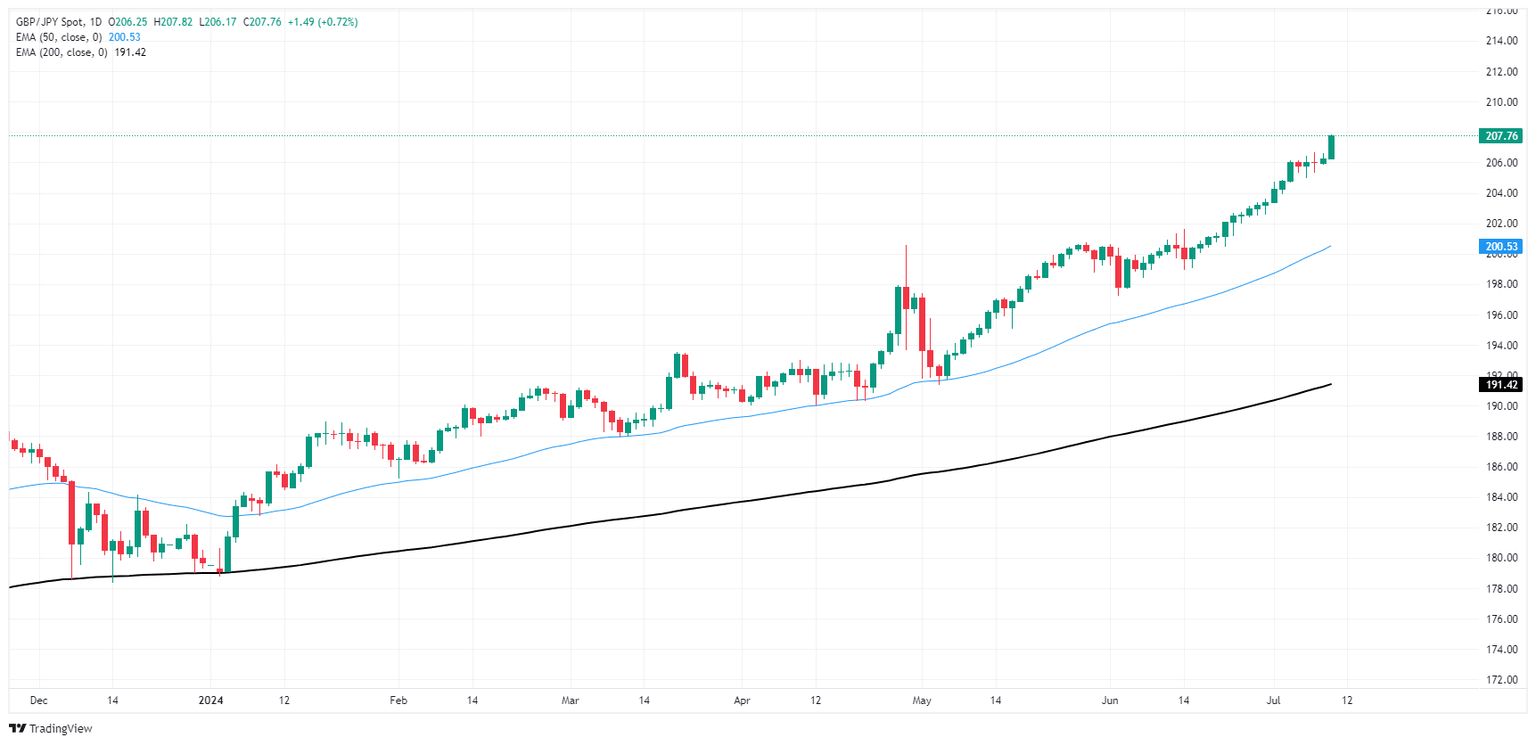
Japanese Yen FAQs
The Japanese Yen (JPY) is one of the world’s most traded currencies. Its value is broadly determined by the performance of the Japanese economy, but more specifically by the Bank of Japan’s policy, the differential between Japanese and US bond yields, or risk sentiment among traders, among other factors.
One of the Bank of Japan’s mandates is currency control, so its moves are key for the Yen. The BoJ has directly intervened in currency markets sometimes, generally to lower the value of the Yen, although it refrains from doing it often due to political concerns of its main trading partners. The current BoJ ultra-loose monetary policy, based on massive stimulus to the economy, has caused the Yen to depreciate against its main currency peers. This process has exacerbated more recently due to an increasing policy divergence between the Bank of Japan and other main central banks, which have opted to increase interest rates sharply to fight decades-high levels of inflation.
The BoJ’s stance of sticking to ultra-loose monetary policy has led to a widening policy divergence with other central banks, particularly with the US Federal Reserve. This supports a widening of the differential between the 10-year US and Japanese bonds, which favors the US Dollar against the Japanese Yen.
The Japanese Yen is often seen as a safe-haven investment. This means that in times of market stress, investors are more likely to put their money in the Japanese currency due to its supposed reliability and stability. Turbulent times are likely to strengthen the Yen’s value against other currencies seen as more risky to invest in.
Author
Joshua Gibson
FXStreet
Joshua joins the FXStreet team as an Economics and Finance double major from Vancouver Island University with twelve years' experience as an independent trader focusing on technical analysis.