European equity indexes close broadly lower amidst US inflation-led rout, FTSE sheds nearly 1%
- European stocks declined on Thursday with a broad lack of positive news.
- ECB’s Economic Bulletin begrudgingly admitted growth is set to decline.
- US CPI inflation rose higher than expected, slapping down market sentiment.

European equity indexes broadly tumbled into the close on Thursday as stock traders pulled back from a dovish-sounding European Central Bank (ECB) and US inflation threatening to tilt hotter once more, pushing out the likelihood of the Federal Reserve (Fed) getting bullied into a rate cut cycle sooner rather than later.
The ECB’s Economic Bulletin revealed little new information from the European Central Bank’s deliberations in December; the ECB remains committed to hinging their rate policy on inflation expectations, and remains determined to brand themselves as being data-dependent in lock-step with markets that continue to roil on a case-by-case basis as economic data gets released.
The ECB grudgingly admitted that growth is set to continue declining looking forward after a technical contraction in 2023’s third quarter, and 4Q is broadly expected to repeat the pattern. Despite flagging growth, the EU’s overall employment landscape remains firm with unemployment sticking to the low side, counter-intuitively hampering equity valuations as a tight labor market makes it harder for the ECB to justify moving interest rates.
European stocks added to Thursday’s declines after US Consumer Price Index (CPI) inflation figures broadly beat market forecasts, with December’s MoM CPI climbing from 0.1% to 0.3% versus the forecast 0.2%. Annualized US CPI also beat the market, ticking up from 3.1% to 3.4% and climbing over the expected 3.2%.
US CPI inflation climbs to 3.4% in December vs. 3.2% expected
YoY Core US CPI declined slightly from 4.0% to 3.9%, but failed to meet the median market forecast of 3.8%. With US inflation surprising to the upside, chances of the Fed beginning to cut rates in March are beginning to wane, despite money markets continuing to price in 67% odds of the first rate cut coming from Fed within the first quarter of 2024.
Germany’s DAX shed nearly 143 points on Thursday to close down 0.86% at €16,547.03, with France’s CAC 40 dropping a little under 39 points close at €7,387.62, down 0.52%. The STOXX600 pan-European index fell 3.65 points to end the trading day down 0.77% at €472.77.
The UK’s FTSE major equity index was the hardest-hit of the major indexes from the European continent, tumbling 0.98% and shedding a little over 75 points, wrapping up Thursday’s trading at £7,576.59.
FTSE Technical Outlook
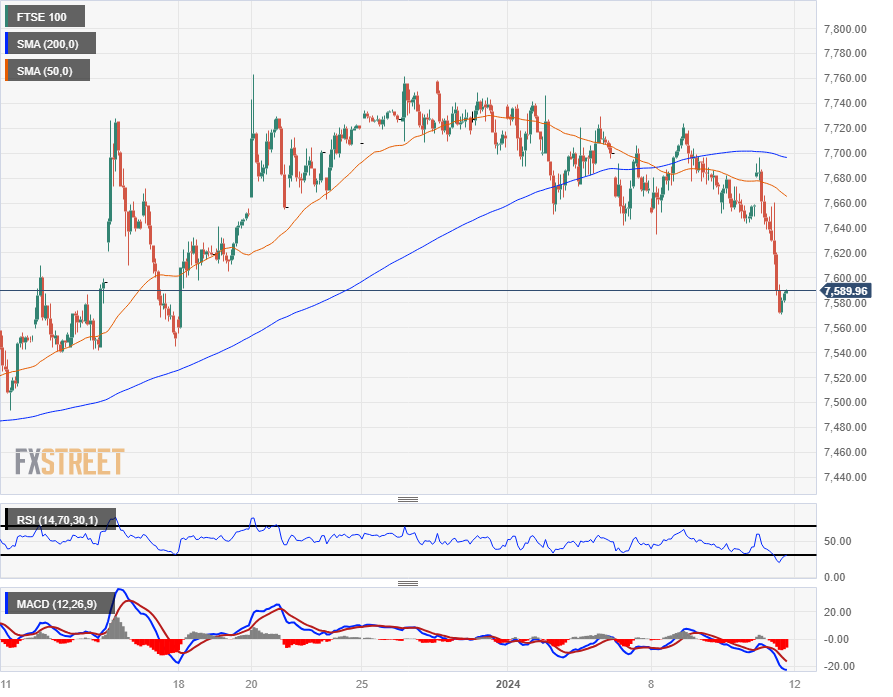
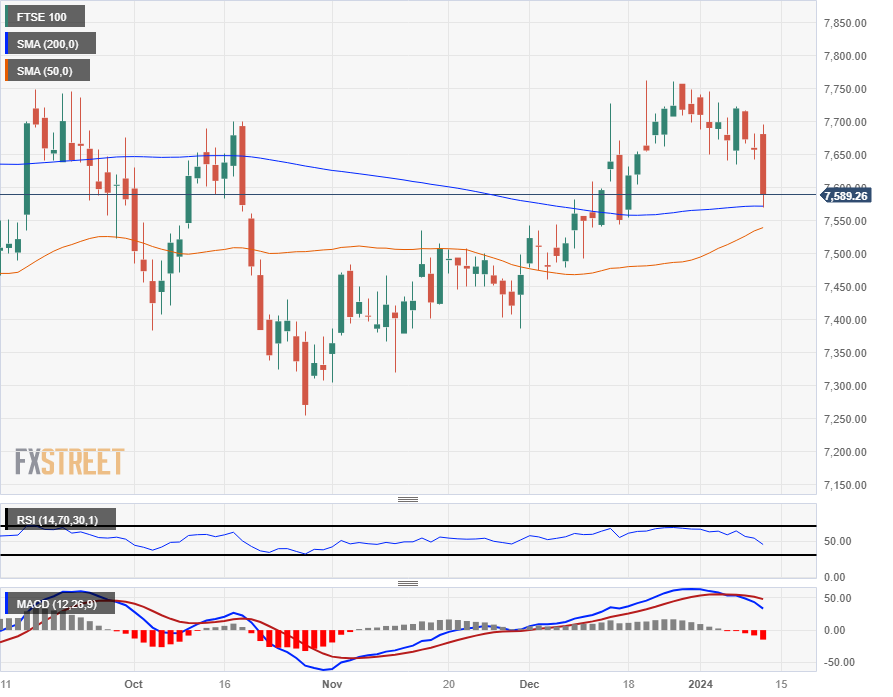
London’s major FTSE 100 equity index saw steep declines on Thursday in a new worst single-day performance for 2024, tumbling from the day’s early peak of £7,696.43.
The FTSE’s near-term rough chop has given way to a quick plunge into fresh lows for the year-to-date, decisively shedding the £7,660 level as the index declines further from the 200-hour Simple Moving Average (SMA) near £7,700.
Thursday’s downside action saw the FTSE tap the 200-day SMA at £7,572 before a clean near-term rebound, but topside momentum remains limited in the overnight session.
FTSE Hourly Chart
FTSE Daily Chart
FTSE Technical Levels
Author

Joshua Gibson
FXStreet
Joshua joins the FXStreet team as an Economics and Finance double major from Vancouver Island University with twelve years' experience as an independent trader focusing on technical analysis.















