EUR/USD stabilises beneath 1.1850 as focus shifts to German IFO data, ECB and Fedspeak
- EUR/USD is consolidating beneath 1.1850, having seen a decent bounce from post-strong US PMI data lows of 1.1801.
- Despite setting hitting both its highest and lowest levels in more than a week on Monday, EUR/USD is now back within last week’s range.

Not that the recovery of the last few hours comes close to the magnitude or speed of the earlier decline, but EUR/USD has managed to recoup a decent percentage of its post-US Markit PMI decline late in Monday’s EU session. The pair managed to rally above 1.1900 during the European morning, only to then drop 100 pips in wake of the data to hit lows around 1.1801, though the pair has now bounced back to 1.1840. That means on the day, EUR/USD is actually only around 10 pips lower than its Monday Asia session opening levels of pretty much bang on 1.1850.
EUR undermined as US data highlights relative economic weakness
Monday’s PMI data out of the US and Eurozone highlighted what might be early signs of a new trend over the coming months; one of Eurozone economic underperformance in comparison to the US. Indeed, though the manufacturing sectors generally performed well across both economies (although US manufacturing PMI was higher at 56.7 versus the Eurozone’s 53.6), the divergence in service sector performance was stark.
US Markit Services PMI came in significantly above expectations at 57.7, more than 10 points above the Eurozone Services PMI which came in at 45.8. The real shock was not the fact that Eurozone services took a sizeable hit from the fact that most of the continent has been in lockdown in November, but that the improvement in US Service sector sentiment was so large.
IHS Markit noted that an end to election uncertainty as well as improved vaccine hopes gave led to the greatest degree of optimism for the year ahead since May 2014 in the US. While these hopes also boosted optimism for the next 12 months in Europe, this was nowhere near enough to make up for pessimism as a result of lockdowns.
Elsewhere of note for EUR/USD, central bank speakers from both sides of the pond featured on Monday, though nothing was said that added anything new or triggered any market reaction.
The most interesting/policy-relevant comments came from FOMC member Charles Evans, who said that if we cannot have fiscal support, the Fed will have lower rates and maintain a bigger balance sheet for longer. Moreover, he said he does not see inflation getting up to 2% until 2022 or maybe 2023, and does not expect to raise rates until late 2023 or maybe 2024 (pretty much in line with Fed forecasts and the Fed’s dot plot guidance). Evans added that he would be surprised if the Fed hiked rates before 2023 even if recovery is stronger than expected, a line of thinking that might be important to reiterate in order to ease market concerns of pre-emptive Fed tightening.
Looking ahead for EUR/USD, the pair will be on notice for German IFO data during Tuesday’s European morning session, then comments from ECB President Christine Lagarde and ECB’s Isabelle Schnabel, de Cos, Oli Rehn and Philip Lane and FOMC’s James Bullard, John Williams, and Vice Chairman Richard Clarida. US consumer confidence and Case-Shiller housing data will also be worth watching.
EUR/USD back in recent ranges following fake-outs in both directions
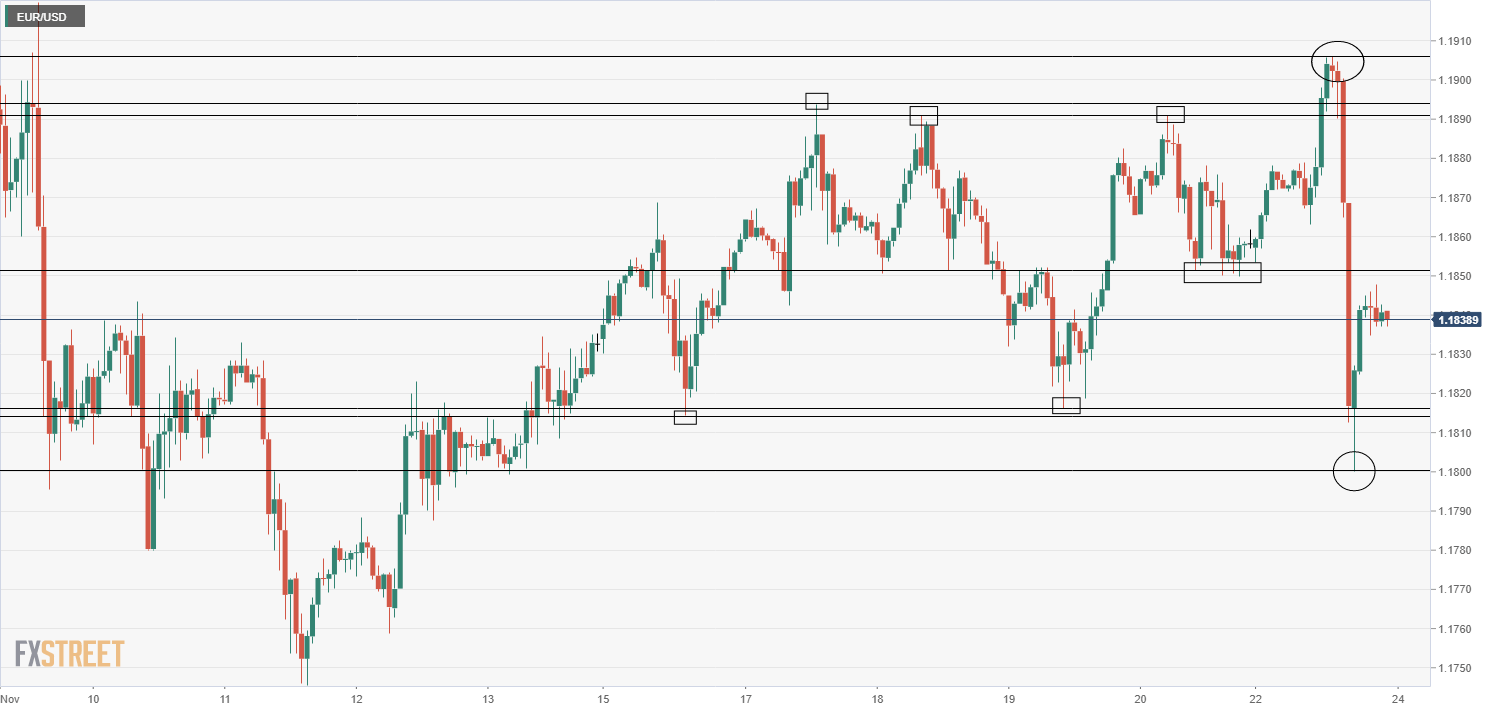
EUR/USD saw more volatility in four hours on Monday than it did over the past week; the pair managed to break to the upside of its recent 1.1814-1.1895 range during the European morning, making highs around 1.1905. Following the strong US data the pair subsequently broke beneath the bottom of its recent range, hitting lows of 1.1801.
However, with EUR/USD back to around the 1.1840 mark and almost bang in the middle of its recent range, it appears that this recent range looks likely to continue to remain relevant, even if the boundaries have been pushed a little further (i.e. the new bottom of the range is pretty much 1.1800 while the top is not basically 1.1900).
These are the key levels for EUR/USD going forward, but in the more immediate term, if EUR/USD wants to rally back to the top of its recent range, it is going to have to overcome resistance at 1.1850, the low of last Friday and Monday Asia session lows. The pair seems to be struggling with this level right now.
EUR/USD one hour chart
Author
Joel Frank
Independent Analyst
Joel Frank is an economics graduate from the University of Birmingham and has worked as a full-time financial market analyst since 2018, specialising in the coverage of how developments in the global economy impact financial asset