|

EUR/USD Price Analysis: Euro surges near 2025 highs as bullish structure strengthens

  • EUR/USD trades near the 1.1200 zone after a sharp rally.
  • Technical indicators lean bullish, with MACD favoring more upside and key moving averages aligned to support.
  • Support is seen near the 1.1000 area, while resistance is uncharted after breaking to new yearly highs.

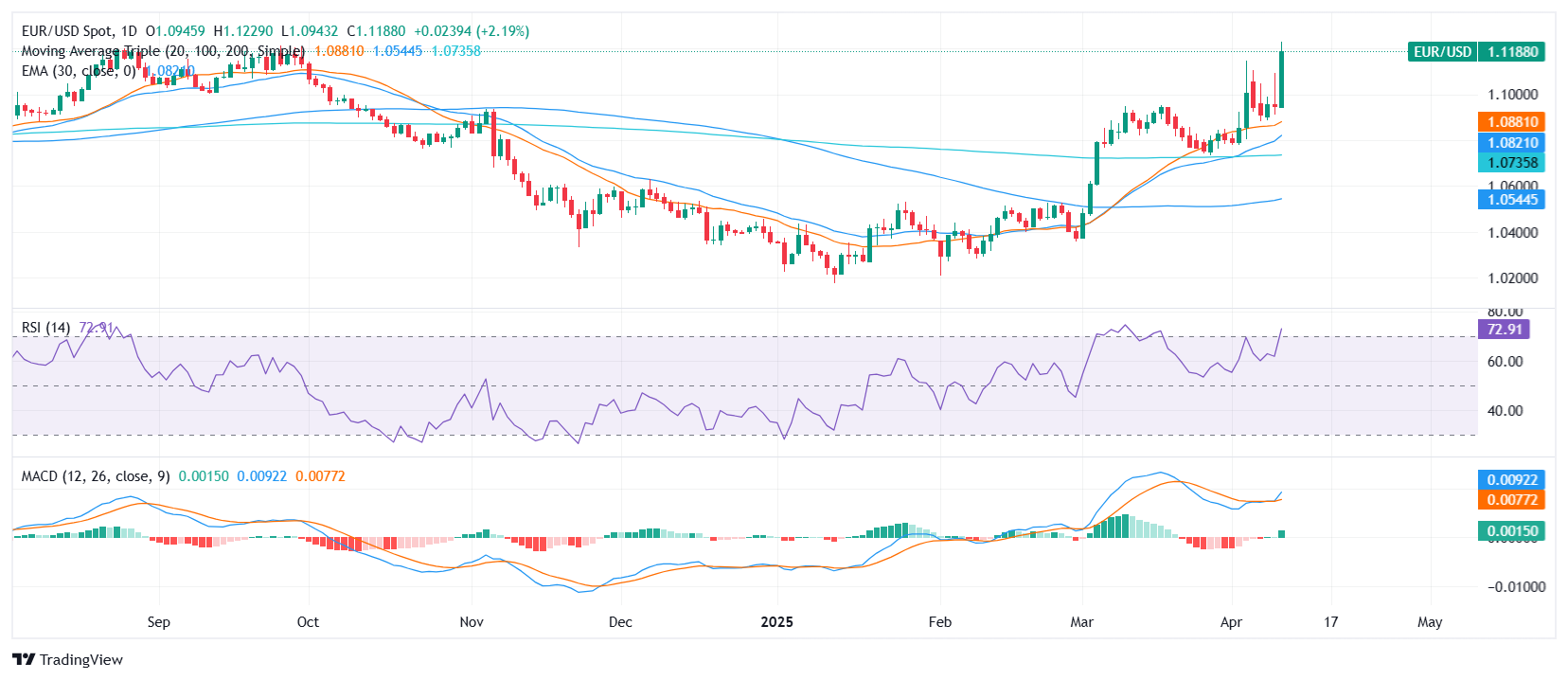
The EUR/USD pair extended its rally on Thursday’s session after the European close, pushing toward the 1.1200 area and posting one of its strongest daily gains in recent months. The move, which places the Euro near the upper boundary of its intraday range between 1.09426 and 1.1220, underscores the pair's bullish momentum as it tests fresh 2025 highs.

Technically, the structure remains supported by a solid combination of indicators. The Relative Strength Index (RSI) sits at 70.98, a level considered high yet still not in extreme overbought territory. Meanwhile, the Moving Average Convergence Divergence (MACD) is flashing a buy signal, pointing to continued upward strength. The Williams Percent Range (−0.50) and Stochastic %K at 68.41 both remain in neutral territory, suggesting there is still room for price extension before a reversal becomes a concern.

Key moving averages reinforce the bullish tone. The 20-day Simple Moving Average (SMA) at 1.08865, the 100-day at 1.05475, and the 200-day at 1.07399 are all sloped upward and well below current levels, confirming broader trend support. Similarly, the 10-day Exponential Moving Average (EMA) at 1.09561 and the 10-day SMA at 1.09285 further strengthen the short-term positive bias.

In terms of levels, initial support is found at 1.10309, followed by 1.09606 and the 10-day EMA at 1.09561. With the pair now trading near yearly highs, resistance is less defined, and traders may look for psychological levels or fib projections as the next potential hurdles.

Daily chart
Author

Patricio Martín

Patricio is an economist from Argentina passionate about global finance and understanding the daily movements of the markets.


More from Patricio Martín
Share:

Editor's Picks

GBP/USD off highs, back to 1.3620

GBP/USD remains slightly on the defensive at the end of the week, receding to the low 1.3600s after hitting fresh tops past 1.3670 earlier in the day. Cable’s correction comes after two daily gains in a row and amid a tepid advance in the Greenback, while poor UK data also accompany the downside.

EUR/USD treads water below 1.1700

EUR/USD now trades with modest losses around 1.1670 following another unsuccessful atempt to advance past 1.1700 the figure in a convincing fashion. The pair’s decline follows a maginal rebound in the US Dollar as market participants continue to assess recent US data as well as developments from the US bond market.

Gold trims gains, recedes to the sub-$4,600 area

Gold rapidly leaves behind Thursday’s inconclusive price action and advances markedly on Friday, briefly surpassing the $4,600 mark per troy ounce to hit three-month peaks. Meanwhile, the precious metal’s solid performance comes despite marginal gains in the buck coupled with another day of rising US Treasury yields across the curve.

Crypto Today: Bitcoin, Ethereum, XRP bulls accelerate rally amid rising ETF inflows

The cryptocurrency market remains bullish on Friday, led by Bitcoin’s surge above $77,000. Altcoins, including Ethereum and Ripple, mirror BTC’s positive outlook, trading near $2,400 and $1.35, respectively.

Week ahead – Fed’s Jackson Hole and Nvidia earnings to dictate markets

Kevin Warsh to make his Jackson Hole debut amid confusing messaging. But a major hawkish surprise unlikely after bond market intervention. Nvidia earnings to also determine market direction as stock rally cools.

$20 billion offered, $2 billion taken: Why Treasury doubled its buyback cap

The US Treasury moved off its own calendar on Wednesday, and that is the part worth sitting with. At 12:32 GMT, the department said it would at least double the size of liquidity support buyback operations in the 10-year to 20-year and 20-year to 30-year sectors, lifting the maximum from $2 billion per operation to at least $4 billion, effective September 9 and running to November 4.