|

EUR/USD Price Analysis: Consolidates around mid-1.0500s, focus remains on US NFP

  • EUR/USD struggles to gain any meaningful traction on Friday and oscillates in a narrow band.
  • The technical setup seems tilted in favour of bears and supports prospects for further decline.
  • Traders now await the release of the key US NFP report before placing fresh directional bets.

The EUR/USD pair is seen oscillating in a narrow trading band during the Asian session on Friday and consolidating its recovery gains registered over the past two days, from mid-1.0400s or the YTD low touched earlier this week. Spot prices currently trade just below the 1.0550 level, nearly unchanged for the day, as traders keenly await the release of the closely-watched US monthly employment details, popularly known as the NFP report.

Heading into the key data risk, the prospects for further policy tightening remain supportive of elevated US Treasury bond yields and act as a tailwind for the US Dollar (USD). Apart from this, a generally weaker tone around the equity markets further seems to underpin the safe-haven Greenback. This, along with expectations that additional rate hikes by the European Central Bank (ECB) may be off the table for now, contributes to keeping a lid on the EUR/USD pair.

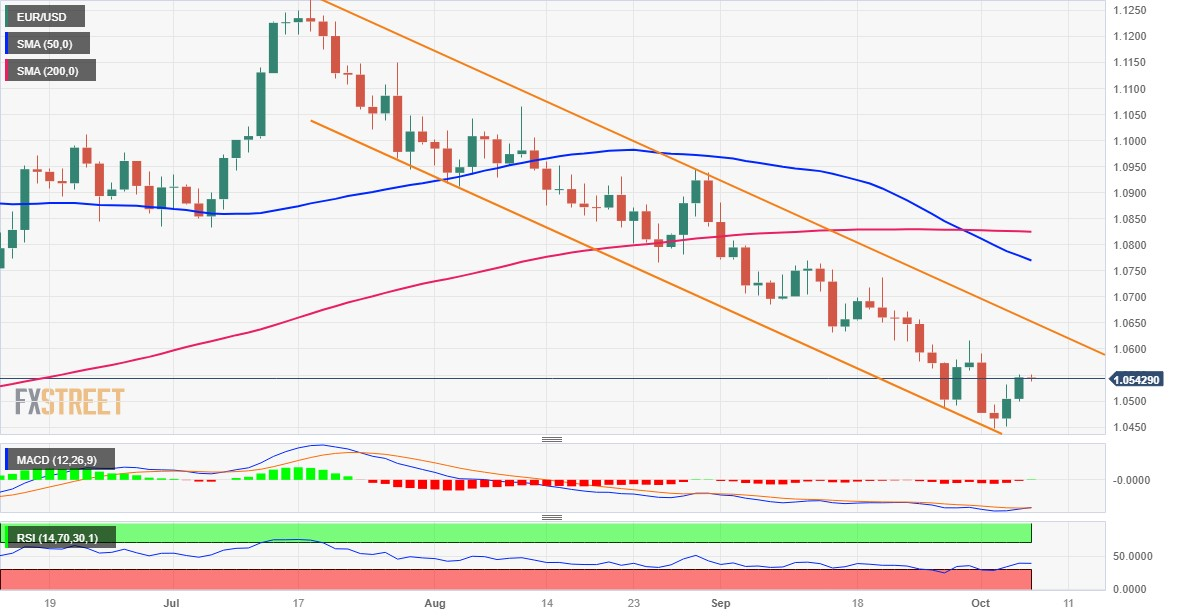
From a technical perspective, the recent decline from a 17-month peak touched in June has been along a descending channel and points to a well-established downtrend. Moreover, the Relative Strength Index (RSI) on the daily chart has also recovered from the oversold territory. Hence, any subsequent move up might still be seen as an opportunity to initial fresh bearish positions around the EUR/USD pair and run the risk of fizzling out rather quickly.

Meanwhile, any positive reaction to a disappointment from the US jobs data could lift spot prices beyond the 1.0600 round-figure mark. The momentum could get extended, though is more likely to remain capped near the top boundary of the aforementioned channel, currently around mid-1.0600s. The latter should act as a key pivotal point, which if cleared will suggest that the EUR/USD pair has formed a nea-term bottom and shift the bias in favour of bulls.

On the flip side, the 1.0500 psychological mark now seems to protect the immediate downside. Some follow-through selling could make spot prices vulnerable to refresh the YTD low and challenge the ascending channel support, near the 1.0420-1.0415 region. A convincing break below will be seen as a fresh trigger for bearish traders and pave the way for an extension of the EUR/USD pair's near-three-month-old downward trajectory.

EUR/USD daily chart
fxsoriginal

Technical levels to watch

EUR/USD

Overview
Today last price1.0543
Today Daily Change-0.0003
Today Daily Change %-0.03
Today daily open1.0546
 
Trends
Daily SMA201.0619
Daily SMA501.0779
Daily SMA1001.0845
Daily SMA2001.0826
 
Levels
Previous Daily High1.0552
Previous Daily Low1.05
Previous Weekly High1.0656
Previous Weekly Low1.0488
Previous Monthly High1.0882
Previous Monthly Low1.0488
Daily Fibonacci 38.2%1.0532
Daily Fibonacci 61.8%1.052
Daily Pivot Point S11.0513
Daily Pivot Point S21.0481
Daily Pivot Point S31.0461
Daily Pivot Point R11.0565
Daily Pivot Point R21.0584
Daily Pivot Point R31.0617

Author

Haresh Menghani

Haresh Menghani is a detail-oriented professional with 10+ years of extensive experience in analysing the global financial markets.


More from Haresh Menghani
Share:

Editor's Picks

AUD/USD consolidates above 0.7000; remains close to monthly top

AUD/USD holds steady above 0.7000 during the Asian session on Friday, trading just below the previous day's monthly low amid diverging forces. A hawkish RBA continues to support the Aussie, while the recent decline in US bond yields keeps the US Dollar depressed near a three-week low. However, oil-driven inflation fears reinforce Fed hike bets, which, along with geopolitical risks, could benefit the safe-haven buck and cap the currency pair.

USD/JPY bounces off one-month low; climbs to 157.00 amid reviving USD demand

USD/JPY rebounds from the 156.00 neighborhood, or a one-month low touched during Friday’s Asian session, with bulls looking to extend momentum beyond 157.00 amid the emergence of some US Dollar buying. Meanwhile, Japan's National CPI rose to a nine-month peak and reaffirmed BoJ rate-hike bets, which could support the Japanese Yen and cap gains for the currency pair.

Gold holds above $4,000/three-month low as Fed hike bets and firm USD cap upside

Gold struggles to capitalize on its modest recovery from levels below the $4,000 psychological mark, or a three-month low set earlier this Friday, and retains a bearish tone through the first half of the European session. Federal Reserve officials recently signaled there is no urgency to raise interest rates. Traders, however, are still pricing in around an 80% chance that the US central bank will raise borrowing costs again at its December policy meeting.

Crypto Today: Bitcoin holds the 50-day EMA as Ethereum and XRP face structural resistance

Bitcoin gradually ticks up on Friday, trading above $81,000. The Crypto King has recently defended structural support near $80,000, reinforcing the prevailing bullish outlook. Ethereum similarly edges higher above $2,400, while Ripple trades above $1.32 after testing support around $1.30.

US S&P Global PMI expected to show moderating business activity in October

The United States S&P Global preliminary Purchasing Managers Indices for October will be released on Friday, providing fresh insights into the health of the world's largest economy ahead of next week's Federal Reserve monetary policy meeting. The report includes the Manufacturing PMI, Services PMI and Composite PMI, which measure business activity across the private sector.

What November 3 means for the Fed's rate path and the US Dollar

The USD faces a decisive period ahead of the November 3 midterm elections. While markets anticipate another interest rate increase from the Fed in December, the battle for control of Congress could reshape fiscal policy expectations and, indirectly, the path of US monetary policy in 2027.