EUR/USD gains after mixed US data, focus shifts to Trump–Putin meeting
- EUR/USD rises 0.47% to 1.1702, shrugging off in-line July US Retail Sales and upward June revision.
- Market focus on Trump–Putin summit in Anchorage; analysts skeptical about securing Ukraine ceasefire.
- UBS sees EUR/USD reaching 1.21 by year-end if truce achieved.
- US consumer sentiment weakens in August amid inflation fears despite strong spending data.

EUR/USD reverses its course, climbs on Friday, ignoring solid US Retail Sales data due to market participants still pricing in a Federal Reserve (Fed) rate cut in September. The pair trades at 1.1702, up 0.47%.
The market's attention turned to Anchorage, Alaska, for the summit of US President Donald Trump and Russian President Vladimir Putin, with analysts’ expectations remaining low for achieving a ceasefire in Ukraine. Meanwhile, Trump said that he doesn’t know what would make the reunion a success and that he would like to reach a truce before Washington and Moscow can talk about other issues.
According to some analysts, a truce would be bullish for the Euro, which, according to UBS analysts, would reach 1.21 against the US Dollar by the end of the year.
Aside from this, Retail Sales in the US were solid in July, while the June print was upwardly revised, signaling the strength of consumers. Nonetheless, the University of Michigan Consumer Sentiment survey in August showed a deterioration of American households, sparked by expectations of a reacceleration of inflation.
Across the pond, the following week’s European Union (EU) economic schedule will feature Flash PMIs for the bloc to provide further evidence of a recovery in the manufacturing sector. Also, the EU and Germany’s inflation figures could cement the case that the European Central Bank (ECB) can pause its easing cycle, providing further support for the shared currency.
Euro PRICE This week
The table below shows the percentage change of Euro (EUR) against listed major currencies this week. Euro was the strongest against the New Zealand Dollar.
| USD | EUR | GBP | JPY | CAD | AUD | NZD | CHF | |
|---|---|---|---|---|---|---|---|---|
| USD | -0.48% | -0.77% | -0.22% | 0.44% | 0.27% | 0.59% | -0.28% | |
| EUR | 0.48% | -0.29% | 0.28% | 0.93% | 0.76% | 1.03% | 0.21% | |
| GBP | 0.77% | 0.29% | 0.50% | 1.23% | 1.06% | 1.33% | 0.50% | |
| JPY | 0.22% | -0.28% | -0.50% | 0.70% | 0.53% | 0.87% | 0.08% | |
| CAD | -0.44% | -0.93% | -1.23% | -0.70% | -0.16% | 0.09% | -0.74% | |
| AUD | -0.27% | -0.76% | -1.06% | -0.53% | 0.16% | 0.27% | -0.54% | |
| NZD | -0.59% | -1.03% | -1.33% | -0.87% | -0.09% | -0.27% | -0.81% | |
| CHF | 0.28% | -0.21% | -0.50% | -0.08% | 0.74% | 0.54% | 0.81% |
The heat map shows percentage changes of major currencies against each other. The base currency is picked from the left column, while the quote currency is picked from the top row. For example, if you pick the Euro from the left column and move along the horizontal line to the US Dollar, the percentage change displayed in the box will represent EUR (base)/USD (quote).
Daily digest market movers: EUR/USD shrugs off strong US Retail Sales report
- Euro’s advance is sponsored by broad US Dollar weakness as the Greenback is poised to sustain 0.43% losses in the week. The US Dollar Index, which measures the buck’s performance against a basket of peers, drops 0.36% daily, down to 97.84.
- Retail Sales in the US rose by 0.5% MoM in July, matching expectations but slowing from June’s upwardly revised 0.9% gain. On an annual basis, growth dipped to 3.9% from 4.4% in June.
- Industrial Production contracted by 0.1% in July, following a 0.4% increase in June and missing forecasts for no change, according to Federal Reserve data.
- Consumer Sentiment, as revealed by the University of Michigan, showed that American consumers grew pessimistic, with the index falling to 58.6 in August from 61.7 in July, missing estimates of 62.0. Inflation was cited as the primary driver of the sudden change in consumers' mood as one-year inflation expectations rose to 4.9% from 4.5% and the five-year outlook climbed to 3.9% from 3.4%.
- Following the latest US data releases, the Atlanta Fed's GDPnow Q3 projection remained unchanged at 2.5%.
- Fed Interest Rate Probabilities show that traders have priced in a 95% chance of a 25 bps rate cut at the September meeting, according to Prime Market Terminal data.
- On the European Central Bank (ECB) front, the easing cycle seems to be on pause for the September meeting, with 94% odds for the ECB to keep rates unchanged and a slim 9% chance of a 25 bps rate cut.
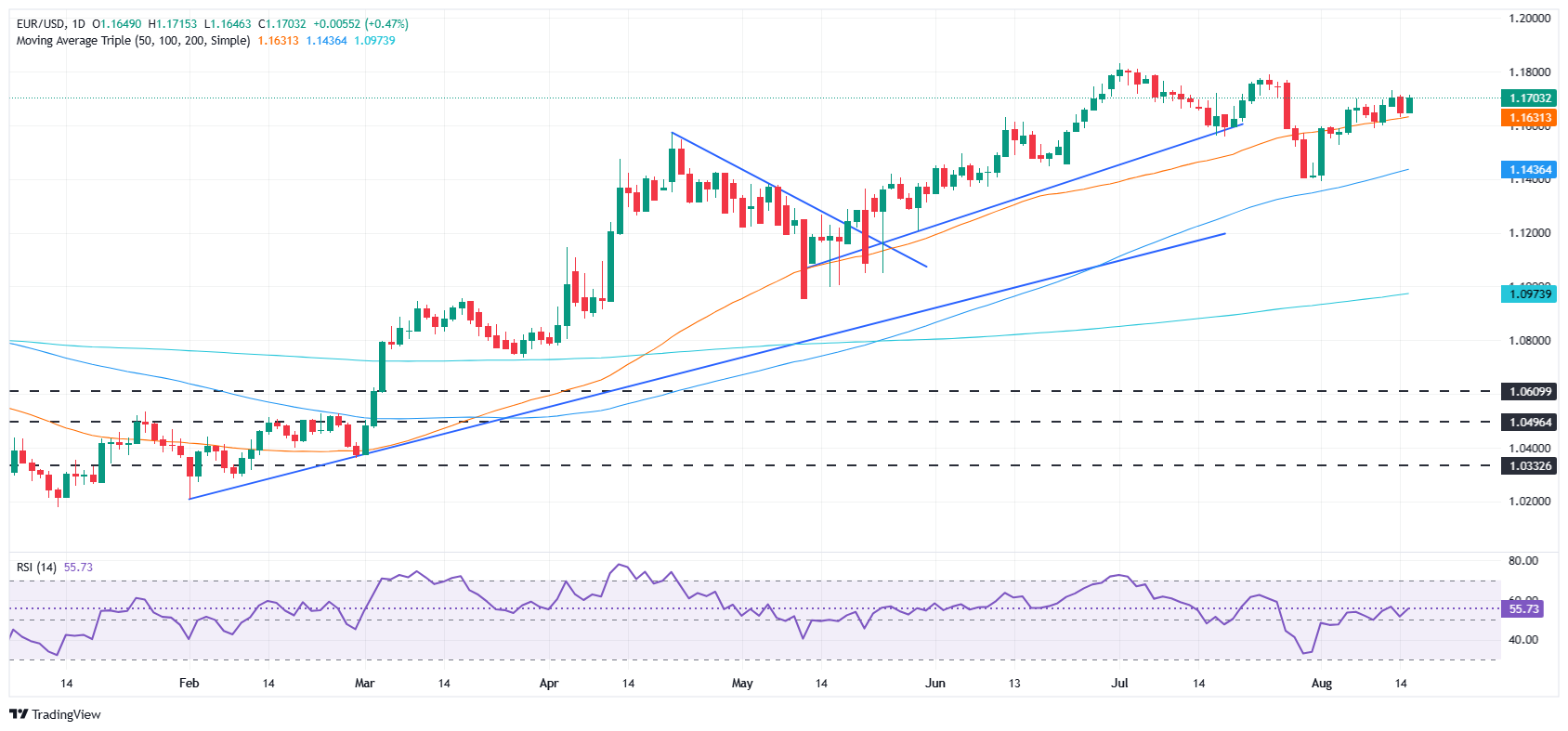
Technical outlook: EUR/USD rises past 1.1700 as bulls target 1.1800
The EUR/USD uptrend resumes on Friday, yet bulls must achieve a daily close above 1.1700 to pave the way for further upside. Momentum as measured by the Relative Strength Index (RSI) shows that further upside is seen, but buyers need to surpass the July 24 high of 1.1788, so they can challenge 1.1800 and the year-to-date (YTD) high of 1.1829.
On the flip side, a daily close below 1.1700 could put into play a test of the confluence of the 20-day and 50-day Simple Moving Averages (SMAs) around 1.1624/30. Further losses are seen below at 1.1600.
Euro FAQs
The Euro is the currency for the 19 European Union countries that belong to the Eurozone. It is the second most heavily traded currency in the world behind the US Dollar. In 2022, it accounted for 31% of all foreign exchange transactions, with an average daily turnover of over $2.2 trillion a day. EUR/USD is the most heavily traded currency pair in the world, accounting for an estimated 30% off all transactions, followed by EUR/JPY (4%), EUR/GBP (3%) and EUR/AUD (2%).
The European Central Bank (ECB) in Frankfurt, Germany, is the reserve bank for the Eurozone. The ECB sets interest rates and manages monetary policy. The ECB’s primary mandate is to maintain price stability, which means either controlling inflation or stimulating growth. Its primary tool is the raising or lowering of interest rates. Relatively high interest rates – or the expectation of higher rates – will usually benefit the Euro and vice versa. The ECB Governing Council makes monetary policy decisions at meetings held eight times a year. Decisions are made by heads of the Eurozone national banks and six permanent members, including the President of the ECB, Christine Lagarde.
Eurozone inflation data, measured by the Harmonized Index of Consumer Prices (HICP), is an important econometric for the Euro. If inflation rises more than expected, especially if above the ECB’s 2% target, it obliges the ECB to raise interest rates to bring it back under control. Relatively high interest rates compared to its counterparts will usually benefit the Euro, as it makes the region more attractive as a place for global investors to park their money.
Data releases gauge the health of the economy and can impact on the Euro. Indicators such as GDP, Manufacturing and Services PMIs, employment, and consumer sentiment surveys can all influence the direction of the single currency. A strong economy is good for the Euro. Not only does it attract more foreign investment but it may encourage the ECB to put up interest rates, which will directly strengthen the Euro. Otherwise, if economic data is weak, the Euro is likely to fall. Economic data for the four largest economies in the euro area (Germany, France, Italy and Spain) are especially significant, as they account for 75% of the Eurozone’s economy.
Another significant data release for the Euro is the Trade Balance. This indicator measures the difference between what a country earns from its exports and what it spends on imports over a given period. If a country produces highly sought after exports then its currency will gain in value purely from the extra demand created from foreign buyers seeking to purchase these goods. Therefore, a positive net Trade Balance strengthens a currency and vice versa for a negative balance.
Author

Christian Borjon Valencia
FXStreet
Markets analyst, news editor, and trading instructor with over 14 years of experience across FX, commodities, US equity indices, and global macro markets.