|

EUR/USD Forecast: near-term bearish on improving December Fed rate hike odds

With investors looking past the latest political turmoil in Spain, the EUR/USD pair was seen building on overnight tepid recovery move from 7-week lows. A modest US Dollar retracement, primarily led by some profit taking amid absent top tier economic releases, helped the pair to gain some positive traction. However, growing market expectations that the Fed would deliver a third rate hike in December, coupled with hopes for US tax reform continued supporting the greenback and might keep a lid on any sharp near-term up-move. 

Investors now look forward to the ADP report on the US private sector employment, which is considered as a precursor for Friday's official jobs report and should provide some fresh impetus. Later during the day, key speeches by the ECB President Mario Draghi and the Fed Chair Janet Yellen might trigger a fresh bout of volatility ahead of this week's key event risk - NFP. 

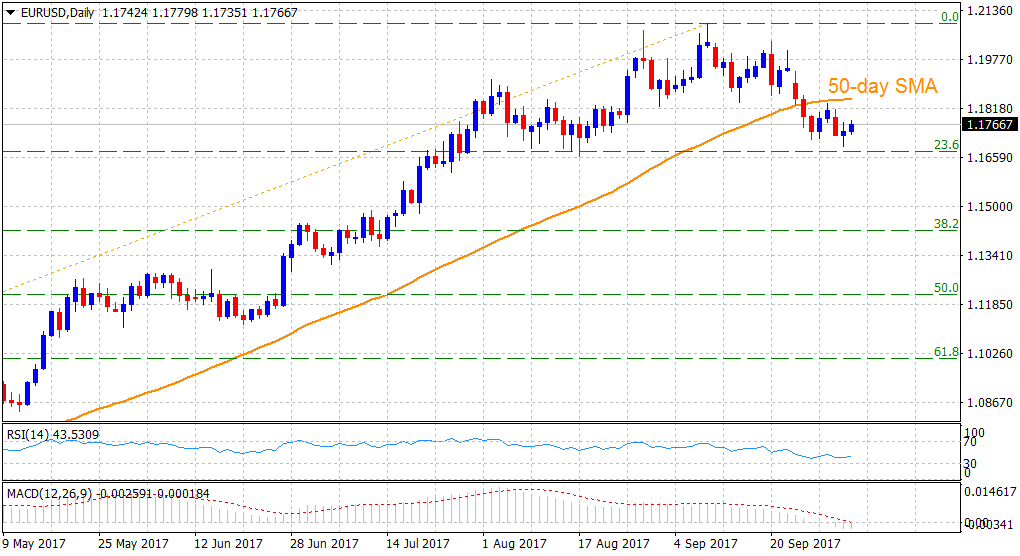
From a technical perspective, the pair has already confirmed a bearish break below 50-day SMA and with short-term indicators holding in negative territory, the pair remains poised to extend its near-term corrective slide. Hence, any additional recovery move now seems to confront fresh supply near the 1.1800 handle and even if the pair managed to clear this immediate hurdle, further up-move should remain capped at 50-day SMA, support break now turned resistance, near the 1.1845 region.

On the flip side, 1.1725 level is likely to protect immediate downside, which if broken would reinforce the bearish bias and should drag the pair below the 1.1700 handle towards testing its immediate strong support near 1.1680-75 zone, marking 23.6% Fibonacci retracement level of 1.0341-1.2092 YTD up-swing. A follow through selling pressure is likely to open room for additional downslide initially towards the 1.1600 mark and eventually towards 1.1555-50 horizontal support.
Author

Haresh Menghani

Haresh Menghani is a detail-oriented professional with 10+ years of extensive experience in analysing the global financial markets.


More from Haresh Menghani
Share:

Editor's Picks

AUD/USD bounces back toward 0.6950 on fresh USD supply

AUD/USD bounces back toward 0.6950 in the Asian session on Friday. The US Dollar retreats from 17-month highs as traders take profits off the table ahead of the all-important US Nonfarm Payrolls report. Meanwhile, the Australian Dollar draws support from reviving expectations of a November interest rate hike amid elevated global yields and inflation risks.


USD/JPY struggles near 158.00 as USD retreats ahead of NFP

USD/JPY is struggling for fresh impetus near 158.00, moving away from the top end of its weekly range in the Asian session on Friday, after hotter-than-expected Tokyo CPI and amid a broad US Dollar retreat. Traders reposition themselves ahead of US Nonfarm Payrolls.

Gold fades the earlier optimism; back below $4,200

Gold could not sustain the post-NFP bull run past the $4,200 mark per troy ounce, receding toward the $4,180 region at the end of the week. The precious metal’s inconclusive price action comes amid fresh selling pressure hurting the US Dollar as investors assess the latest NFP data.

Crypto Today: Bitcoin, Ethereum and XRP gains reinforce bullish outlook

Cryptocurrency prices are broadly recovering on Friday, led by Bitcoin moving above $86,000. Ethereum has reaffirmed its bullish outlook, rising above $2,700 while the immediate area at $2,800 caps upside. Meanwhile, Ripple hovers near $1.54.

Week ahead – Fed minutes in the spotlight amid bond market rout

Energy crisis and soaring bond yields to stay in driver’s seat in quiet week. Fed minutes eyed after drop in October rate hike bets. ISM services PMI and Treasury auctions to be watched too. Canadian employment, Japanese wages and ECB minutes also on tap.

The Euro is near a one-year low: Inflation could trigger its rebound, not its fall

EUR/USD has fallen to its lowest level since May 2025. The pair hit 1.1312 on Wednesday and trades well below the January peak of 1.2082. The decline reflects a powerful combination of US Dollar strength, geopolitical uncertainty and renewed concerns about Europe's exposure to higher energy prices.















