EUR/USD remains firm with markets awaiting ECB and Fed speakers
- EUR/USD appreciates for the second consecutive day, reaching highs above 1.1870.
- Eurozone's Sentix Index points to an improving economic outlook.
- A brighter risk sentiment and a weaker US Dollar are boosting the pair on Monday.
The Euro (EUR) is trading firm against the US Dollar (USD) at the week's opening, trading at levels right above 1.1870 at the time of writing on Monday. Upbeat Eurozone investors' sentiment data has provided additional support to a firm euro, already on a strong footing, as market expectations that the US Federal Reserve (Fed) will cut interest rates further in the coming months are weighing on the US Dollar.
In the Asian session, the market welcomed the landslide victory of Prime Minister Sanae Takaichi in Japan, which has soothed concerns amid prospects of a stable government. The immediate reaction has been a Japanese Yen (JPY) recovery, which has increased bearish pressure on the USD.
Later in the day, the focus will shift to the speeches of European Central Bank (ECB) policymakers, including President Christine Lagarde. Nevertheless, there are no reasons to think that they might have changed the message from last week's monetary policy meeting, pointing to a steady monetary policy.
Also on Monday's US trading session, speeches from Fed members will likely show the divergence within the central bank's monetary policy committee. Governors Stephen Miran and Christopher Waller are likely to defend lower interest rates, while the Atlanta Fed President Raphael Bostic might show a more cautious stance.
Euro Price Today
The table below shows the percentage change of Euro (EUR) against listed major currencies today. Euro was the strongest against the US Dollar.
| USD | EUR | GBP | JPY | CAD | AUD | NZD | CHF | |
|---|---|---|---|---|---|---|---|---|
| USD | -0.44% | -0.19% | -0.36% | -0.26% | -0.34% | -0.16% | -0.58% | |
| EUR | 0.44% | 0.24% | 0.04% | 0.17% | 0.11% | 0.28% | -0.14% | |
| GBP | 0.19% | -0.24% | -0.19% | -0.09% | -0.14% | 0.03% | -0.38% | |
| JPY | 0.36% | -0.04% | 0.19% | 0.11% | 0.03% | 0.21% | -0.22% | |
| CAD | 0.26% | -0.17% | 0.09% | -0.11% | -0.08% | 0.11% | -0.32% | |
| AUD | 0.34% | -0.11% | 0.14% | -0.03% | 0.08% | 0.18% | -0.24% | |
| NZD | 0.16% | -0.28% | -0.03% | -0.21% | -0.11% | -0.18% | -0.43% | |
| CHF | 0.58% | 0.14% | 0.38% | 0.22% | 0.32% | 0.24% | 0.43% |
The heat map shows percentage changes of major currencies against each other. The base currency is picked from the left column, while the quote currency is picked from the top row. For example, if you pick the Euro from the left column and move along the horizontal line to the US Dollar, the percentage change displayed in the box will represent EUR (base)/USD (quote).
Daily Digest market Movers: Rising Fed cuts hopes are weighing on the US Dollar
- The US Dollar has opened the week on the back foot, as weak employment figures last week have boosted investors' expectations that the Fed will be forced to lower borrowing costs further to support employment creation. This contrasts with the hawkish tone of the last ECB's statement, leading to a Euro-supportive monetary policy divergence.
- The odds of a Fed interest rate cut in March have risen above 17% from 10% last week, while markets are pricing in nearly a 70% chance of monetary easing in June – the first meeting after Chairman Jerome Powell's term ends – according to data from the CME Group's Fed Watch Tool.
- Earlier on Monday, the Eurozone's Sentix Investors' Sentiment Index showed an improvement to 4.2 in February, from -1.8 in January, posting the first positive reading since July. The survey also highlights investors' greater confidence in the German economy amid greater hopes of a global stabilisation driven by higher growth in the US and Asia.
- The highlight of Monday's Asian session has been the strong victory of Sanae Takaichi's Liberal Democratic Party (LDP) in Japan's Elections. The LDP and its coalition partner have obtained 352 of the 465 seats in the Lower House, which paves the path for her fiscal-expansionist agenda. Traders have scaled back Yen short positions as the immediate reaction to the news, which has sent the US lower.
- The US Dollar struggled to hold gains last week, as a string of downbeat employment reports brought concerns about the labor market back to the table.
- On Friday, the preliminary data showed that the Michigan Consumer Sentiment Index rose for the third consecutive month in February, against expectations, but it failed to improve investors' sentiment towards the US Dollar.
- Later this week, the market will be attentive to key US economic releases, including the delayed February Nonfarm Payrolls (NFP) report, which is due on Wednesday. US Retail Sales, due on Tuesday, and the Consumer Price Index (CPI) report on Friday will also be analysed in detail
Technical Analysis: EUR/USD bulls take control, aiming for the 1.1900 area
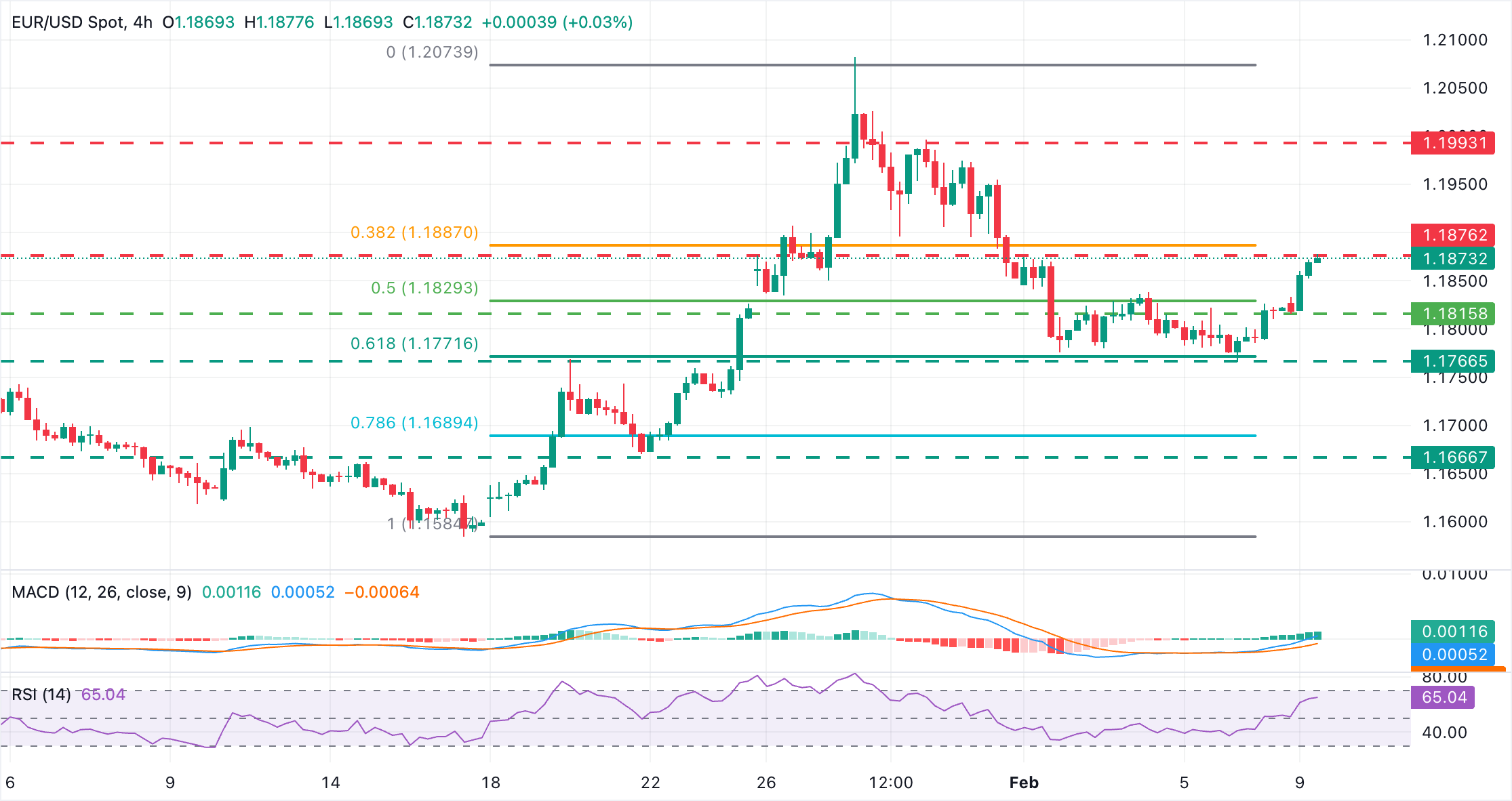
EUR/USD correction has found support at the 61.8% Fibonacci retracement level from the late-January upswing, and the pair is trending higher again, with technical indicators in 4-hour chart underscoring the bullish momentum. The Moving Average Convergence Divergence (MACD) histogram turns positive and widens, and the Relative Strength Index (RSI) has climbed above 60, reinforcing the positive tone.
Bulls are aiming for the area between February 1 and 2 highs, near 1.1875, and the previous support zone around 1.1895, which capped bears on January 28 and 30. Further up, 1.1954 comes into focus.
Intraday support is at 1.1815, ahead of the key 1.1765 level (Friday's low)
(The technical analysis of this story was written with the help of an AI tool.)
Economic Indicator
ECB's President Lagarde speech
The European Central Bank's President Christine Lagarde, born in 1956 in France, has formerly served as Managing Director of the International Monetary Fund, and minister of finance in France. She began her eight-year term at the helm of the ECB in November 2019. As part of her job in the Governing Council, Lagarde holds press conferences in detailing how the ECB observes the current and future state of the European economy. Her comments may positively or negatively the Euro's trend in the short term. Usually, a hawkish outlook boosts the Euro (bullish), while a dovish one weighs on the common currency (bearish).
Read more.Next release: Mon Feb 09, 2026 16:00
Frequency: Irregular
Consensus: -
Previous: -
Source: European Central Bank
Economic Indicator
Fed's Miran speech
Stephen Miran is a member of the Board of Governors of the Federal Reserve system, taking office from September 2025 to fill the vacancy left by Adriana Kugler. Miran, who was nominated by President Donald Trump, has served as the chair of the Council of Economic Advisers.
Read more.Next release: Mon Feb 09, 2026 19:30
Frequency: Irregular
Consensus: -
Previous: -
Source: Federal Reserve
Economic Indicator
Fed's Bostic speech
Raphael W. Bostic is an American economist and academic, who became the 15th President and CEO of the Federal Reserve Bank of Atlanta on June 5, 2017. In 2018, he serves as a voting member of the Federal Open Market Committee.
Read more.Next release: Mon Feb 09, 2026 20:15
Frequency: Irregular
Consensus: -
Previous: -
Source: Federal Reserve Bank of Atlanta
Author

Guillermo Alcala
FXStreet
Graduated in Communication Sciences at the Universidad del Pais Vasco and Universiteit van Amsterdam, Guillermo has been working as financial news editor and copywriter in diverse Forex-related firms, like FXStreet and Kantox.

















