AUD/USD Price Forecast: Needs decisive break above 50% Fibo retracement at 0.7050 for more upside
- AUD/USD falls to near 0.7035 as the US Dollar bounces back.
- Traders doubt over US President Trump stating that the Iran deal has been approved by its top leadership.
- The RBA is expected to leave its OCR steady at 4.35% on Tuesday.

The AUD/USD pair is down 0.22% to near 0.7035 in the early European trade on Friday. The Aussie pair faces selling pressure as the US Dollar (USD) rebounds, following Iran’s denial upon agreeing to the Memorandum of Understanding (MoU) with the United States (US), as reported by Iran’s Fars News agency, which President Donald Trump claimed to have been agreed by Tehran’s top leadership.
During press time, the US Dollar Index (DXY), which tracks the Greenback’s value against six major currencies, trades 0.15% higher to near 99.85.
On Thursday, US President Trump said that planned attacks on Iran have been called off, and discussions and final points of the peace deal have been, in both concept and great detail, approved by all parties involved. However, he clarified that the US naval blockade on Iranian sea ports will remain intact until the deal is finalized.
Meanwhile, the Australian Dollar (AUD) trades with caution ahead of the Reserve Bank of Australia’s (RBA) monetary policy, which will be announced on Tuesday. According to the latest Reuters poll, the RBA will halt its monetary tightening cycle and leave its Official Cash Rate (OCR) unchanged at 4.35%. This year, the RBA has already raised its OCR by 75 basis points (bps).
AUD/USD technical analysis
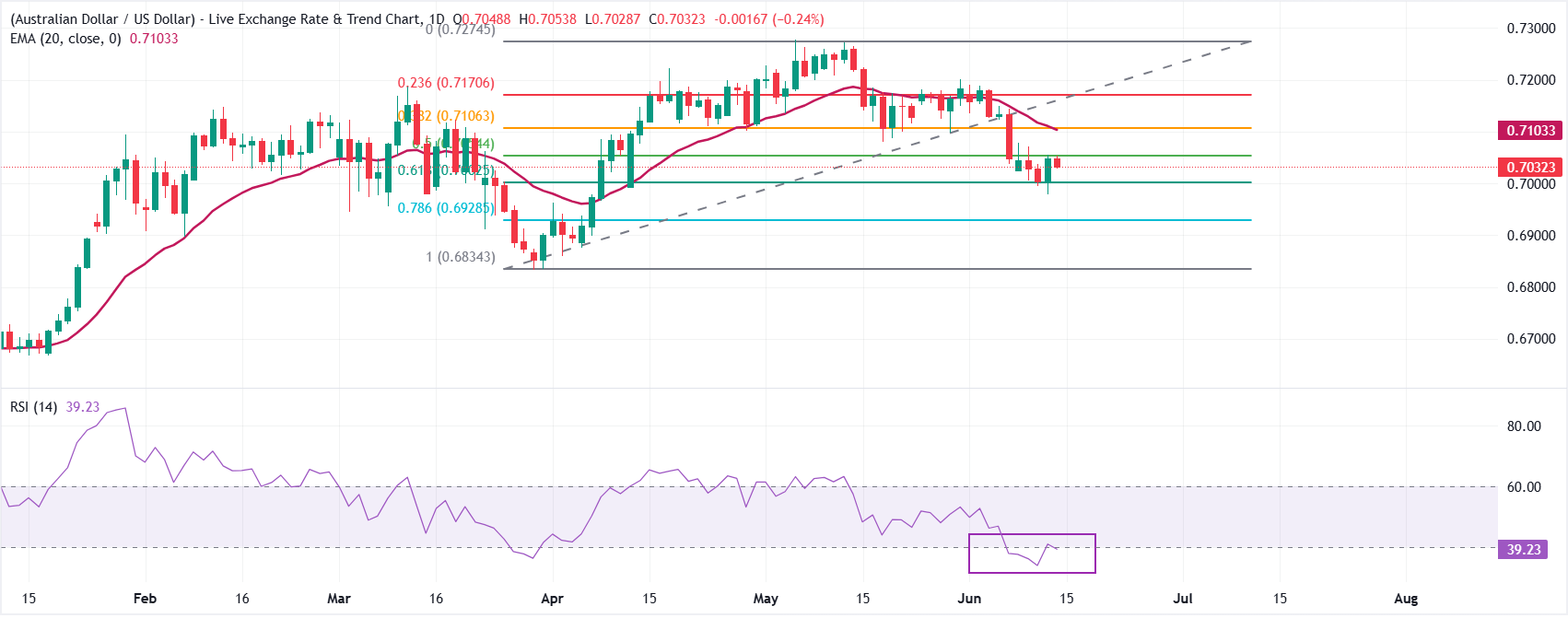
AUD/USD trades lower at around 0.7035, maintaining a bearish near-term tone as spot holds beneath the 20-day exponential moving average (EMA) at 0.7103 and the 50% Fibonacci retracement at 0.7054.
The pair is hovering just above the 61.8% retracement at 0.7002, while the Relative Strength Index (14) around 39 hints at weak, but not extreme, downside momentum after the recent slide from the mid-0.72 area.
On the downside, initial support emerges at the 61.8% Fibonacci retracement at 0.7002, ahead of the 78.6% level at 0.6929 and the swing low anchor around the 100% retracement at 0.6834. On the topside, a recovery would first need to clear the 50% retracement at 0.7054, followed by a dense resistance zone formed by the 20-day EMA at 0.7103 and the 38.2% retracement at 0.7106, with further bullish scope only opening toward the 23.6% level at 0.7171 and the recent cycle high near 0.7274.
(The technical analysis of this story was written with the help of an AI tool.)
Economic Indicator
RBA Interest Rate Decision
The Reserve Bank of Australia (RBA) announces its interest rate decision at the end of its eight scheduled meetings per year. If the RBA is hawkish about the inflationary outlook of the economy and raises interest rates it is usually bullish for the Australian Dollar (AUD). Likewise, if the RBA has a dovish view on the Australian economy and keeps interest rates unchanged, or cuts them, it is seen as bearish for AUD.
Read more.Next release: Tue Jun 16, 2026 04:30
Frequency: Irregular
Consensus: 4.35%
Previous: 4.35%
Source: Reserve Bank of Australia
Author

Sagar Dua
FXStreet
Sagar Dua is associated with the financial markets from his college days. Along with pursuing post-graduation in Commerce in 2014, he started his markets training with chart analysis.