EUR/USD aims to capture 1.1100 as Fed to reconsider rate-hiking spell , ECB eyes more hikes
- EUR/USD is looking to capture the critical resistance of 1.1100 as the risk-on mood strengthens.
- Federal Reserve is expected to reconsider further rate hikes amid softening US CPI and PPI and easing labor market.
- European Central Bank is divided over the pace of policy-hiking to arrest core inflation.
- EUR/USD is eyeing a seventh consecutive bullish weekly closing amid the declining US Dollar Index.

EUR/USD is displaying a back-and-forth action around 1.1070 in the early European session. The major currency pair is expected to continue its north-side journey towards the round-level resistance of 1.1100 as the US Dollar Index (DXY) is struggling to defend its downside momentum. The USD Index remained in the grip of bears on Thursday as the higher-than-anticipated softening of the United States Producer Price Index (PPI) report strengthened the need of pausing the policy-tightening cycle earlier than previously anticipated.
S&P500 futures have generated marginal losses in the Asian session. US equities were heavily bought on Thursday after the release extremely decelerated US PPI report as it triggered the need of reconsidering expectations of one more rate hike in the May monetary policy meeting by the Federal Reserve. The overall market mood is extremely positive as hopes for the adaptation of neutral policy by the Federal Reserve (Fed) have strengthened.
Apart from that, lower gasoline prices in March have bolstered expectations that S&P500 companies will report robust quarterly results. Input cost of firms must be remained lower amid below-average gasoline bills, which would have boosted operating profit margins.
The demand for US government bonds has improved marginally in hopes of a decline in US consumer inflation expectations. The 10-year US Treasury yields have slipped below 3.44%.
Synergic effect of decelerated US PPI and CPI to pause Fed’s rate hike spell
Scrutiny of the US PPI report showed that the US headline PPI softened heavily to 2.6% vs. the expectations of 3.0% and the former release of 4.6% amid lower gasoline prices. The core US PPI remained steady at 3.4% as expected by the market participants but critically lower than the former release of 4.8%. Firms passed on the benefit of lower input costs inspired by lower gasoline bills to end users by offering goods and services at lower prices at their factory gates.
This is going to ease overall retail demand in value terms and might force the Federal Reserve to look for pausing rates sooner.
US labor market conditions are easing further as US Department of Labor reported a jump in weekly Initial Jobless Claims data on Thursday. The economic data jumped to 239K from the estimates of 232K and the former release of 228K. This has also receded fears of stubborn US inflation further.
Apart from that, Bloomberg reported that US commercial banks reduced their borrowings from two Federal Reserve backstop lending facilities for a fourth straight week as liquidity constraints continue to ease following the collapse of Silicon Valley Bank last month. The synergic effect of tight credit conditions, softened US Consumer Price Index (CPI) and PPI, and loosening labor market would also force Fed chair Jerome Powell to dial back rate cuts.
Eurozone’s persistent core inflation supports hawkish European Central Bank bets
Weaker oil and energy prices are weighing heavily on Eurozone‘s headline inflation, however, core inflation is moving in the opposite direction and is extremely persistent. Thanks to the tight labor market, which is providing ample funds to households for disposal and keeping core inflation extremely sticky.
There is no denying the fact that the European Central Bank (ECB) has no other option than to continue elevating its interest rates higher in efforts of arresting galloping inflation. However, European Central Bank policymakers are divided over the pace of rate hikes by the central bank.
European Central Bank Governing Council member Bostjan Vasle said that they are considering 25 and 50 basis points (bps) rate hike options for the May policy meeting, per Reuters. Also, The European Central Bank policymaker Pierre Wunsch said on Friday, “The policy decision in May is between 25- and 50-basis-point rate hikes,” although “size depends in large part on April core inflation.” He further added, “Market pricing of terminal rate reasonable; but no quick rate cuts likely thereafter.”
EUR/USD technical outlook
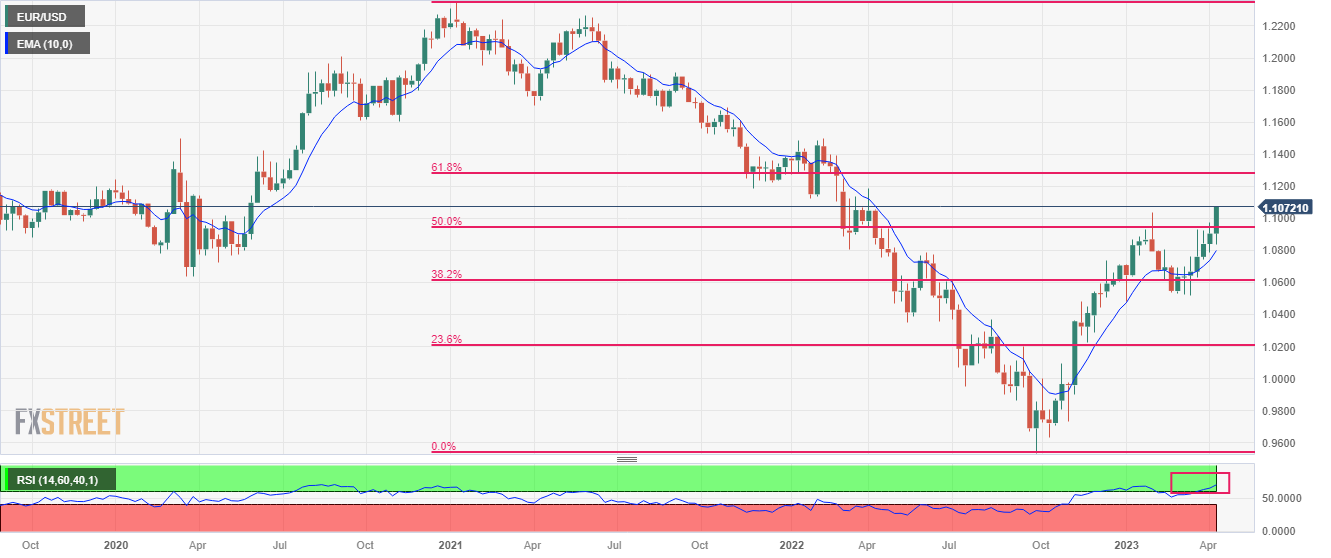
EUR/USD is highly expected to settle the week on a bullish note. This would be the seventh consecutive positive closing of the shared currency pair. The major currency pair is expected to close above the 50% Fibonacci retracement (plotted from 08 January 2021 high at 1.2350 to 30 September 2022 low at 0.9536) at 1.0952, which will strengthen the Euro bulls further.
Upward-sloping 10-period Exponential Moving Average (EMA) at 1.0800 is advocating more upside for the shared continent currency.
The Relative Strength Index (RSI) (14) has shifted into the bullish range of 60.00-80.00, indicating that the upside momentum is active now.
Author

Sagar Dua
FXStreet
Sagar Dua is associated with the financial markets from his college days. Along with pursuing post-graduation in Commerce in 2014, he started his markets training with chart analysis.
















