EUR/GBP Price Forecast: Testing the neckline of an inverse H&S, at 0.8460
- The Euro is pushing against the top of last month's trading range, at 0.8460.
- The Pound loses ground, weighed by weak UK employment data.
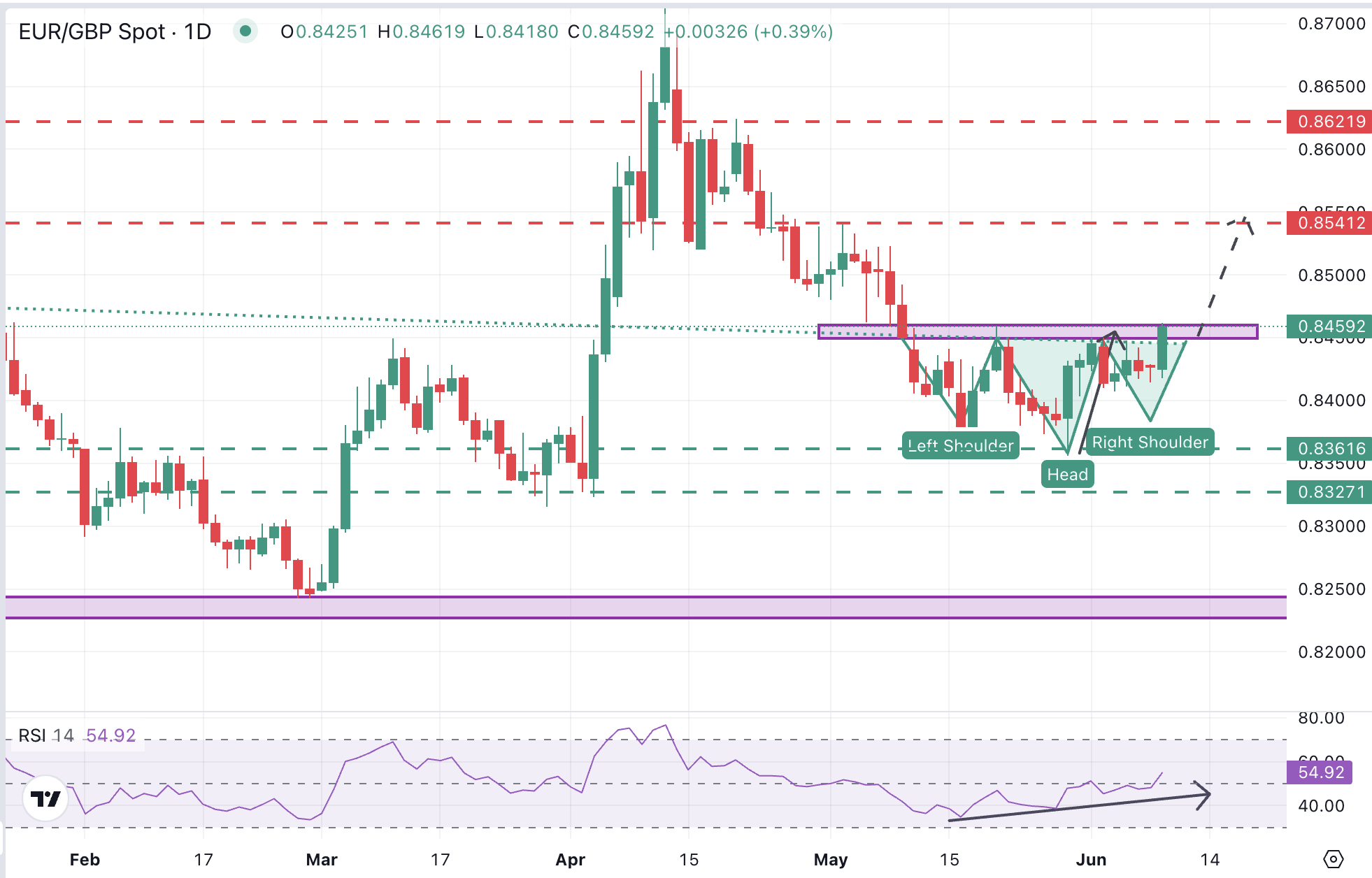
- Above 0.8460, the H&S's measured target is 0.8540.

The Euro is trading higher on Tuesday with the Pound hit by downbeat UK employment figures, and soft wage inflation, which have strengthened the case for further BoE easing in the coming months.
Claimants for unemployment benefits increased by 33.1K in May, more than three times the 9.5K increment foreseen by market analysts. The Unemployment Rate increased to 4.6%, its highest level in four years, and wage growth slowed to 5.2%, below the 5.3% expected.
Technical analysis: EUR/GBP might have reached a bottom at 0.8360
The technical picture suggests that the bearish cycle from mid-April highs might have been completed at 0.8360, and the pair is about to correct higher. A bullish divergence on the 4-Hour RSI, which is now popping up above the 50 level, and a potential inverse bullish Head & Shoulders pattern are endorsing that view.
UK data has boosted the Euro, which is treading the 0.8450-0.8460 area, a previous support, now turned resistance and the neckline of the mentioned Head and Shoulders pattern.
A confirmation above shifts the focus towards the measured target of the H&S formation at the April 25, 30 and May 2 highs, in the area of 0.8540 ahead of the April 21 high, at 0.8620.
On the downside, a bearish reaction below 0.8360 cancels this view and increases pressure towards 0.8325 (April 3 low) and the key 0.8245 year-to-date low.
EUR/GBP Daily Chart
Employment FAQs
Labor market conditions are a key element to assess the health of an economy and thus a key driver for currency valuation. High employment, or low unemployment, has positive implications for consumer spending and thus economic growth, boosting the value of the local currency. Moreover, a very tight labor market – a situation in which there is a shortage of workers to fill open positions – can also have implications on inflation levels and thus monetary policy as low labor supply and high demand leads to higher wages.
The pace at which salaries are growing in an economy is key for policymakers. High wage growth means that households have more money to spend, usually leading to price increases in consumer goods. In contrast to more volatile sources of inflation such as energy prices, wage growth is seen as a key component of underlying and persisting inflation as salary increases are unlikely to be undone. Central banks around the world pay close attention to wage growth data when deciding on monetary policy.
The weight that each central bank assigns to labor market conditions depends on its objectives. Some central banks explicitly have mandates related to the labor market beyond controlling inflation levels. The US Federal Reserve (Fed), for example, has the dual mandate of promoting maximum employment and stable prices. Meanwhile, the European Central Bank’s (ECB) sole mandate is to keep inflation under control. Still, and despite whatever mandates they have, labor market conditions are an important factor for policymakers given its significance as a gauge of the health of the economy and their direct relationship to inflation.
Author

Guillermo Alcala
FXStreet
Graduated in Communication Sciences at the Universidad del Pais Vasco and Universiteit van Amsterdam, Guillermo has been working as financial news editor and copywriter in diverse Forex-related firms, like FXStreet and Kantox.