|

EUR/AUD Price Forecast: Stalls below 1.6500 amid EU political turmoil

  • EUR/AUD remains flat, with the formation of a 'doji' indicating indecision among traders in the face of Eurozone political challenges.
  • RSI suggests a neutral stance, hinting at potential sideways movement in the near term.
  • Key resistance and support levels to watch include 1.6574 and 1.6450 respectively, with further downside possibly testing SMA levels at 1.6375 and 1.6359.

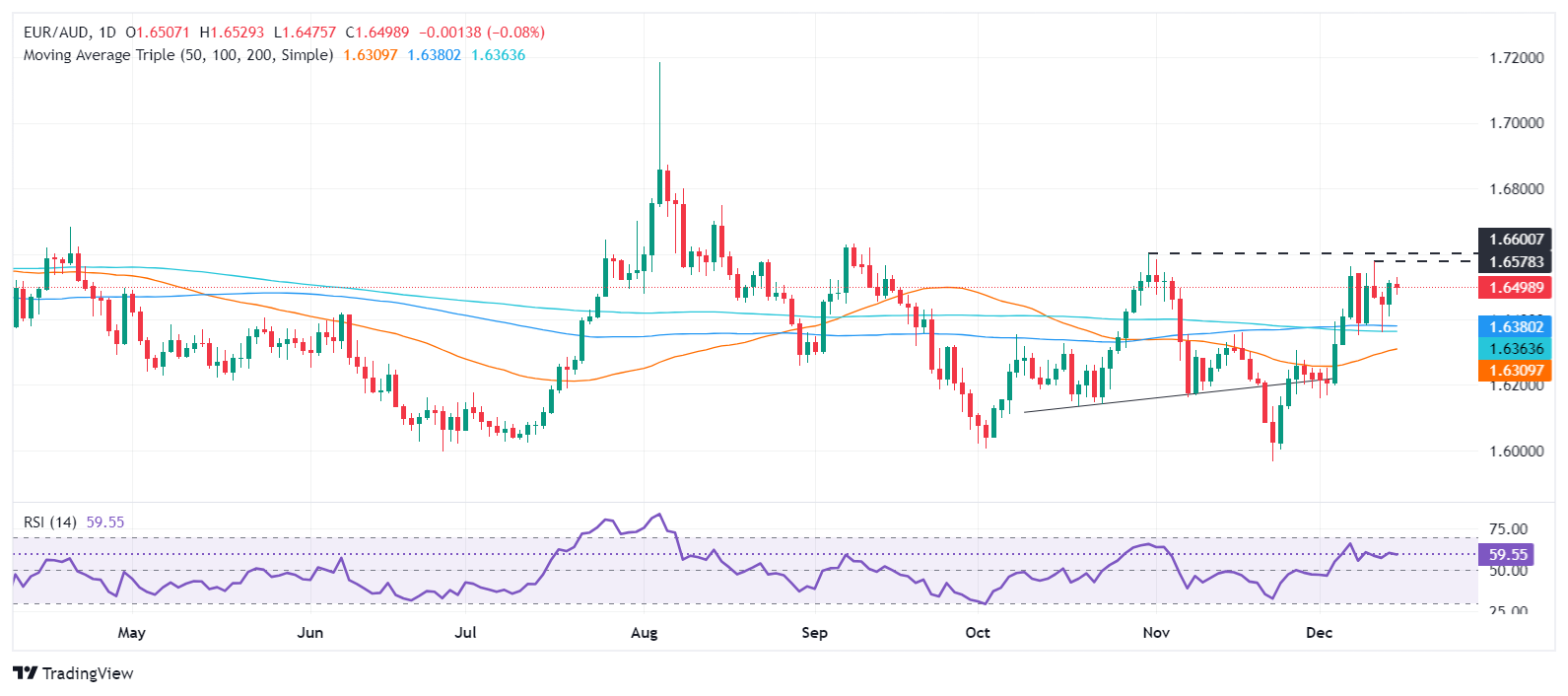
The EUR/AUD consolidates below 1.6500 for the second consecutive day and trades at 1.6499, virtually unchanged. The Eurozone is experiencing turbulent moments amid political issues in France and Germany, two of the bloc's largest economies. Although the Euro holds firm, the end of the year keeps traders from opening fresh bets against the shared currency.

EUR/AUD Price Forecast: Technical outlook

The EUR/AUD consolidates, forming a ‘doji,’ meaning neither buyers nor sellers are in control. The Relative Strength Index (RSI) is bullish, though the slope turned flat, meaning the cross would likely remain sideways.

For a bullish resumption, the EUR/AUD first resistance would be the December 11 high at 1.6574. Once surpassed, the next stop would be the 1.6600 figure. Conversely, if EUR/AUD extends its losses below 1.6450, the next support would be the 100-day Simple Moving Average (SMA) at 1.6375, followed by the 200-day SMA at 1.6359.

EUR/AUD Price Charr – Daily
Euro FAQs

The Euro is the currency for the 20 European Union countries that belong to the Eurozone. It is the second most heavily traded currency in the world behind the US Dollar. In 2022, it accounted for 31% of all foreign exchange transactions, with an average daily turnover of over $2.2 trillion a day, according to data from the Bank of International Settlements. EUR/USD is the most heavily traded currency pair in the world, accounting for an estimated 30% of all transactions, followed by EUR/JPY (4%), EUR/GBP (3%) and EUR/AUD (2%).

Author

Christian Borjon Valencia

Markets analyst, news editor, and trading instructor with over 14 years of experience across FX, commodities, US equity indices, and global macro markets.


More from Christian Borjon Valencia
Share:

Editor's Picks

AUD/USD sits near a one-month top, above 0.7000 amid fresh USD selling

AUD/USD holds above 0.7000 through the Asian session, trading near a one-month high touched earlier this Monday amid renewed US Dollar selling. US bond yields decline further amid a modest pullback in crude oil prices, capping the USD recovery from a three-week low. Moreover, bets for a November RBA rate hike support the Aussie, though upside seems capped ahead of the crucial two-day FOMC meeting, starting Tuesday.

USD/JPY struggles below 157.00 on weak USD; holds above one-month low ahead of Fed, BoJ meetings

USD/JPY attracts fresh sellers during the Asian session on Monday, stalling its recovery from the lowest level since September 18, touched Friday as a further decline in US bond yields weighs on the US Dollar. Meanwhile, the Japanese Yen benefits from a more hawkish BoJ, further weighing on the currency pair. The downside, however, seems limited as traders keenly await Fed and BoJ policy meetings later this week.

Gold gains at start of Fed’s policy week

Gold finds bids below $4,000 in the Asian trade on Monday. The precious metal starts the Federal Reserve’s monetary policy week on positive note, but is broadly vulnerable, being closer to its three-month low of $3,975.


Bitcoin slides below $80,000, Ethereum and XRP bears in control
Bitcoin (BTC), Ethereum (ETH) and Ripple (XRP) bears remain in control, extending losses on Monday after three straight weeks of declines. BTC slips below $80,000, while ETH and XRP follow BTC’s lead and trade lower at $2,315 and $1.30, respectively. The price action of these top three cryptocurrencies suggests weakening momentum indicators, raising the risk of a deeper correction.
CFTC Report: WTI rally runs ahead of positioning
The week in one sentence: WTI prices surged while speculative longs were cut in the week to October 20, creating the clearest price/positioning divergence. Sterling and the Canadian Dollar led the constructive currency shift, while Yen longs also rebuilt. Speculators turned less constructive on the WTI, reducing their net exposure to around 89.3K contracts.
What November 3 means for the Fed's rate path and the US Dollar

The USD faces a decisive period ahead of the November 3 midterm elections. While markets anticipate another interest rate increase from the Fed in December, the battle for control of Congress could reshape fiscal policy expectations and, indirectly, the path of US monetary policy in 2027.















