|

Elliott Wave analysis: NVDA (Nvidia’s) leading diagonal pattern targets $193

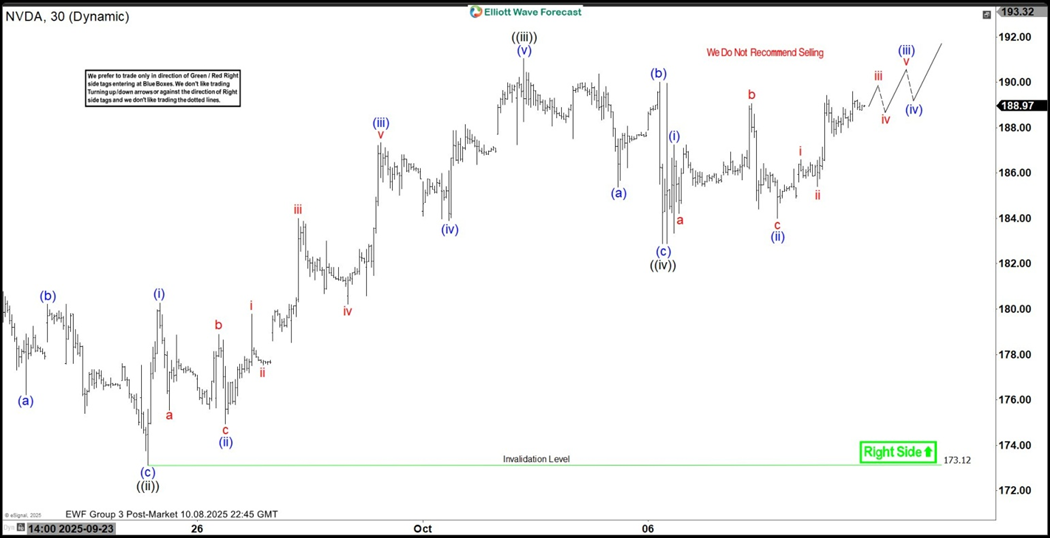
The short-term Elliott Wave analysis for Nvidia (NVDA) indicates that the cycle from the September 18 low is unfolding as a leading diagonal. Starting from that low, wave ((i)) concluded at $184.55, followed by a pullback in wave ((ii)) that ended at $173.12, as depicted in the 30-minute chart. The stock then surged in wave ((iii)), displaying an internal impulse structure. From wave ((ii)), wave (i) peaked at $180.26, with wave (ii) dipping to $174.93. Wave (iii) climbed to $187.35, followed by a wave (iv) pullback to $183.90. The final leg, wave (v), reached $191.05, completing wave ((iii)) in a higher degree.

The subsequent wave ((iv)) pullback formed a zigzag Elliott Wave pattern. From wave ((iii)), wave (a) declined to $185.38, wave (b) rose to $190, and wave (c) dropped to $182.88, finalizing wave ((iv)). The stock has since resumed its ascent in wave ((v)), with wave (i) ending at $187.23 and wave (ii) dips concluding at $184. The stock is poised to climb further, likely completing wave (iii) soon. A wave (iv) pullback should follow to correct the cycle from the October 8, 2025 low before resuming higher. As long as the $173.12 pivot holds, any pullback should find support in a 3, 7, or 11 swing, setting the stage for additional upside.

Nvidia (NVDA) – 30 Minute Elliott Wave technical chart
Chart

Author

Elliott Wave Forecast Team

Elliott Wave Forecast Team

ElliottWave-Forecast.com

More from Elliott Wave Forecast Team
Share:

Editor's Picks

GBP/USD advaces beyond 1.3450 after BoE decision, US Q2 GDP

GBP/USD gains positive momentum on Thursday, surpassing 1.3450 and trading at fresh multi-week highs. The Bank of England decided to maintain the benchmark rate unchanged at 3.75%. The MPC voted 6-3 to keep rates on hold, with the 3 dissenters favoring a rate hike. US Q2 GDP missing expectations helped the pair advance, while renewed US Dollar weakness across the FX board pushed the pair further up ahead of the monthly close.

EUR/USD confortable around 1.1530, highest in six weeks

The EUR/USD pair trades around 1.1530 in the American session on Thursday, reaching fresh six-week highs. The US Dollar is in sell-off mode, with multiple factors weighing on the American currency. Not only did the Federal Reserve vote divided to keep rates on hold on Wednesday, creating doubts about a September hike, but US Q2 GDP missed expectations. A suspected JPY intervention adds pressure on the Greenback.

Gold sellers keep lurking above $4,100 as USD rebounds

Gold struggles to capitalize on its gains registered over the past two days and trades with a mild negative bias just below $4,100 in the Asian session on Friday. The US Dollar recovers slightly from its lowest level since June 17 amid a further escalation of US-Iran tensions, acting as a headwind for the bullion.

Why is IDR near historic lows despite Bank Indonesia's 5.75% rate?

The Indonesian Rupiah has faced persistent depreciation pressures against the US Dollar during the first half of 2026, with the USD/IDR pair stabilizing around the 18,100–18,200 range at the time of writing after reaching a record high at 18,247 on June 8, marking the Rupiah's weakest level on record against the Greenback.

9-3: Is the Federal Reserve’s vote tally Warsh's new forward guidance?
The rate did not move. Neither did the statement, and that’s the more interesting fact. Set the July 29 Federal Open Market Committee (FOMC) statement beside the one issued on June 17, and the two documents are identical apart from a single verb and a paragraph at the bottom naming three dissenters.
9-3: Is the Federal Reserve’s vote tally Warsh's new forward guidance?
The rate did not move. Neither did the statement, and that’s the more interesting fact. Set the July 29 Federal Open Market Committee (FOMC) statement beside the one issued on June 17, and the two documents are identical apart from a single verb and a paragraph at the bottom naming three dissenters.













