Indonesian Rupiah mid-year outlook: Why is IDR near historic lows despite Bank Indonesia's 5.75% rate?

The Indonesian Rupiah (IDR) has faced persistent depreciation pressures against the US Dollar (USD) during the first half (H1) of 2026, with the USD/IDR pair stabilizing around the 18,100–18,200 range at the time of writing after reaching a record high at 18,247 on June 8, marking the Rupiah's weakest level on record against the Greenback. While Indonesia's domestic economic growth remained resilient, external shocks, including geopolitical unrest in the Middle East, high global energy costs, and capital flight from emerging markets, weighed heavily on the IDR.
Bank Indonesia steps in to defend the Rupiah
After maintaining an accommodative stance earlier this year, Bank Indonesia (BI) pivoted decisively to defend the Rupiah by raising the benchmark BI-Rate to 5.25% in May and further to 5.75% in June.
According to Trading Economics’ global macro models and analyst expectations, Indonesia’s interest rate is projected to reach 6.25% by the end of the third quarter. Over the longer term, econometric models forecast the rate will trend lower, settling around 6.00% in 2027 and 5.50% in 2028.
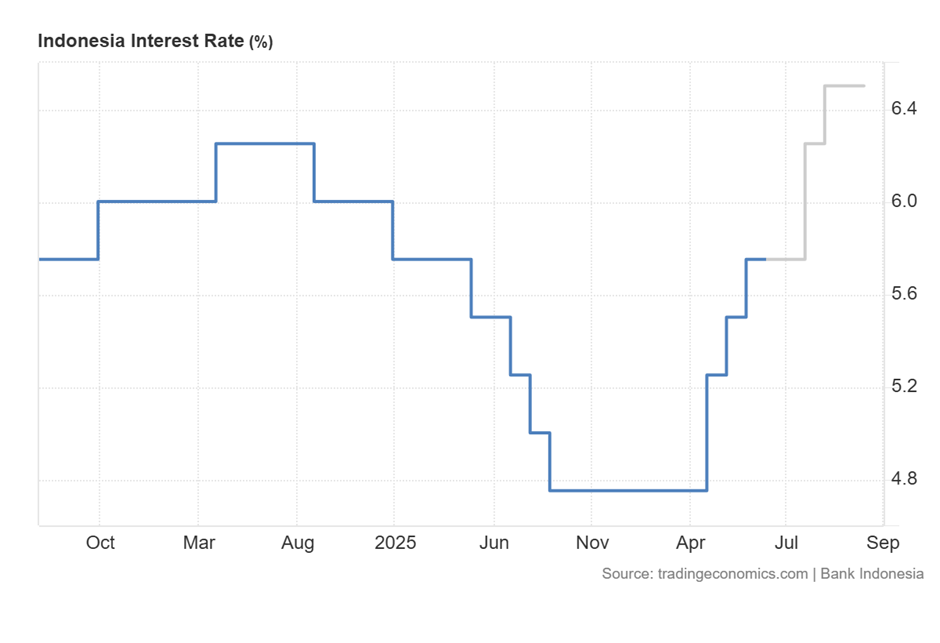
By offering optimized yield structures relative to Government Securities (SBN) alongside strategic policy incentives, such as a 10% reduction in hedging swap premiums to lower transaction friction, BI successfully sparked a massive wave of foreign investor demand. SRBI issuance surged by IDR 126.70 trillion in April alone to reach IDR 957.91 trillion, before breaking past IDR 1,072 trillion by June and July. This yield-driven absorption strategy proved remarkably effective, as offshore capital flooded back into the market, pushing non-resident SRBI holdings up from IDR 238.09 trillion on June 15 to IDR 288.65 trillion by July 20.
Foreign capital returns despite policy uncertainty
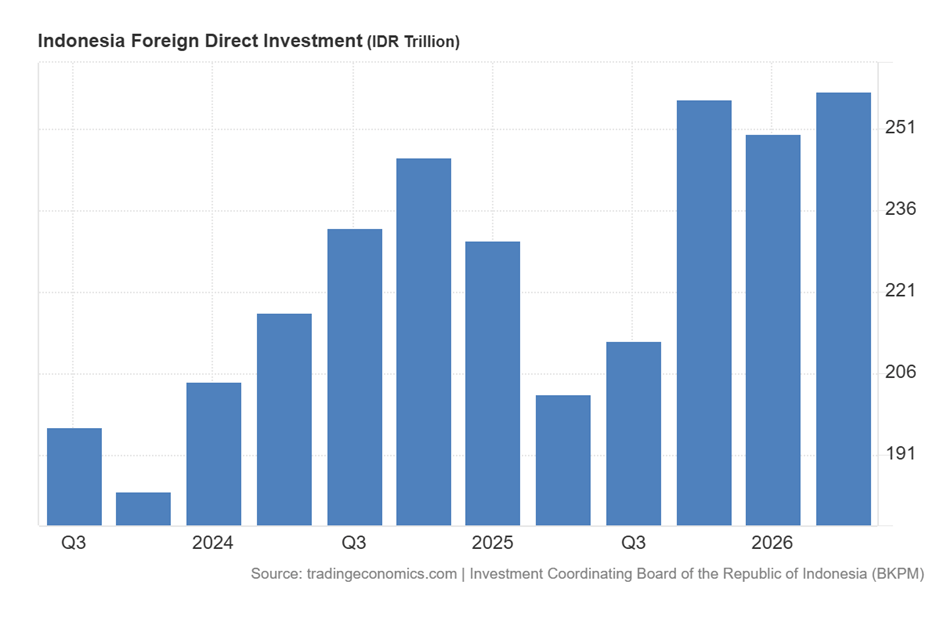
Foreign Direct Investment (FDI) in Indonesia increased by IDR 257.70 trillion in the second quarter, marking the highest quarterly inflow on record. FDI in Indonesia has averaged IDR 116.78 trillion since 2010.
The credit picture showed signs of stabilization later in the summer. On July 13, S&P Global Ratings affirmed Indonesia’s long-term sovereign credit rating at BBB and short-term rating at A-2, while maintaining a stable outlook. S&P noted that this stable outlook reflects its expectation that the government will continue to adhere to the statutory fiscal deficit ceiling of 3% of Gross Domestic Product (GDP) as a crucial fiscal anchor, easing earlier concerns regarding rising spending commitments under President Prabowo Subianto’s administration.
Federal Reserve repricing drives USD/IDR higher
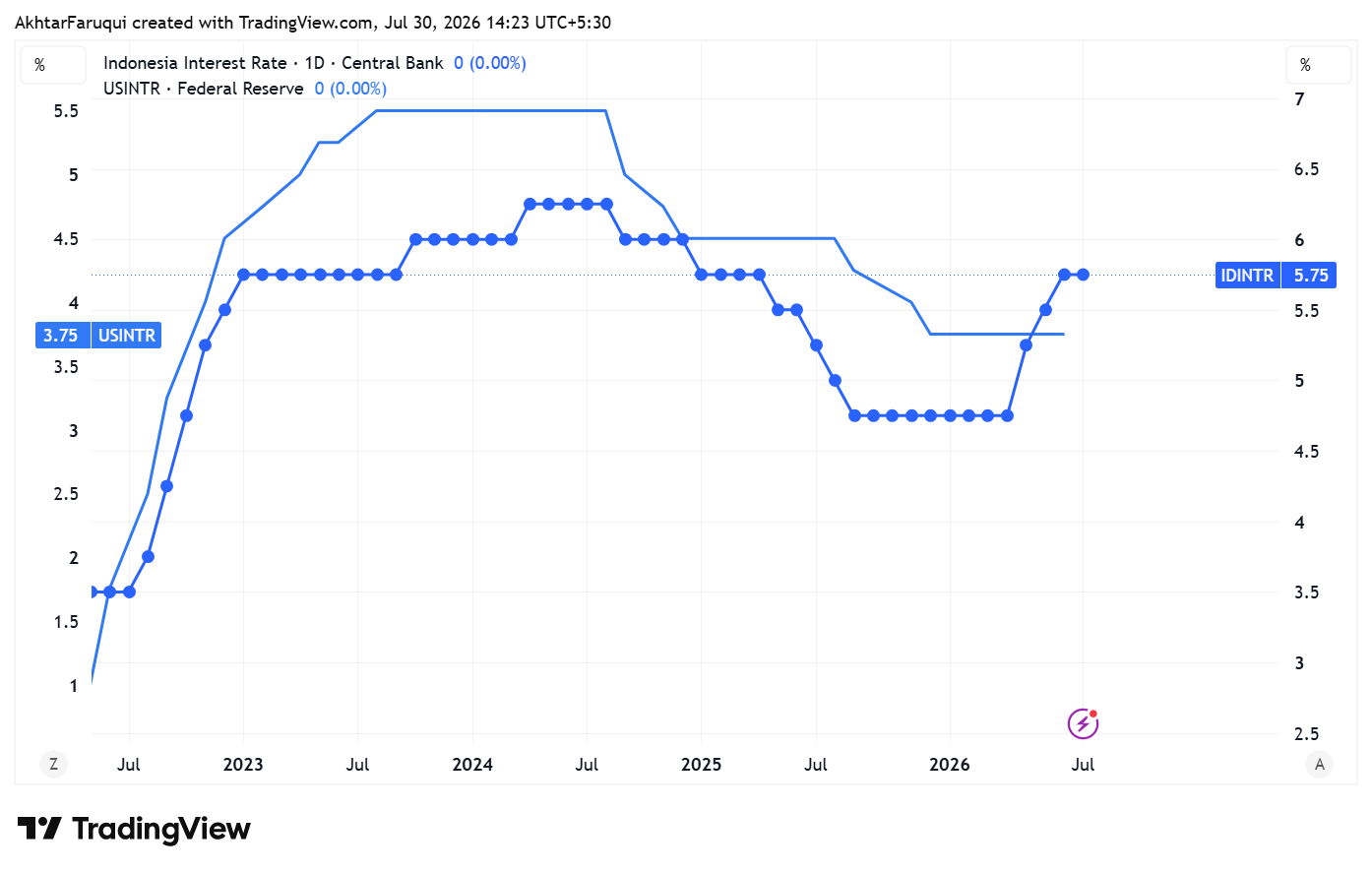
The trajectory of the USD/IDR pair through H1 2026 was shaped by shifting Federal Reserve (Fed) rate expectations, evolving interest-rate differentials, and Bank Indonesia’s monetary policy response. In early 2026, global financial markets heavily anticipated a monetary policy easing cycle, expecting the Fed to cut benchmark rates down toward 3.00%–3.25% as US inflation appeared to cool. This dovish outlook dragged the US Dollar Index (DXY) down to two-year lows, allowing the Indonesian Rupiah to hold ground. During this period, Bank Indonesia maintained its benchmark BI-Rate at 4.75%, preserving a favorable yield differential over US interest rates that sustained steady foreign portfolio inflows into Indonesian assets. However, this supportive backdrop began to fade as stronger-than-expected US inflation amid surging energy prices due to the US-Iran war prompted markets to reassess the pace of Federal Reserve easing.
As spring unfolded, persistent US core inflation and robust wage growth forced the Federal Reserve to halt its rate-cutting path, holding the Federal Funds target rate steady at 3.50%–3.75%. Concurrently, new Fed Chair Kevin Warsh scaled back explicit forward guidance and initiated strategic policy task forces, reinforcing uncertainty over the future path of US interest rates. The shrinking yield spread between US cash rates and Indonesian sovereign paper, compounded by geopolitical tension and rising energy prices in the Middle East, triggered foreign capital outflows from Indonesia. These developments ultimately prompted Bank Indonesia to tighten monetary policy more aggressively in an effort to preserve the Rupiah's yield advantage and stabilize capital flows.
By June, market expectations pivoted to a hawkish direction as the updated FOMC dot plot and renewed inflation concerns, reinforced by resurgent energy prices, led futures markets to price in a Fed rate hike by late summer. Benchmark 10-year US Treasury yields climbed toward 4.66%, triggering broad US Dollar strength. The stronger US Dollar and higher Treasury yields intensified pressure on emerging-market currencies, including the Indonesian Rupiah.
To protect the domestic currency, prevent capital flight, and curb imported inflation, Bank Indonesia launched an aggressive defense, raising its benchmark BI-Rate by a cumulative 100 basis points across May and June to reach 5.75%. BI also pushed Sekuritas Rupiah Bank Indonesia (SRBI) yields up to 6.21%–6.45% to rebuild the yield buffer over US rates. Despite these interventions, intense global US Dollar demand briefly pushed the USD/IDR pair into the IDR 18,000–IDR 18,100 range in July, before stabilizing near IDR 17,950–IDR 18,050 as Bank Indonesia's policy measures and a partial easing in commodity prices helped temper depreciation pressures.
Trade balance and foreign exchange reserves come under pressure
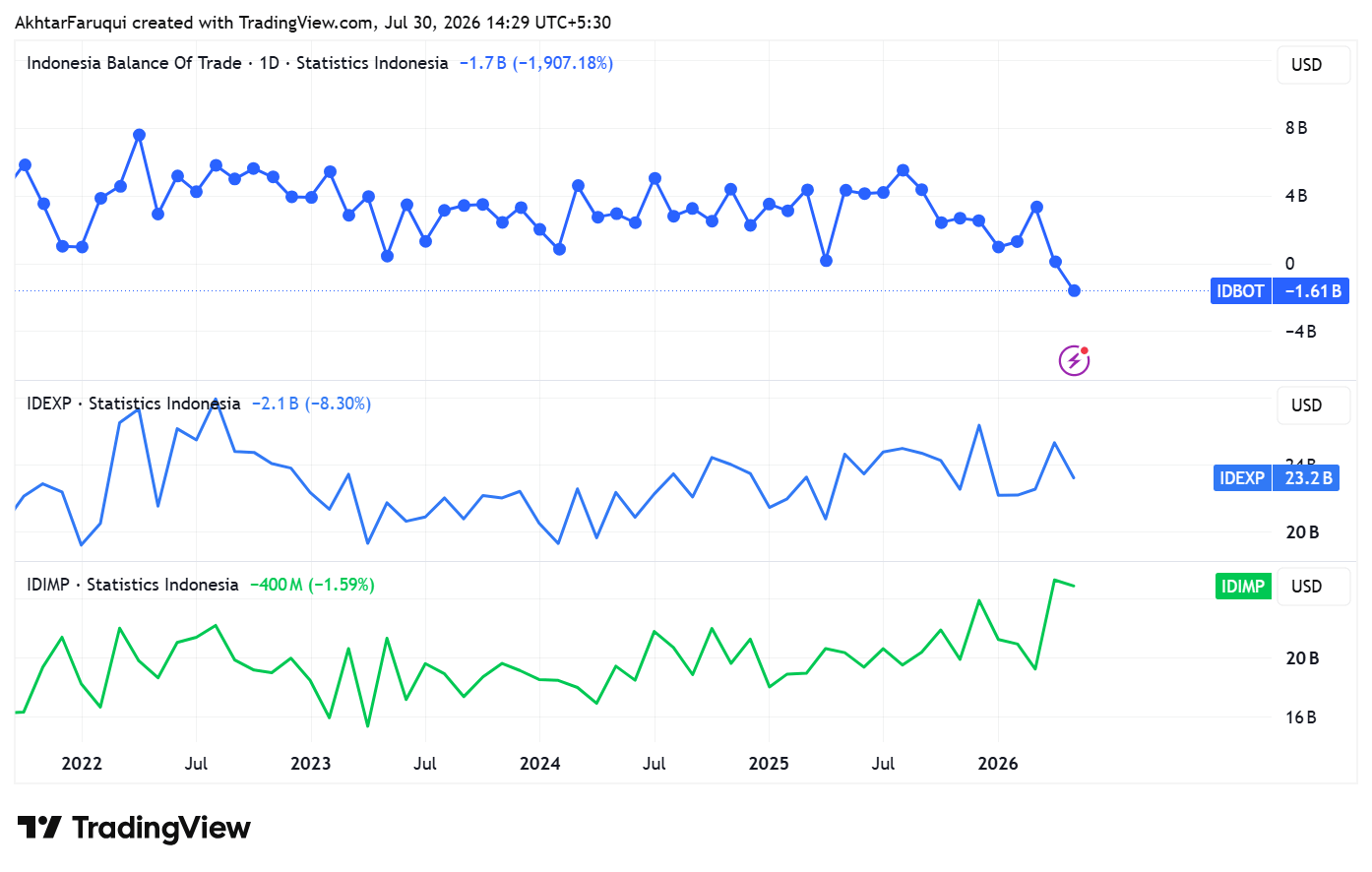
Indonesia experienced significant trade pressure toward the end of the first half of 2026. The year started on a strong note, continuing a six-year trend of uninterrupted monthly trade surpluses. Indonesia recorded surpluses of $0.96 billion in January, around $1.28 billion in February, $3.32 billion in March, and a narrower $0.09 billion in April. Throughout these early months, the trade surplus was largely sustained by non-oil and gas exports, particularly manufacturing goods, mineral fuels, and palm oil products shipped to primary trading partners including China, the United States, and India.
However, the trend shifted sharply in May, when Indonesia ended its 72-month streak of trade surpluses after posting a $1.61 billion trade deficit, its first monthly deficit since April 2020.
Statistics Indonesia (BPS) official Ateng Hartono explained earlier in July that, unlike the 2020 deficit, the non-oil and gas sector actually maintained a surplus in May, making the energy trade balance the primary driver behind the overall downturn. The energy deficit widened drastically as oil and gas imports surged 71% year-on-year to $4.51 billion, driven by both rising prices and a 7.28% increase in import volume. Compounding the issue, oil and gas exports plunged 32% over the same period, dropping to just $760 million from $1.11 billion in May 2025.
Indonesia’s foreign exchange reserves declined to a near two-year low of $144.9 billion in May from $156.5 billion in December 2025, followed by a modest rebound to $145.6 billion in June, directly reflecting Bank Indonesia's (BI) aggressive intervention strategy to stabilize the Rupiah amid a hawkish Federal Reserve and surging US Dollar strength. Between December 2025 and January 2026, Indonesia’s reserve buffers remained elevated near 9-month highs at around $156.5 billion–$154.6 billion, supported by robust foreign capital inflows as global markets were pricing in aggressive Fed interest rate cuts. To prevent an uncontrolled surge in USD/IDR, Bank Indonesia actively intervened in the spot and Non-Deliverable Forward (NDF) markets.
Indonesian Rupiah outlook for the second half of 2026
The Indonesian Rupiah faces challenges following the surprise resignation of Bank Indonesia Governor Perry Warjiyo. While rating agency S&P notes that Indonesia's credit ratings remain unaffected (BBB/A-2), increased transition uncertainty surrounding BI's future monetary policy direction and central bank independence is likely to weigh on investor sentiment. Nevertheless, as diplomatic progress in the Middle East tempers Oil prices and relieves global inflation pressures, BI's elevated yield advantage should eventually limit further currency losses and restore exchange-rate stability by Q4.
Analysts at Commerzbank highlight that the Indonesian rupiah (IDR) is coming under renewed strain in the wake of the leadership shake-up at Bank Indonesia, noting that “the Indonesian rupiah (IDR) faces renewed depreciation pressure following the surprise resignation of long-serving Bank Indonesia (BI) Governor Perry Warjiyo yesterday.” They argue that the abrupt departure of such a key policymaker has added to existing concerns over policy continuity and institutional credibility at a time when IDR is already trading near historic lows versus the US Dollar (USD), leaving the currency vulnerable to further weakness as investors reassess the outlook for BI’s policy direction.
While potential late-summer hawkish risk from the Federal Reserve and elevated US Treasury yields will keep foreign exchange volatility alive in Q3, Bank Indonesia’s proactive monetary posture, anchored by a 5.75% benchmark rate and attractive SRBI yields above 7%, should effectively limit further capital flight. As foreign portfolio inflows normalize into high-yielding short-term paper and foreign exchange reserves rebuild above $148 billion, financial stability should strengthen. Provided Middle East geopolitical supply risks temper, a clearer Fed easing trajectory in late Q4 could relieve persistent US Dollar dominance, allowing the Indonesian Rupiah to stabilize.
Fed’s Warsh doubles down on 2% goal, keeps Dollar bulls engaged
Warsh’s press conference tone after the July Fed meeting screens clearly more hawkish than usual, with a 7/10 FXS Speechtracker score relative to the historical average of 6/10, underpinned by repeated emphasis that “only one target and it is 2%” and that inflation “cannot be cured in 9 weeks.” The insistence on delivering the 2% objective, rejection of any tolerance for a higher inflation target, and pledge that the Committee “will not hesitate to act” all point to a resolute stance on price stability even as Warsh highlights “impressive resilience” in output and the labor market. Warsh’s focus on trends over short‑term data, higher nominal and real yields, and reduced forward guidance signals a preference to let markets price the path while keeping the option open for further tightening if inflation dynamics broaden again.
USD/IDR Weekly Technical Price Forecast: Fresh highs above 18,250 seem possible
USD/IDR gains ground after two weeks of losses, trading within the 18,000-18,200 range during the last week of July. The pair is maintaining a bullish bias as it holds above both the nine-period and 50-period Exponential Moving Averages (EMAs).
The weekly 14-day Relative Strength Index (RSI) above 73 suggests overbought conditions that could slow the upside rather than reverse it outright. The technical analysis of the weekly chart suggests that the USD/IDR pair is moving sideways within a rectangle channel, suggesting a consolidation. Moreover, the Fed Sentiment Index around 128.64 continues to favor US Dollar strength against the Indonesian Rupiah.
The USD/IDR pair is hovering below its all-time high of 18,247, which aligns with the upper boundary of the rectangle channel. A sustained break above the channel could support the pair to explore the region around 18,500. On the downside, the initial support lies at the nine-day EMA of 17,942, followed by the lower boundary of the channel around 17.750 and a 11-week low of 17,600. Further support lies at the 50-day EMA at 17,197.
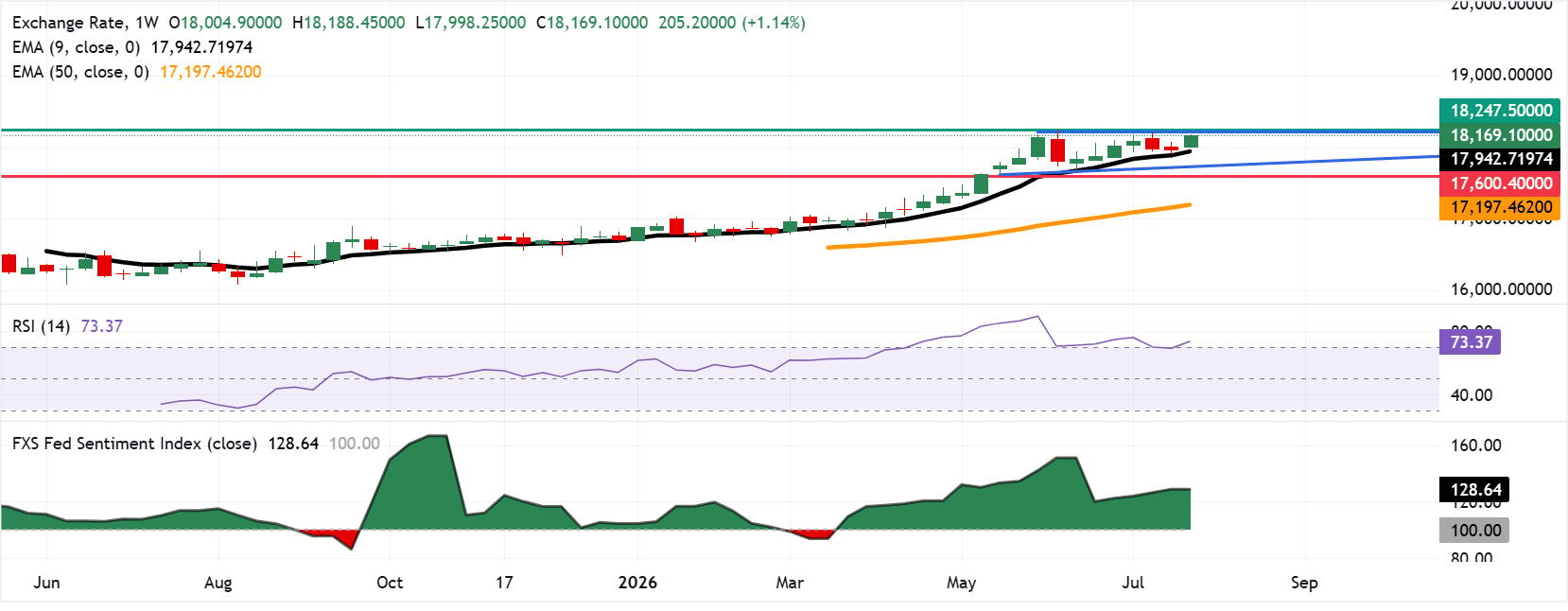
(The technical analysis of this story was written with the help of an AI tool. Know more.)
US Dollar Price This Year
The table below shows the percentage change of US Dollar (USD) against listed major currencies this year. US Dollar was the strongest against the Indonesian Rupiah.
| USD | EUR | GBP | JPY | CAD | AUD | NZD | IDR | |
|---|---|---|---|---|---|---|---|---|
| USD | 2.53% | 0.77% | 4.45% | 2.57% | -4.26% | -0.70% | 9.09% | |
| EUR | -2.53% | -1.76% | 1.91% | 0.10% | -6.26% | -3.08% | 6.25% | |
| GBP | -0.77% | 1.76% | 3.74% | 1.90% | -4.58% | -1.34% | 7.32% | |
| JPY | -4.45% | -1.91% | -3.74% | -1.87% | -8.22% | -5.36% | 2.56% | |
| CAD | -2.57% | -0.10% | -1.90% | 1.87% | -6.47% | -3.56% | 5.13% | |
| AUD | 4.26% | 6.26% | 4.58% | 8.22% | 6.47% | 3.39% | 11.25% | |
| NZD | 0.70% | 3.08% | 1.34% | 5.36% | 3.56% | -3.39% | 8.42% | |
| IDR | -9.09% | -6.25% | -7.32% | -2.56% | -5.13% | -11.25% | -8.42% |
The heat map shows percentage changes of major currencies against each other. The base currency is picked from the left column, while the quote currency is picked from the top row. For example, if you pick the US Dollar from the left column and move along the horizontal line to the Japanese Yen, the percentage change displayed in the box will represent USD (base)/JPY (quote).
Author

Akhtar Faruqui
FXStreet
Akhtar Faruqui is a Forex Analyst based in New Delhi, India. With a keen eye for market trends and a passion for dissecting complex financial dynamics, he is dedicated to delivering accurate and insightful Forex news and analysis.

















