ECB policymakers agree: Inflation in Eurozone to remain high amid energy crisis
- EUR/USD weakens to near 1.1535 even as ECB officials warn of upside inflation risks.
- A number of market experts see the ECB delivering one more interest rate hike this year.
- The Fed is almost certain to raise interest rates at the policy meeting on Wednesday.

The Euro (EUR) is down 0.12% at around 1.1535 against the US Dollar (USD) in the early European trading session on Tuesday. The major currency pair is under pressure even as a slew of European Central Bank (ECB) officials have warned of upside inflation risks, which have fuelled expectations of one more interest rate hike this year.
On Thursday, the ECB raised its key policy rates by 25 basis points (bps), as expected, and warned that more hikes could follow.
According to a report from Reuters, Goldman Sachs, Citi and Barclays expect the ECB to raise rates again in December. Traders are pricing in a 94% chance of a quarter-point rate hike in December, according to LSEG data. Citi also anticipates an additional hike in March 2027.
Following the policy decision, comments from policymakers have signaled fears of prolonged inflationary pressures.
Over the weekend, ECB President Christine Lagarde said in an interview with Ouest-France that the “current energy shock is longer-lasting”. She added that the “conflict is continuing” and, “We [ECB] expect the volatility and pressure on energy prices to continue, even though the increase in prices also poses a risk of lower growth.
On Monday, ECB Executive Board member Isabel Schnabel also warned of prolonged inflation risks, citing that “refining capacities have reduced drastically and can’t be rebuilt quickly”.
Scotiabank noted that “hawkish comments from the ECB appear to be intensifying in response to the latest rise in energy prices,” with Executive Board member Isabel Schnabel describing the recent move in energy costs as “quite concerning,” reinforcing expectations of a more forceful policy stance.
Separately on Monday, ECB member and Latvia’s central bank governor, Martins Kazaks told Reuters that rise in fuel costs due to the Iran war starts seeping through to wages and other prices, adding, “The case is building up for more tightening.”
Meanwhile, the US Dollar’s outperformance on expectations that the Federal Reserve (Fed) will hike interest rates on Wednesday is significantly hurting the major currency pair.
At press time, the US Dollar Index (DXY), which tracks the Greenback’s value against six major currencies, trades 0.18% higher to near 99.64.
EUR/USD Technical Analysis
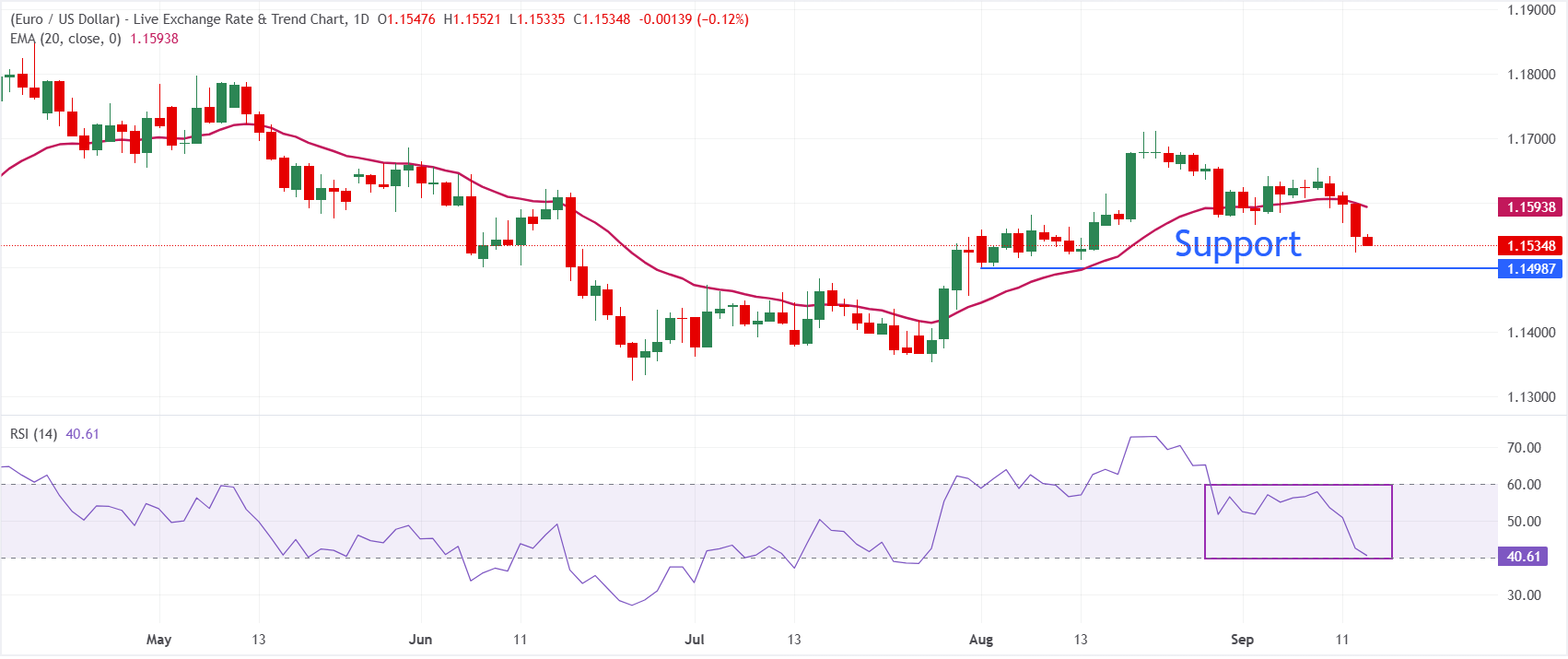
EUR/USD trades lower at around 1.1535, holding below the 20-day Exponential Moving Average (EMA) at 1.1594 and keeping the near-term bias tilted lower. The pair remains capped by this short-term average, while the Relative Strength Index (RSI) at around 41 hovers in neutral-to-soft territory, suggesting downside pressure is present but not yet overstretched.
On the topside, initial resistance stands at the 20-day EMA near 1.1594, and a daily close above this barrier would be needed to ease the current bearish tone and open the way for a more sustained recovery toward the September 9 high at 1.1654. Looking down, the pair could extend its decline to near the psychological level of 1.1500.
(The technical analysis of this story was written with the help of an AI tool. Know more.)
Economic Indicator
ECB Rate On Deposit Facility
One of the European Central Bank's three key interest rates, the rate on the deposit facility, is the rate at which banks earn interest when they deposit funds with the ECB. It is announced by the European Central Bank at each of its eight scheduled annual meetings.
Read more.Last release: Thu Sep 10, 2026 12:15
Frequency: Irregular
Actual: 2.5%
Consensus: 2.5%
Previous: 2.25%
Source: European Central Bank
Author

Sagar Dua
FXStreet
Sagar Dua is associated with the financial markets from his college days. Along with pursuing post-graduation in Commerce in 2014, he started his markets training with chart analysis.