British Pound steadies as cooler UK CPI meets Oil shock
- UK CPI slows to 2.6%, easing near-term BoE pressure.
- Oil surge keeps inflation risks alive for Fed policymakers.
- US jobless claims, PMIs and Fed decision drive next catalyst.

The Pound Sterling holds firm during the North American session as UK inflation data dipped, easing pressure on the Bank of England to tackle higher prices, while attacks between the US and Iran don’t seem to be ending in the Middle East. The GBP/USD trades at 1.3377.
GBP/USD holds as softer inflation offsets Middle East risks
During the European session, UK inflation data for June dipped from 2.8% to 2.6% YoY. The core Consumer Price Index (CPI) remained steady at 2.6% YoY for the same period. Even though this relieves the BoE, traders continued to price in an 82% chance for a rate hike by the November 5 meeting, according to Prime Terminal data.
The data was a relief to the new Prime Minister, Andy Burnham, who is seeking to implement measures to reduce the high living costs.
The new UK Finance Minister, John Healey, said the data was positive but that the government would need to do more to help households.
Despite this, the Gulf War triggered a jump in Oil prices, with West Texas Intermediate (WTI), the US crude benchmark, rising by over 2.5% to $86.70. So far in July, petrol prices have risen nearly 24%, shy of recovering the $90 figure, WTI’s floor level in June.
Recently, the US President Donald Trump warned Iran that if they attack ships, the US would retaliate, attacking bridges or power plants, including those located near Tehran.
In the US, the economic docket is absent, yet traders are waiting for the release of Initial Jobless Claims for the week ending July 18. Alongside this, traders are also bracing for S&P Flash PMIs and the Federal Reserve’s (Fed) monetary policy decision next week.
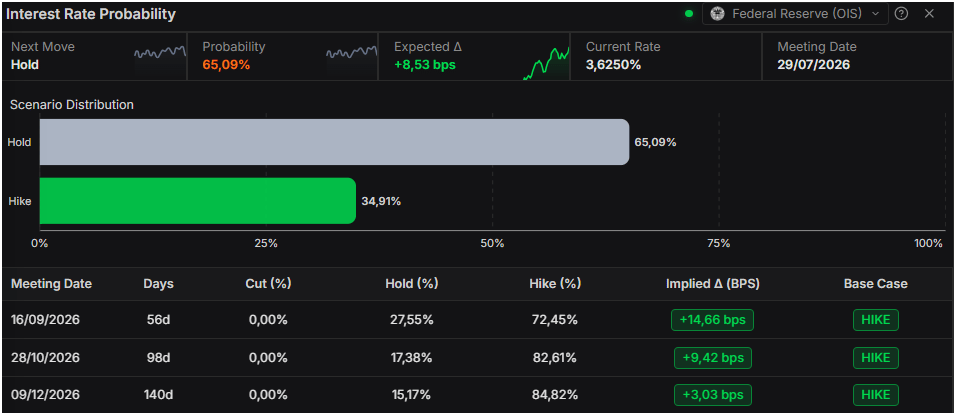
Money markets have priced in a 65% chance that the Fed would keep rates unchanged at the July 29 meeting, down from 78% a day earlier, according to Prime Terminal data.
GBP/USD price forecast: Technical outlook
In the daily chart, GBP/USD trades at 1.3375, maintaining a mildly bearish near-term bias as spot continues to hold beneath the cluster of Simple Moving Averages (50, 100 and 200-day SMAs) between roughly 1.3464 and 1.3472, as well as the descending resistance trend line at 1.3476. The Relative Strength Index (RSI 14) at 50 reads neutral, hinting at a consolidative tone rather than strong directional momentum. The latest FXS Fed Sentiment Index reading at 128.64 suggests a relatively firm policy backdrop that may continue to cap Sterling on rallies.
On the topside, initial resistance is located at the 50-day SMA at 1.3464, followed by the 100-day SMA at 1.3468 and the 200-day SMA at 1.3472, all reinforcing a dense supply zone near the recent trendline barrier at 1.3476. A sustained break above this band would be needed to ease bearish pressure. With no clear technical support levels immediately below the market in the current dataset, any pullback from present levels would likely retest recent lows, leaving the pair vulnerable to further downside while it trades under the aforementioned moving average cluster and trend resistance.
(The technical analysis of this story was written with the help of an AI tool. Know more.)
Pound Sterling FAQs
The Pound Sterling (GBP) is the oldest currency in the world (886 AD) and the official currency of the United Kingdom. It is the fourth most traded unit for foreign exchange (FX) in the world, accounting for 12% of all transactions, averaging $630 billion a day, according to 2022 data. Its key trading pairs are GBP/USD, also known as ‘Cable’, which accounts for 11% of FX, GBP/JPY, or the ‘Dragon’ as it is known by traders (3%), and EUR/GBP (2%). The Pound Sterling is issued by the Bank of England (BoE).
The single most important factor influencing the value of the Pound Sterling is monetary policy decided by the Bank of England. The BoE bases its decisions on whether it has achieved its primary goal of “price stability” – a steady inflation rate of around 2%. Its primary tool for achieving this is the adjustment of interest rates. When inflation is too high, the BoE will try to rein it in by raising interest rates, making it more expensive for people and businesses to access credit. This is generally positive for GBP, as higher interest rates make the UK a more attractive place for global investors to park their money. When inflation falls too low it is a sign economic growth is slowing. In this scenario, the BoE will consider lowering interest rates to cheapen credit so businesses will borrow more to invest in growth-generating projects.
Data releases gauge the health of the economy and can impact the value of the Pound Sterling. Indicators such as GDP, Manufacturing and Services PMIs, and employment can all influence the direction of the GBP. A strong economy is good for Sterling. Not only does it attract more foreign investment but it may encourage the BoE to put up interest rates, which will directly strengthen GBP. Otherwise, if economic data is weak, the Pound Sterling is likely to fall.
Another significant data release for the Pound Sterling is the Trade Balance. This indicator measures the difference between what a country earns from its exports and what it spends on imports over a given period. If a country produces highly sought-after exports, its currency will benefit purely from the extra demand created from foreign buyers seeking to purchase these goods. Therefore, a positive net Trade Balance strengthens a currency and vice versa for a negative balance.
Author

Christian Borjon Valencia
FXStreet
Markets analyst, news editor, and trading instructor with over 14 years of experience across FX, commodities, US equity indices, and global macro markets.