British Pound rises as Burnham fiscal pledge calms markets
- Burnham pledges to follow Reeves’ fiscal rules, easing nerves.
- US Dollar weakness helps Cable recover from early session lows.
- UK GDP, Warsh remarks, and US NFP drive the next catalysts.

The Pound Sterling (GBP) advances 0.40% on Monday after Andy Burnham, who is expected to become the new UK Prime Minister, commented that he will adhere to fiscal rules set by Chancellor Rachel Reeves at a speech in which he laid the path for the economy. The GBP/USD pair trades at 1.3244 after reaching daily lows of 1.3191.
GBP/USD gains as Burnham reassures investors on fiscal discipline
Cable is underpinned by broad US Dollar weakness, with the Greenback losing 0.20%, according to the US Dollar Index (DXY). The DXY, which tracks the performance of the buck’s value against six currencies, is down at 101.15.
Burnham said that he wouldn’t name government appointments until the end of the election process. He added that he will stick to the Labour Party’s 2024 manifesto, committing to certain fiscal rules set by the Finance Minister Reeves.
On the news, GBP/USD improved from around 1.3200 flat towards the current exchange rate, with markets relieved, listening to Burnham’s latest speech before being named Britain’s new Prime Minister, the seventh in the last ten years.
Although buyers are gaining momentum, they’re not out of the woods, as the Gross Domestic Product (GDP) print for Q1 2026 looms. In the US, the docket was absent on Monday, yet traders will be focused on jobs data, the ISM Manufacturing PMI, and the US Nonfarm Payrolls on Thursday, with the markets closed on Friday for the celebration of US Independence Day.
Alongside this, the new Fed Chair, Kevin Warsh, will be at the European Central Bank (ECB) Sintra Symposium, with traders focused on whether he offers any hints on monetary policy or stand pat.
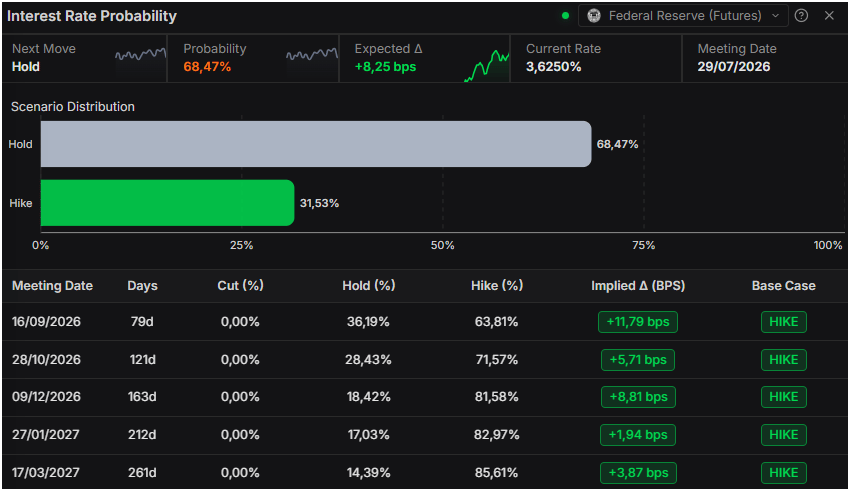
Money markets had priced in 30 basis points of Federal Reserve (Fed) tightening by the end of 2026, according to Prime Terminal data.
GBP/USD Price Forecast: Technical outlook
In the daily chart, GBP/USD trades at 1.3249, maintaining a bearish tone as spot holds below the clustered simple moving averages (50-, 100- and 200-day) grouped around 1.3424, while the long-standing downward resistance trend line, broken at 1.3529, stays well overhead. The Relative Strength Index (14) at 41.9 remains under the midline, hinting at subdued bullish momentum and reinforcing the notion that rallies are likely to be capped by the nearby moving average barrier.
On the topside, immediate resistance is provided by the triple simple moving average cluster near 1.3424, ahead of the former downward trend-line break at 1.3529, which marks a stronger hurdle for any recovery attempt. On the downside, the current area around 1.3249 acts as a short-term pivot, with more significant structural support only emerging toward the upward trend-line origin near 1.3159, where buyers could attempt to slow the decline.
(The technical analysis of this story was written with the help of an AI tool.)
Pound Sterling Price Today
The table below shows the percentage change of British Pound (GBP) against listed major currencies today. British Pound was the strongest against the Australian Dollar.
| USD | EUR | GBP | JPY | CAD | AUD | NZD | CHF | |
|---|---|---|---|---|---|---|---|---|
| USD | -0.36% | -0.42% | 0.10% | 0.12% | 0.16% | -0.14% | -0.23% | |
| EUR | 0.36% | -0.06% | 0.48% | 0.47% | 0.56% | 0.24% | 0.13% | |
| GBP | 0.42% | 0.06% | 0.54% | 0.54% | 0.59% | 0.27% | 0.19% | |
| JPY | -0.10% | -0.48% | -0.54% | 0.02% | 0.04% | -0.27% | -0.34% | |
| CAD | -0.12% | -0.47% | -0.54% | -0.02% | 0.03% | -0.28% | -0.38% | |
| AUD | -0.16% | -0.56% | -0.59% | -0.04% | -0.03% | -0.31% | -0.38% | |
| NZD | 0.14% | -0.24% | -0.27% | 0.27% | 0.28% | 0.31% | -0.09% | |
| CHF | 0.23% | -0.13% | -0.19% | 0.34% | 0.38% | 0.38% | 0.09% |
The heat map shows percentage changes of major currencies against each other. The base currency is picked from the left column, while the quote currency is picked from the top row. For example, if you pick the British Pound from the left column and move along the horizontal line to the US Dollar, the percentage change displayed in the box will represent GBP (base)/USD (quote).
Author

Christian Borjon Valencia
FXStreet
Markets analyst, news editor, and trading instructor with over 14 years of experience across FX, commodities, US equity indices, and global macro markets.