British Pound recovers some losses against US Dollar, ISM Services PMI eyed
- The British Pound rebounds against the US Dollar, but is still 0.15% down to near 1.3220.
- Hawkish Fed bets have receded due to soft US NFP data for September.
- Investors keenly await the US ISM Services PMI data.


The British Pound (GBP) claws back some of its early losses against the US Dollar (USD), but is still 0.15% down to near 1.3220 during the European trading session on Monday. The GBP/USD pair recovers slightly as the US Dollar Index retreats after hitting a fresh annual high near 102.53.
It is highly likely that receded hawkish Federal Reserve (Fed) expectations are capping the US Dollar’s upside.
According to the CME FedWatch tool, the odds of the Fed hiking interest rates in the policy meeting later this month have diminished to 19.4% from 70.9% seen a week ago.
Traders have scaled back hawkish Fed expectations after the release of the United States (US) Nonfarm Payrolls (NFP) data for September on Friday, which showed a moderate job growth.
However, market experts believe that the negative reaction in hawkish Fed prospects after the US NFP data release could prove to be short-term, as high inflation is key challenge for the United States (US) central bank.
Societe Generale’s Kenneth Broux argues that the softer US payrolls report has reinforced the recent pullback in expectations for near‑term Fed tightening, but the bank stresses that it is “not a game changer for the hawkish predisposition of the Fed – inflation is the bogeyman.” In their view, the latest jobs print instead “justifies caution over cadence and quantity of future policy adjustments articulated last week by FOMC voter Williams,” tempering the pace and scale of any further tightening even as inflation remains the central focus for policymakers.
During the day, investors will focus on the US ISM Services Purchasing Managers’ Index (PMI) data for September, which will be published at 14:00 GMT. The ISM Services PMI is expected to arrive lower at 55.0 from 55.4 in August.
On the Pound Sterling front, the major trigger will be the United Kingdom (UK) budget, which will be announced later this month.
Strategists at Rabobank highlight that both Prime Minister Burnham and Chancellor Healey “have provided reassurances that former Chancellor Reeves’ fiscal rules will be adhered too.” In Rabobank’s view, the clear implication is that “taxes are likely to be raised again,” a prospect they judge as “neither constructive for the growth outlook nor for voters’ reactions.”
GBP/USD Technical Analysis
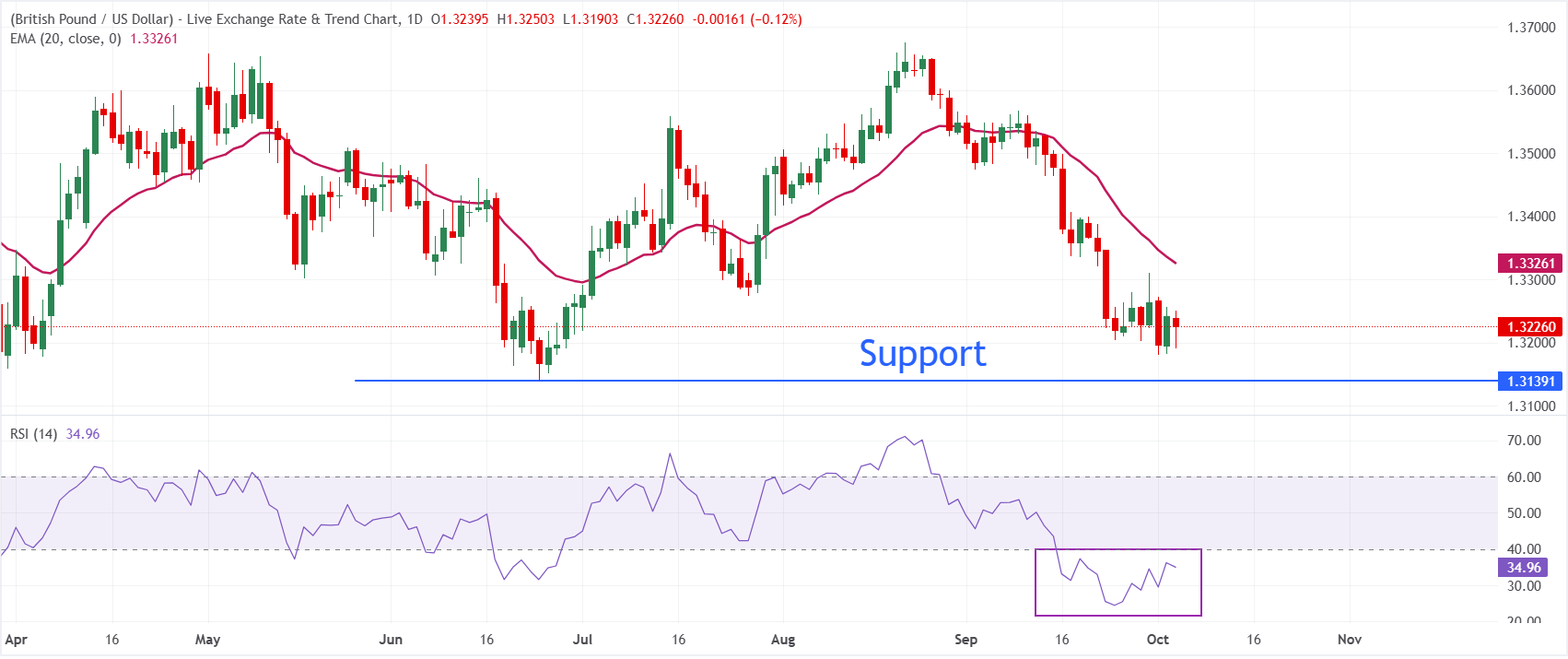
In the daily chart, GBP/USD trades at 1.3225, keeping a bearish near-term tone as spot holds below the 20-day exponential moving average (EMA) at 1.3326. The pair has retreated decisively beneath this short-term trend gauge, suggesting rallies are likely to be capped while price remains under the EMA. The Relative Strength Index (14) at 34.9 sits just above oversold territory, hinting at lingering downside pressure rather than a completed exhaustion phase.
On the topside, immediate resistance is located at the 20-day EMA at 1.3326, which is the key level bulls would need to reclaim to ease the current bearish pressure and open the way for a more sustained recovery. Until that barrier is overcome, the technical stance favors further consolidation or slippage at lower levels, with any bounce likely to be viewed as corrective within the broader pullback from recent highs.
(The technical analysis of this story was written with the help of an AI tool. Know more.)
Economic Indicator
ISM Services PMI
The Institute for Supply Management (ISM) Services Purchasing Managers Index (PMI), released on a monthly basis, is a leading indicator gauging business activity in the US services sector, which makes up most of the economy. The indicator is obtained from a survey of supply executives across the US based on information they have collected within their respective organizations. Survey responses reflect the change, if any, in the current month compared to the previous month. A reading above 50 indicates that the services economy is generally expanding, a bullish sign for the US Dollar (USD). A reading below 50 signals that services sector activity is generally declining, which is seen as bearish for USD.
Read more.Next release: Mon Oct 05, 2026 14:00
Frequency: Monthly
Consensus: 55
Previous: 55.4
Source: Institute for Supply Management
The Institute for Supply Management’s (ISM) Services Purchasing Managers Index (PMI) reveals the current conditions in the US service sector, which has historically been a large GDP contributor. A print above 50 shows expansion in the service sector’s economic activity. Stronger-than-expected readings usually help the USD gather strength against its rivals. In addition to the headline PMI, the Employment Index and the Prices Paid Index numbers are also watched closely by investors as they provide useful insights regarding the state of the labour market and inflation.
Author
Sagar Dua
FXStreet
Sagar Dua is associated with the financial markets from his college days. Along with pursuing post-graduation in Commerce in 2014, he started his markets training with chart analysis.

















