Bank of Japan maintains interest rate, pledges to make YCC more flexible

At the highly-anticipated July policy review meeting, the Bank of Japan (BoJ) board members decided to leave their current monetary policy settings unchanged, maintaining rates and 10yr JGB yield target at -10bps and 0.00% respectively.
Summary of the statement
BoJ maintains band around 10-year JGB yield target at up and down 0.5% each.
BoJ makes decision on ycc by 8-1 vote.
BoJ board member Nakamura dissents to decision on YCC.
BoJ board member Nakamura dissents to decision on YCC, considering it was desirable to allow greater flexibility after confirming rise in firms' earnings power from sources such as financial statements statistics.
BoJ board member Nakamura dissents to decision on YCC but in favour of idea of conducting YCC with greater flexibility.
Will guide yield curve control more flexibly.
Appropriate to heighten sustainability of monetary easing.
Will operate yield curve control more flexibly to respond nimbly to upside, downside risks.
Will keep offering fixed-rate operations for 10-year JGB yield at 1.0%.
In order to encourage formation of yield curve that is consistent guideline, boj will continue with large-scale jgb buying and make nimble responses for each maturity.
For exmaple, by increasing amount of JGB buying and conducting fixed-rate purchase ops and funds-supplying ops against pooled collateral.
BoJ widens range of 5-10 year bond buying, offering to buy as much as JPY900 bln each time, up from JPY875 bln.
Market reaction
USD/JPY’s renewed upside gained extra traction on the BoJ’s policy announcements. The pair is currently trading at 140.06, up 0.45% on the day, having tested 141.08 in a knee-jerk reaction to the BoJ decision.
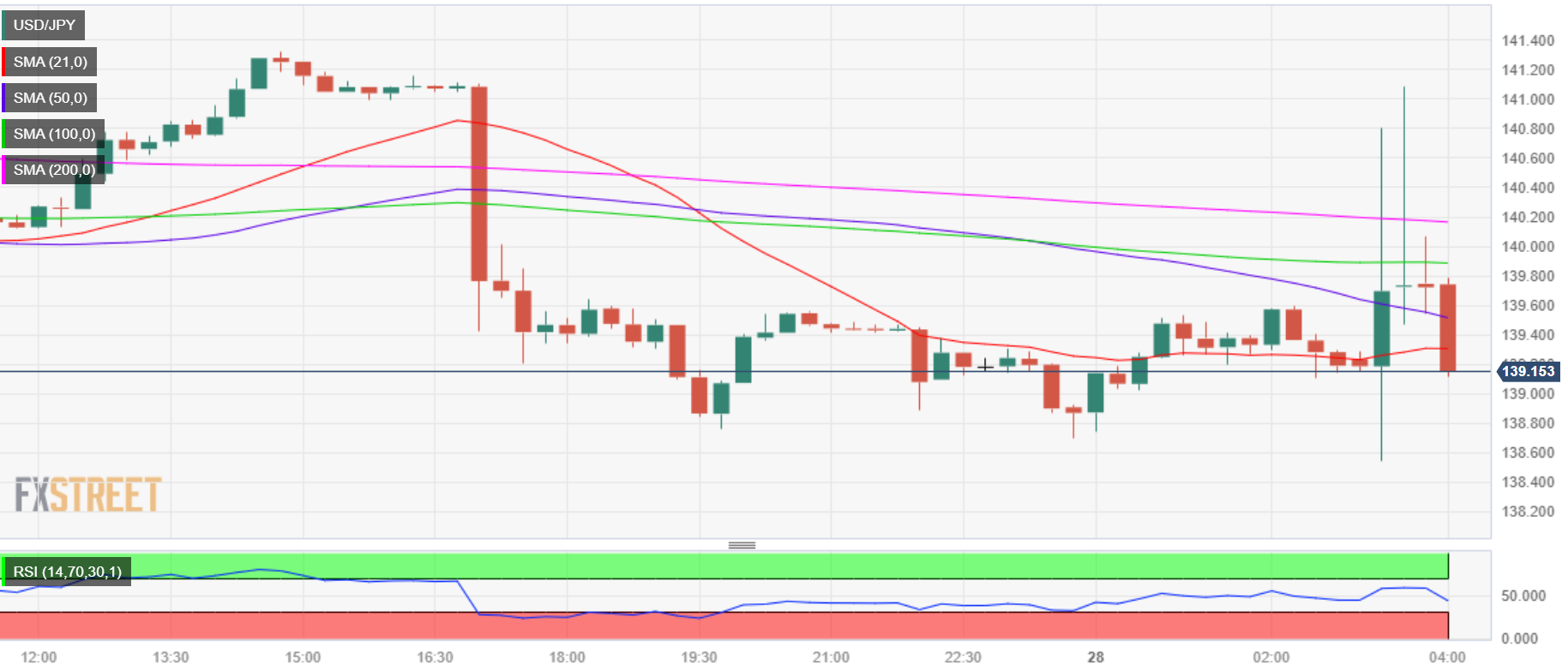
USD/JPY: 15-minutes chart
Interest rates FAQs
What are interest rates?
Interest rates are charged by financial institutions on loans to borrowers and are paid as interest to savers and depositors. They are influenced by base lending rates, which are set by central banks in response to changes in the economy. Central banks normally have a mandate to ensure price stability, which in most cases means targeting a core inflation rate of around 2%.
If inflation falls below target the central bank may cut base lending rates, with a view to stimulating lending and boosting the economy. If inflation rises substantially above 2% it normally results in the central bank raising base lending rates in an attempt to lower inflation.
How do interest rates impact currencies?
Higher interest rates generally help strengthen a country’s currency as they make it a more attractive place for global investors to park their money.
How do interest rates influence the price of Gold?
Higher interest rates overall weigh on the price of Gold because they increase the opportunity cost of holding Gold instead of investing in an interest-bearing asset or placing cash in the bank.
If interest rates are high that usually pushes up the price of the US Dollar (USD), and since Gold is priced in Dollars, this has the effect of lowering the price of Gold.
What is the Fed Funds rate?
The Fed funds rate is the overnight rate at which US banks lend to each other. It is the oft-quoted headline rate set by the Federal Reserve at its FOMC meetings. It is set as a range, for example 4.75%-5.00%, though the upper limit (in that case 5.00%) is the quoted figure.
Market expectations for future Fed funds rate are tracked by the CME FedWatch tool, which shapes how many financial markets behave in anticipation of future Federal Reserve monetary policy decisions.
Author

FXStreet Team
FXStreet
Composed of a group of economic journalists and FX experts, the FXStreet content team produces and oversees all content published on FXStreet. It provides a purely journalistic approach to the Forex market.

















