Breaking: The BoE matches consensus, leaves its interest rate unchanged

At its June meeting, the Bank of England (BoE) held its policy rate at 4.25%, as markets had anticipated.
The vote, however, exposed a split on the Monetary Policy Committee (MPC) as three members supported a 25-basis-point cut: Dhingra, Ramsden and Taylor.
BoE policy statement takeaways
- Policymakers vote 6-3 to keep rates at 4.25%.
- Monetary policy statement: all MPC members stressed that monetary policy is not on a pre-set path.
- MPC members who voted to cut rates cited “material further loosening in the labour market”, subdued consumer demand, and pay deals near sustainable rates.
- Underlying UK GDP growth appears to have remained weak.
- CPI expected to peak at 3.7% in Sept, remain just under 3.5% for the rest of the year (May forecast: Sept CPI 3.7%, CPI at 3.5% in Q3 on a quarterly basis).
- MPC still expects significant slowing in UK pay growth this year.
- Risks around the medium-term path for CPI are two-sided.
- Policy summary keeps the phrase “a gradual and careful approach to the further withdrawal of monetary policy restraint remains appropriate”.
- Recent global developments did not have a significant impact on the June rate decision to hold rates.
- Staff forecast Q2 GDP around +0.25% QQ (May forecast: +0.1%).
- MPC will remain sensitive to heightened unpredictability in the economic and geopolitical environment.
- Provisional staff analysis suggests the direct impact of tariff shocks on global GDP could be smaller than expected in May.
- Global uncertainty remains elevated; escalated middle east conflict has increased energy prices.
- Trade policy uncertainty will continue to harm the UK economy.
Market reaction
The British Pound (GBP) loses momentum and trades with slight losses vs. the US Dollar (USD) and the Euro (EUR), taking GBP/USD to the vicinity of the 1.3400 region, while EUR/GBP hovers around the 0.8550 zone. UK 10-year yields, in the meantime, reverse three daily drops in a row and orbit just above 4.50%.
British Pound PRICE Today
The table below shows the percentage change of British Pound (GBP) against listed major currencies today. British Pound was the strongest against the New Zealand Dollar.
| USD | EUR | GBP | JPY | CAD | AUD | NZD | CHF | |
|---|---|---|---|---|---|---|---|---|
| USD | 0.09% | 0.09% | 0.42% | 0.19% | 0.83% | 0.99% | -0.11% | |
| EUR | -0.09% | 0.01% | 0.30% | 0.05% | 0.68% | 0.88% | -0.25% | |
| GBP | -0.09% | -0.01% | 0.31% | 0.04% | 0.67% | 0.95% | -0.07% | |
| JPY | -0.42% | -0.30% | -0.31% | -0.26% | 0.28% | 0.51% | -0.46% | |
| CAD | -0.19% | -0.05% | -0.04% | 0.26% | 0.54% | 0.83% | -0.11% | |
| AUD | -0.83% | -0.68% | -0.67% | -0.28% | -0.54% | 0.33% | -0.81% | |
| NZD | -0.99% | -0.88% | -0.95% | -0.51% | -0.83% | -0.33% | -1.06% | |
| CHF | 0.11% | 0.25% | 0.07% | 0.46% | 0.11% | 0.81% | 1.06% |
The heat map shows percentage changes of major currencies against each other. The base currency is picked from the left column, while the quote currency is picked from the top row. For example, if you pick the British Pound from the left column and move along the horizontal line to the US Dollar, the percentage change displayed in the box will represent GBP (base)/USD (quote).
This section below was published as a preview of the Bank of England's (BoE) interest rate decision at 06:00 GMT.
- The Bank of England is expected to keep its policy rate at 4.25%.
- UK inflation figures remain well above the BoE’s target.
- GBP/USD maintains its trade in the upper end of the range near 1.3600.
The Bank of England (BoE) is set to reveal its latest monetary policy decision on Thursday, coinciding with its fourth rate-setting meeting of 2025.
Follow our live coverage of the Bank of England policy decisions and the market reaction.
Market analysts anticipate that the central bank will keep its benchmark interest rate steady at 4.25% after the reduction announced during the May 8 meeting.
The Monetary Policy Committee’s (MPC) decision will be followed by the release of Meeting Minutes, which will detail the internal discussions that shaped the outcome.
As the rate decision appears to be largely anticipated, investors are likely to shift their focus to the anticipated performance of the UK economy, which presents mixed signals. Key considerations will include the potential trajectory of interest rates, the ongoing debate over tariffs, and the recent developments surrounding the US-UK trade agreement.
Rates, elevated inflation and tariffs
The Bank of England has reduced its policy rate by a quarter point to 4.25% as of May 8, following a notably divided vote among the Monetary Policy Committee (MPC): Swati Dhingra and Alan Taylor supported a more significant half-point cut, while Chief Economist Huw Pill and Catherine Mann argued for keeping interest rates unchanged.
The “Old Lady” has updated its inflation forecast for the year and is now projecting a peak of around 3.50%. This adjustment signifies a reduction from a prior estimate of 3.75%, while simultaneously reflecting an increase from the latest official figure of 2.60% noted in March. Experts predict that inflation will reach the 2% target by the first quarter of 2027.
The central bank has forecasted a 1% growth rate for the economy this year, an increase from the previous estimate of 0.75%. The revision reflects a robust conclusion to 2024, bolstered by promising official data from early 2025, which reveals a quarterly growth rate of 0.60% for the first quarter.
The report indicates that the growth surge observed in the January-March period seems to be an isolated incident. As a result, the growth forecast for 2026 has been revised downward to 1.25%, a decrease from the previous estimate of 1.5%.
The most recent data released by the Office for National Statistics (ONS) indicates that the annual headline Consumer Price Index (CPI) increased to 3.4% in May. Core inflation, excluding the fluctuating costs of food and energy, increased by 3.50%, indicating a continued trend of easing underlying price pressure. Services inflation, in the meantime, rose by 4.70% over the last 12 months.
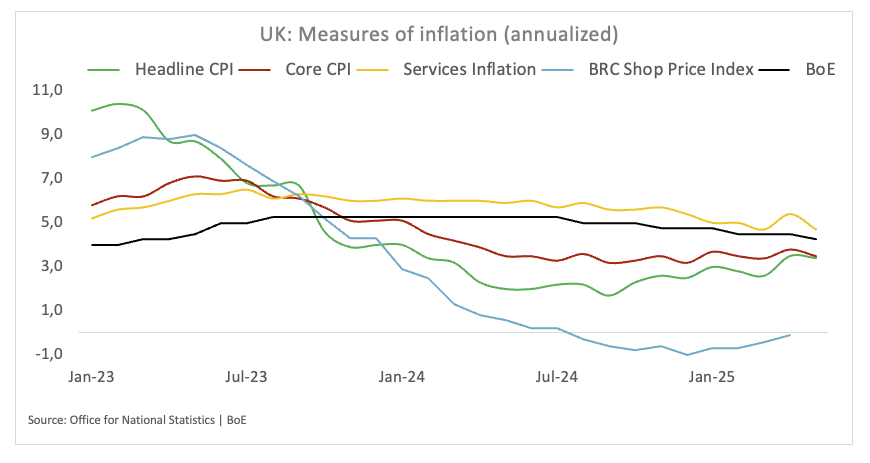
In the meantime, some rate setters, Governor Bailey included, showed some caution regarding the easing cycle going forward, as well as the still elevated consumer prices:
Addressing the Treasury Committee, Governor Andrew Bailey said that his approach to reducing interest rates would be “gradual and careful”. He emphasised that these words served as his guiding principles. He stated that, while he continued to anticipate a decline in rates, the trajectory had become “shrouded in a lot more uncertainty” and had turned “unpredictable” due to the turmoil in global trade policy.
Deputy Governor Sarah Breeden informed the committee that she believed a case for a rate cut existed in May, independent of international developments. She assessed that the domestic disinflationary process was advancing as anticipated and was expected to persist.
MPC member Swati Dhingra also noted that she perceives downside risks to the forecast for UK inflation. She said that the recent upticks in inflation are primarily attributed to escalating energy costs rather than fundamental price pressure.
Policymaker Megan Greene argued that although the bank anticipates a decline in the recent inflation surge, it remains "not sanguine" regarding the outlook. She cautioned about the considerable risk posed by potential second-round effects.
How will the BoE interest rate decision impact GBP/USD?
Investors expect the BoE to retain its reference rate at 4.25% on Thursday at 11:00 GMT.
While the result is fully priced in, attention will focus on the vote split among MPC members, which might be a market mover for the British Pound if it indicates an atypical vote.
In the run-up to the meeting, GBP/USD appears to have met decent contention around the 1.3400 zone, driven by US Dollar (USD) dynamics and shifting sentiment toward US trade policy, as well as reignited geopolitical jitters.
"Cable came under some unconvincing downside pressure after hitting more than three-year highs north of 1.3600 the figure on June 13," said Pablo Piovano, senior analyst at FXStreet. He noted that a decisive break above the yearly tops could potentially trigger a move toward the 2022 high of 1.3748 (January 13).
On the downside, Piovano identified the 55-day Simple Moving Average (SMA) at 1.3329 as an initial provisional support, followed by the May trough at 1.3139 (May 12). Once Cable clears the latter, the more relevant 200-day SMA could return to investors’ radar at 1.2922, just before the April floor of 1.2707 (April 7).
BoE FAQs
The Bank of England (BoE) decides monetary policy for the United Kingdom. Its primary goal is to achieve ‘price stability’, or a steady inflation rate of 2%. Its tool for achieving this is via the adjustment of base lending rates. The BoE sets the rate at which it lends to commercial banks and banks lend to each other, determining the level of interest rates in the economy overall. This also impacts the value of the Pound Sterling (GBP).
When inflation is above the Bank of England’s target it responds by raising interest rates, making it more expensive for people and businesses to access credit. This is positive for the Pound Sterling because higher interest rates make the UK a more attractive place for global investors to park their money. When inflation falls below target, it is a sign economic growth is slowing, and the BoE will consider lowering interest rates to cheapen credit in the hope businesses will borrow to invest in growth-generating projects – a negative for the Pound Sterling.
In extreme situations, the Bank of England can enact a policy called Quantitative Easing (QE). QE is the process by which the BoE substantially increases the flow of credit in a stuck financial system. QE is a last resort policy when lowering interest rates will not achieve the necessary result. The process of QE involves the BoE printing money to buy assets – usually government or AAA-rated corporate bonds – from banks and other financial institutions. QE usually results in a weaker Pound Sterling.
Quantitative tightening (QT) is the reverse of QE, enacted when the economy is strengthening and inflation starts rising. Whilst in QE the Bank of England (BoE) purchases government and corporate bonds from financial institutions to encourage them to lend; in QT, the BoE stops buying more bonds, and stops reinvesting the principal maturing on the bonds it already holds. It is usually positive for the Pound Sterling.
Economic Indicator
BoE Interest Rate Decision
The Bank of England (BoE) announces its interest rate decision at the end of its eight scheduled meetings per year. If the BoE is hawkish about the inflationary outlook of the economy and raises interest rates it is usually bullish for the Pound Sterling (GBP). Likewise, if the BoE adopts a dovish view on the UK economy and keeps interest rates unchanged, or cuts them, it is seen as bearish for GBP.
Read more.Last release: Thu May 08, 2025 11:02
Frequency: Irregular
Actual: 4.25%
Consensus: 4.25%
Previous: 4.5%
Source: Bank of England
Author

FXStreet Team
FXStreet
Composed of a group of economic journalists and FX experts, the FXStreet content team produces and oversees all content published on FXStreet. It provides a purely journalistic approach to the Forex market.