|

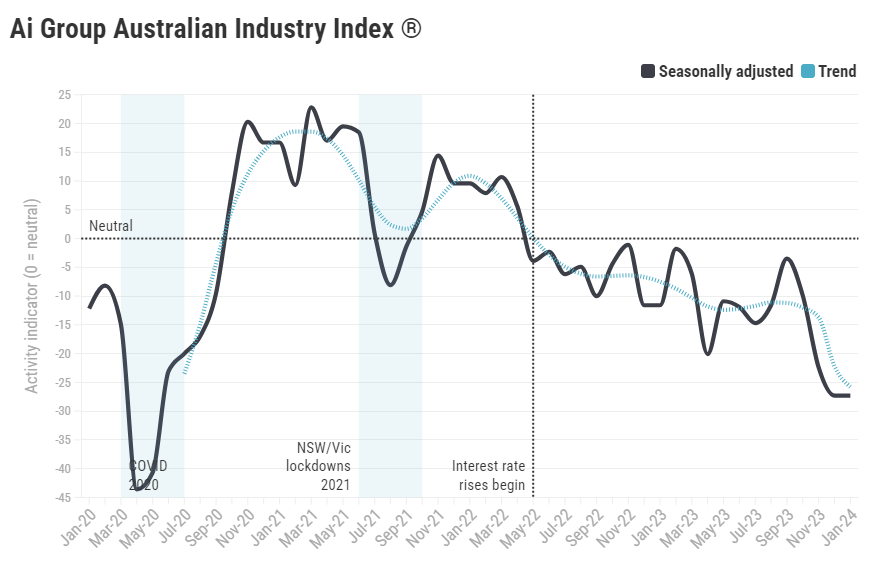
Australia's AiG Industry Index recovers in January to -14.9 from -27.3

The Australia Industry Group (AiG) released its latest Industry Index for January, which showed a recovery in Australia's performance but still remains buried deep in contraction territory, printing at -14.9 compared to the previous month's -27.3.

According to AiG:

The new year contraction in the Australian Industry Index® eased in February, but the index remains in overall contraction.

February saw a modest improvement in upstream manufacturing and business services, but consumer facing industries (food and construction) posted slight drops.

Minor but continuing increased in the price indicators suggests that inflation in industrial products continues to be widespread.

Australia's AiG Construction Purchasing Managers Index (PMI) for January fell to 018.4 versus the previous -11.5, and the Manufacturing PMI as measured by AiG recovered to -12.6 compared to the previous month's -23.8.
About Australia's AiG Industry Index

The AiG Industry Index, released on a monthly basis by the Australian Industry Group, is a leading indicator gauging private-business activity in Australia. This indicator integrates the different sub-indexes calculated by the AiG, including the manufacturing, construction, and services sectors – industries that together account for 36% of the Australian economy. The Australian Industry Index is based on monthly surveys from a national sample of Australian businesses. A positive reading indicates that activity is expanding; negative indicates contraction. The distance from zero indicates the strength of the expansion or decline. A positive reading tends to be a bullish sign for the Australian Dollar (AUD). Meanwhile, a negative reading is seen as bearish for AUD.

Author

Joshua Gibson

Joshua joins the FXStreet team as an Economics and Finance double major from Vancouver Island University with twelve years' experience as an independent trader focusing on technical analysis.


More from Joshua Gibson
Share:

Editor's Picks

EUR/USD slumps below 1.1750 as USD benefits from risk-aversion

EUR/USD comes under renewed bearish pressure in the European session and trades below 1.1750 following a recovery attempt earlier in the day. The US Dollar gathers strength and weighs on the pair as investors seek refuge in the wake of Israel and the United States' joint attack on Iran.

GBP/USD targets 1.3500 barrier near moving averages

GBP/USD rebounds from the daily losses, trading around 1.3450 during the Asian hours on Monday. The technical analysis of the daily chart indicates an ongoing bearish bias, as the pair trades within a descending channel pattern.

Gold surges on safe-haven demand, rises above $5,400

Gold benefits from intense risk-aversion on Monday and climbs above $5,400, setting a fresh monthly-high in the process. Tensions in the Middle East remain high as Israel and Hezbollah continue to exchange strikes following the US-Israel joint attack on Iran over the weekend.

Bitcoin, Ethereum and Ripple under pressure as key supports face breakdown risk

Bitcoin, Ethereum, and Ripple prices trade on the back foot at the start of this week on Monday, after extending losses in the previous week. BTC is on the brink of a breakdown, ETH is capped below key resistance, and XRP risks a crack of the trendline.

The market is paying for insurance, not apocalypse

As expected, this morning felt less like a Monday market open and more like a fire drill. Futures screens flickered red. S&P contracts down almost 1%. Nasdaq off 1.2%. Brent leaped 13% through $80. Gold rose 1.6% toward $5350 before paring some gains. The dollar is strutting mildly. The Swiss franc is quietly doing what it always does in a storm, catching some safe-haven flows.

Pi Network Price Forecast: Core team offloads supply, weighing on PI recovery

Pi Network  hovers below $0.1700, broadly steady at press time on Monday, attempting a recovery after a 2% loss the previous day. Sunday’s decline aligned with nearly 49 million PI tokens offloaded by the Pi Foundation, implying a spike in supply pressure that capped the prevailing four-day recovery.















